Joseph Anton Koch’s ‘Heroic Landscape with Rainbow’: Bridging Neoclassicism and Romanticism
Joseph Anton Koch (1768-1839) stands as a singular figure in Austrian art history—a painter who deftly navigated the shifting currents of neoclassicism into the burgeoning fervor of German romanticism. Born in Elbigenalp, Austria, his early life was marked by pastoral simplicity; tending cattle instilled in him an appreciation for the natural world that would profoundly shape his artistic vision. A fortuitous recommendation from Bishop Umgelder secured him a prestigious academic education at Stuttgar’s Karlsschule, a rigorous military academy where discipline and intellectual pursuit converged. However, Koch's youthful spirit rebelled against such constraints, leading to a brief but formative wanderlust through France and Switzerland before he finally established himself in Rome in 1795.
Here, amidst the artistic crucible of the Roman Baroque, Koch found kinship with fellow painter Asmus Jacob Carstens, adopting Carstens’ “her
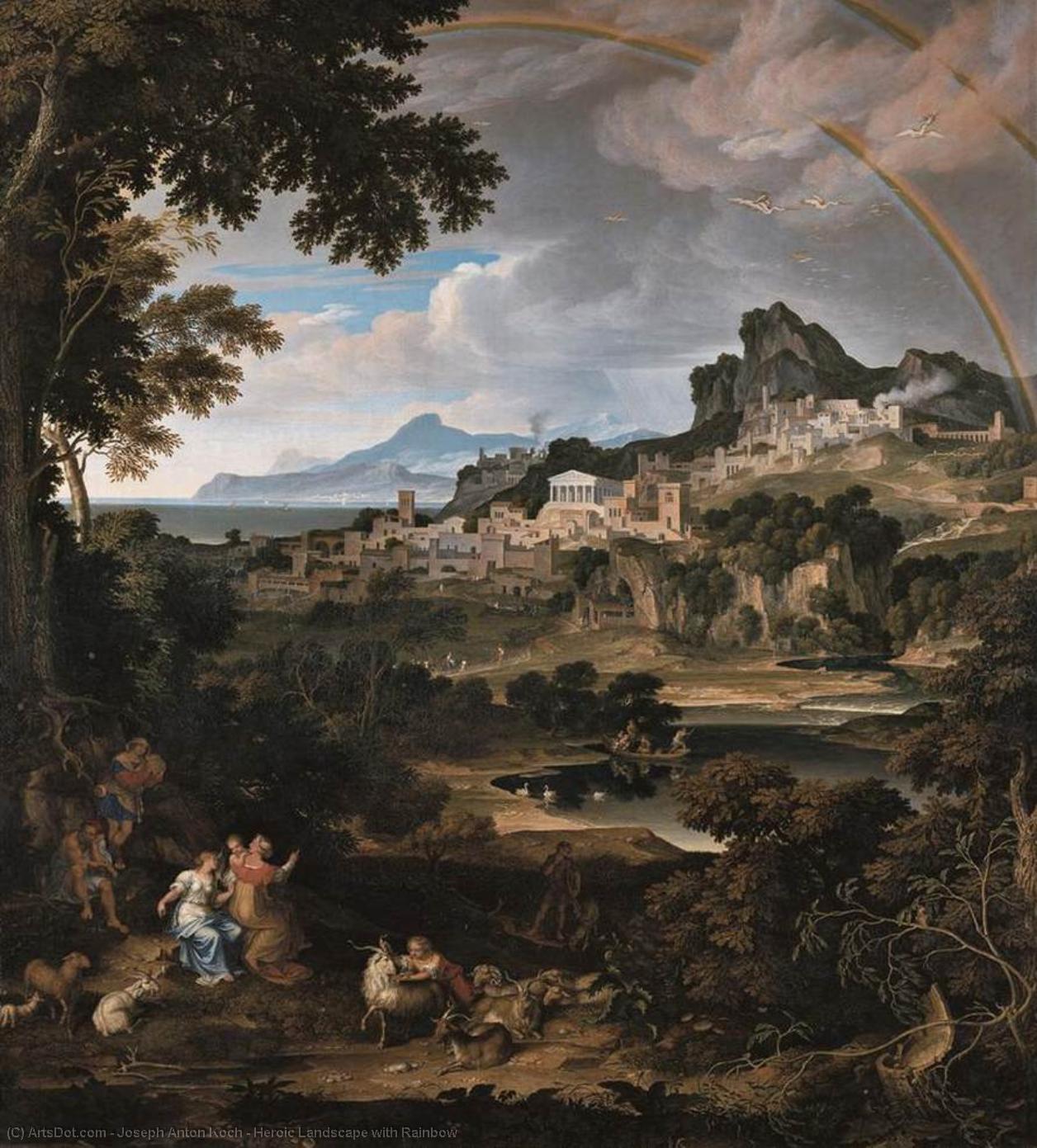
Koch's oeuvre is characterized by an extraordinary ability to synthesize disparate influences—the formal elegance of neoclassical ideals alongside the emotive power of Romantic sensibilities. This duality finds its most striking expression in works like ‘Heroic Landscape with Rainbow,’ painted between 1805 and 1824, a quartet of canvases that solidified his reputation as Austria’s foremost landscape artist during this pivotal period. The painting depicts a panoramic vista of the Austrian Alps bathed in ethereal light, dominated by towering peaks and verdant valleys—a scene deliberately designed to evoke awe and contemplation. Yet, interwoven into this majestic panorama is a vibrant rainbow stretching across the heavens, an element that transcends mere visual spectacle and embodies profound symbolic significance.
The stylistic hallmarks of ‘Heroic Landscape with Rainbow’ are undeniably Baroque, albeit tempered by neoclassical restraint. Koch meticulously employs dramatic chiaroscuro—the interplay of light and shadow—to sculpt the mountainous terrain and illuminate figures scattered throughout the composition. Strong horizontal lines delineate the coastline and architectural structures, anchoring the scene in a sense of stability while diagonal lines emphasize the dynamism of the mountains themselves. The artist’s masterful brushwork creates textures that convincingly simulate stone surfaces, foliage, and flowing water—a testament to his technical prowess and unwavering dedication to realism. Furthermore, Koch's use of color is deliberate; earthy tones dominate the landscape palette – browns, greens, ochres – providing a grounding counterpoint to the luminous blues and whites of the sky and sea.
Beyond its aesthetic qualities, ‘Heroic Landscape with Rainbow’ resonates deeply with the intellectual currents of its time. It reflects Romanticism's fascination with sublime beauty—the awe-inspiring grandeur of nature perceived as both powerful and benevolent. The rainbow itself serves as a potent symbol of hope, divine grace, and transcendence—a visual affirmation of faith amidst the uncertainties of the Enlightenment era. Koch’s intention was not merely to depict a landscape; he sought to convey an emotional experience—a communion with the sublime—that would inspire contemplation and elevate the viewer's spirit.
The painting’s enduring appeal lies in its ability to capture the essence of Romantic idealism while maintaining a grounding connection to classical tradition. It exemplifies Koch’s artistic genius – his capacity to synthesize disparate influences into a cohesive vision that speaks across time, continuing to captivate audiences with its breathtaking beauty and profound symbolic depth. Its meticulous detail and masterful technique ensure that reproductions faithfully convey the original artwork's emotional impact and grandeur.
- Artist: Joseph Anton Koch
- Year Painted: 1824
- Medium: Oil on Canvas
- Dimensions: 188 x 171 cm
- Location: Currently housed in The Metropolitan Museum of Art, New York.
Further Exploration:
To delve deeper into Koch’s artistic legacy and the broader context of Romantic landscape painting, consider researching:
- The influence of Bishop Umgelder on Koch's education
- Comparisons with other prominent Romantic painters like Caspar David Friedrich
- Detailed analyses of Koch’s compositional techniques and color palette
Recommended Reproduction:
For a high-quality reproduction that faithfully captures the artwork’s luminosity and textural richness, explore prints from reputable art dealers specializing in Baroque and Romantic masterpieces.