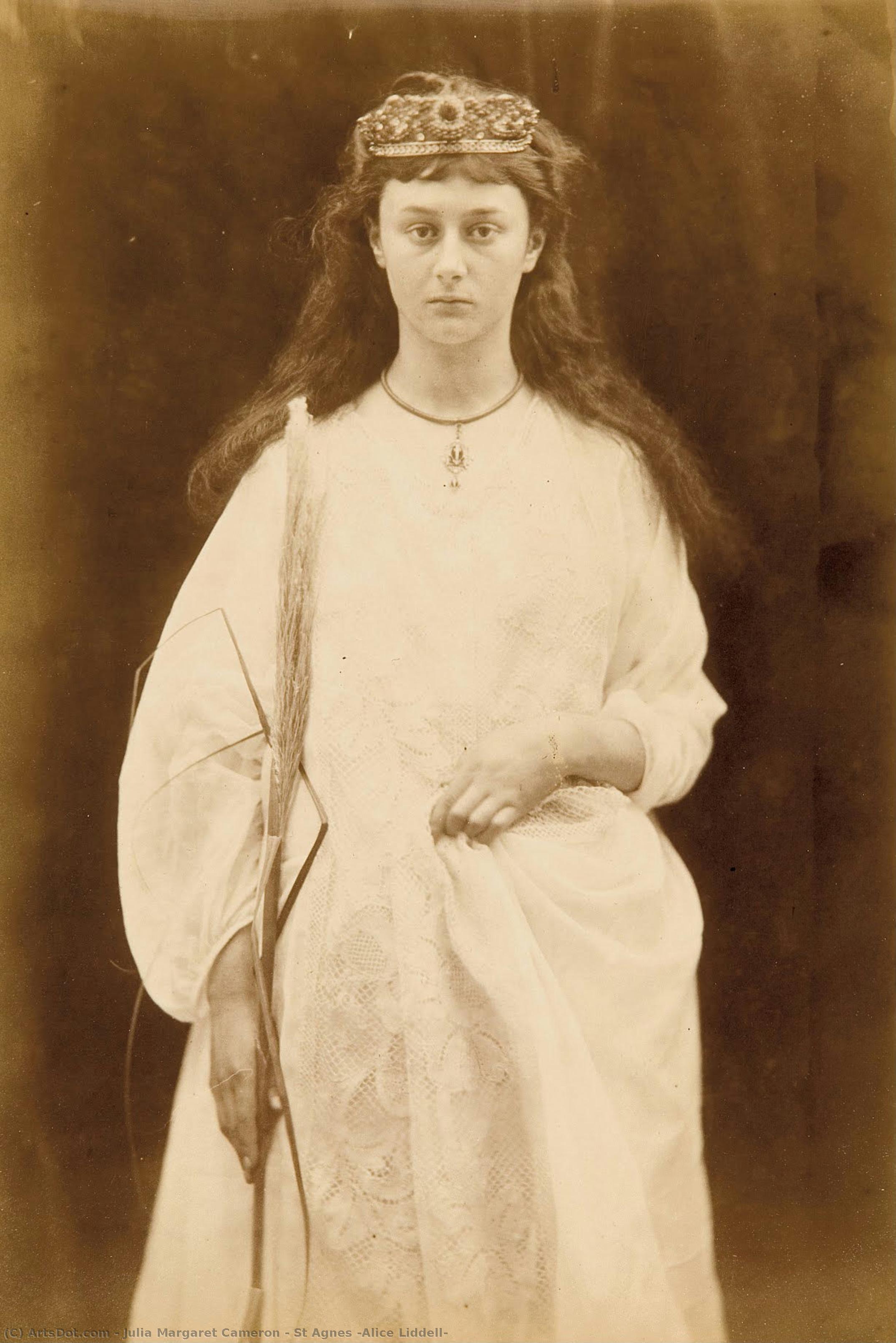
A Window Into Victorian Sentimentality: Julia Margaret Cameron’s ‘St Agnes’
Julia Margaret Cameron's “St Agnes,” painted in 1872, isn’t merely a photograph; it’s an exquisitely crafted distillation of Victorian spiritual yearning and artistic innovation. Captured by the celebrated British photographer herself – a figure remarkably late to embrace the burgeoning medium – this image transcends its technical simplicity to deliver a profound statement about faith, femininity, and the transformative power of imagination. Cameron's decision to portray Alice Liddell, the young heroine of Lewis Carroll’s “Alice’s Adventures in Wonderland,” as Saint Agnes—a martyr revered for her unwavering devotion—immediately establishes a symbolic framework that speaks volumes about Victorian anxieties regarding morality and spiritual renewal.
- Technical Brilliance Amidst Imperfection: Cameron's technique – employing albumen printing – was revolutionary for its time. Unlike the crisp, meticulously calibrated prints favored by many of her contemporaries, “St Agnes” revels in subtle imperfections—a slight blurring, a delicate scratch—that imbue the image with an atmosphere of intimacy and vulnerability. These deliberate deviations from photographic convention underscore Cameron’s artistic vision: she wasn't striving for objective representation but rather sought to evoke emotion and convey spiritual truth.
- The Symbolism of Light and Darkness: The photograph is dominated by a soft, diffused light that washes over Liddell’s face, creating an ethereal glow reminiscent of biblical depictions of saints bathed in divine radiance. This luminosity contrasts sharply with the dark background—a deliberate choice that symbolizes the spiritual darkness confronting Victorian society. Cameron skillfully utilizes chiaroscuro to heighten the dramatic effect and draw the viewer's gaze inward, prompting contemplation on themes of purity, sacrifice, and redemption.
- Victorian Aestheticism: “St Agnes” embodies the core tenets of Aestheticism—a movement that championed beauty for its own sake and rejected utilitarian concerns. Cameron’s artistic sensibilities aligned perfectly with this ethos, prioritizing emotional resonance over factual accuracy. The photograph's dreamy quality reflects a broader cultural preoccupation with exploring inner landscapes and capturing fleeting moments of sublime experience.
- Cameron’s Artistic Legacy: Julia Margaret Cameron stands apart from many Victorian artists due to her late entry into photography. Despite initial criticism from the photographic establishment, she persevered in her craft, producing over 900 images that continue to captivate audiences today. Her pioneering approach—embracing spontaneity and prioritizing artistic expression—established a precedent for future generations of photographers who sought to elevate the medium beyond mere documentation.
Provenance: The Royal Photographic Society Collection at the V&A, acquired with the generous assistance of the National Lottery Heritage Fund and Art Fund.
Dimensions: 22 x 33 cm
Date: 1872