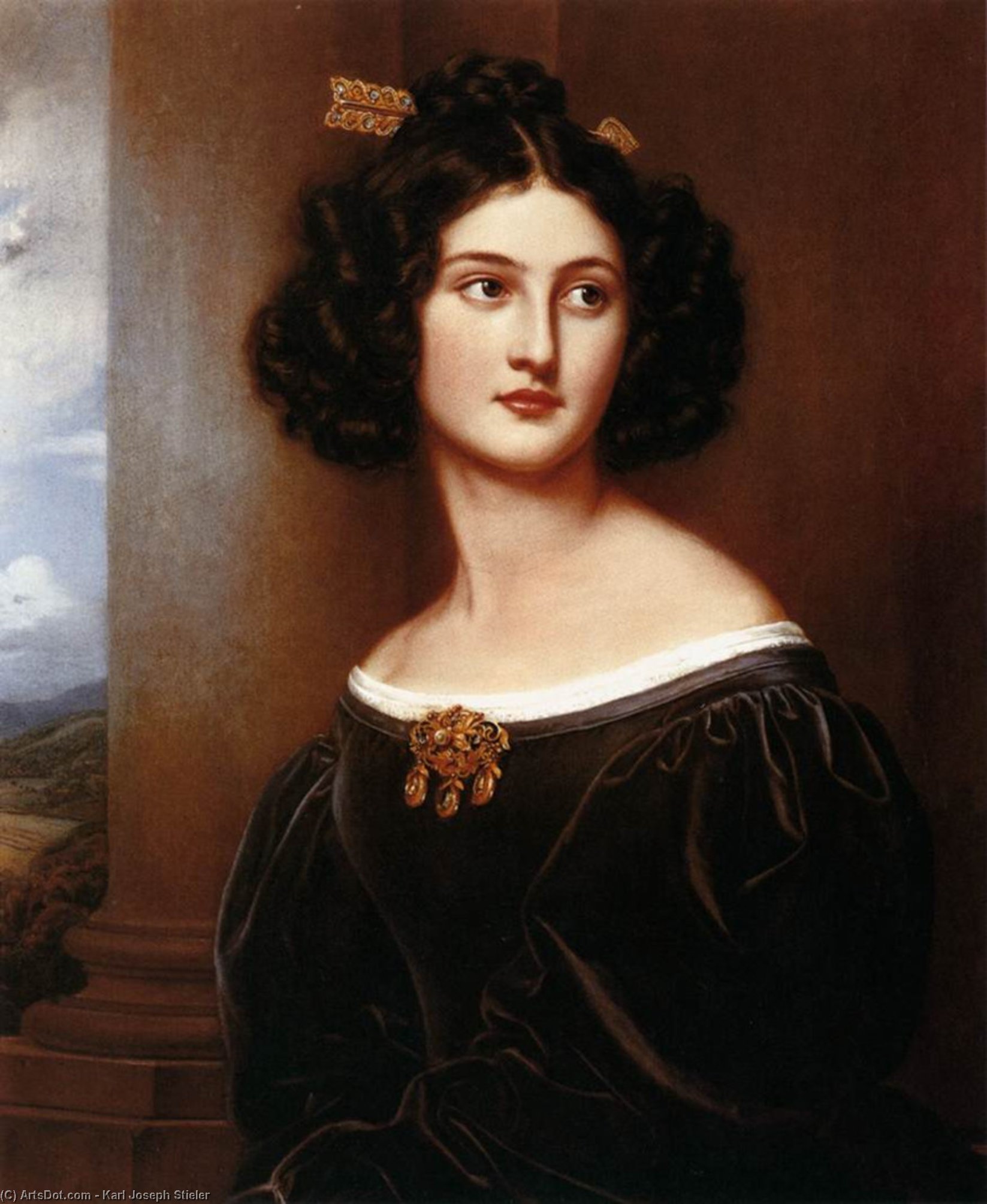
Ein beeindruckendes Neoklassizismus-Porträt von Nanette Heine, geboren Kaula, gemalt von Karl Joseph Stieler im Jahr 1829. Bewundern Sie die Eleganz und Detailtreue dieses Meisterwerks der bayerischen Kunstgeschichte.
A Portrait of Elegance: Nanette Heine, née Kaula by Joseph Karl Stieler
The painting “Nanette Heine, née Kaula,” executed in 1829 by the Bavarian Court Painter Joseph Karl Stieler, stands as a testament to the neoclassical aesthetic that dominated European art during its formative years. More than just a likeness of a woman—a commission reflecting Dalberg’s patronage—the portrait embodies a carefully considered visual language designed to convey status and sophistication.
Stieler's meticulous approach is immediately evident in the painting’s technique. Employing oil paints on canvas, he achieved remarkable tonal gradation and subtle modeling effects, capturing the contours of Nanette Heine’s face with precision. The artist skillfully utilized chiaroscuro—the dramatic interplay between light and shadow—to sculpt the woman’s features, emphasizing her gaze and lending an air of contemplative seriousness to her expression.
The composition itself adheres to classical principles of balance and symmetry. Nanette Heine is positioned centrally within a formal landscape setting, dominated by a towering column and distant mountains. This backdrop serves not merely as decorative ornamentation but functions symbolically—the column representing stability and authority, mirroring the aristocratic lineage of its subject, while the mountains evoke grandeur and permanence.
Beyond its technical mastery, “Nanette Heine” resonates with deeper artistic intentions. The woman’s attire – a black dress adorned with a delicate gold necklace – speaks to the prevailing fashions of the era and underscores her social standing. Her gaze directly confronts the viewer, inviting contemplation and establishing an intimate connection between subject and observer—a hallmark of neoclassical portraiture aimed at capturing not just physical appearance but also inner character.
Stieler’s work exemplifies the broader artistic currents of his time, reflecting Dalberg's commitment to elevating Bavarian culture. The painting’s enduring appeal lies in its ability to transport us back to a period defined by aristocratic grandeur and refined sensibilities. It remains an inspiring example of how art can communicate both visual beauty and profound emotional resonance.