A Symphony of Form: The Geometric Resonance of Malevich
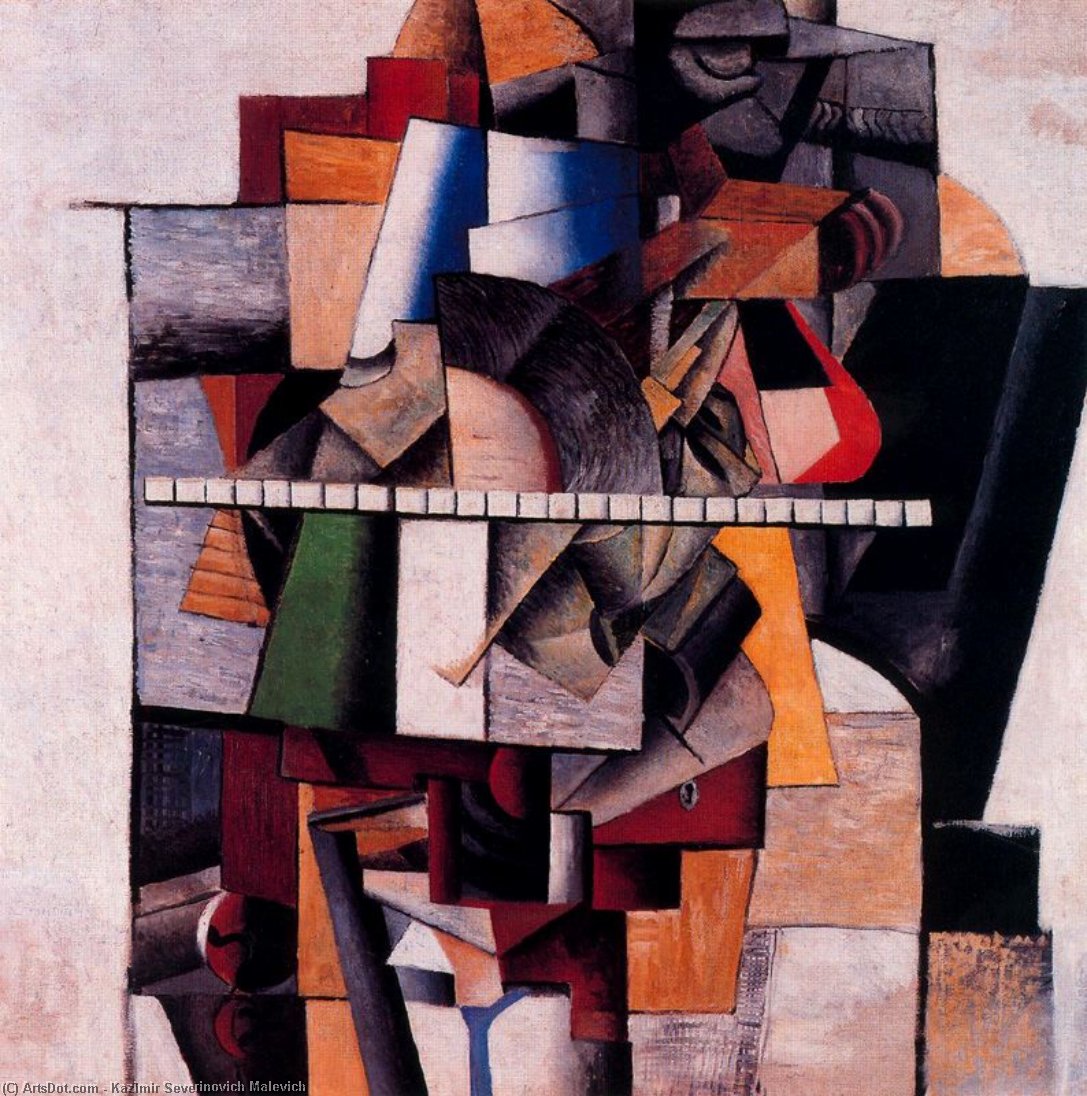
In the early twentieth century, the boundaries of visual perception were being violently dismantled by the avant-garde, and few artists stood at the precipice of this revolution quite like Kazimir Malevich. His 1913 masterpiece, Portrait of the Composer M. V. Maliushin, serves as a breathtaking bridge between the recognizable world and the dawn of pure abstraction. At first glance, the viewer encounters a scene that feels anchored in reality—a man seated at a desk, a piano poised before him, the quiet intimacy of a study suggested by the presence of a simple cup. Yet, beneath this representational surface lies a radical deconstruction of reality. Malevich does not merely paint a musician; he attempts to paint the very essence of musicality through a Cubist lens, translating the rhythmic vibrations of sound into a language of fragmented planes and intersecting geometries.
The technique employed here is a masterful marriage of Cubism and Futurism. Rather than adhering to the traditional laws of perspective that create an illusion of three-dimensional space, Malevich utilizes a blueprint of squares, rectangles, and sharp angles to construct his subject. This fragmentation acts as a visual metaphor for the way sound waves disperse and overlap in a concert hall. By breaking the figure into geometric shards, the artist invites us to look past the physical skin and bone of the composer to find the structural harmony beneath. For the discerning collector or interior designer, this piece offers a sophisticated tension; it possesses the structural stability of geometric art while maintaining a dynamic, kinetic energy that breathes life into any contemporary space.
Color, Emotion, and the Soul of the Avant-Garde
Beyond the rigorous geometry, the emotional heartbeat of the portrait is driven by a daring and emotive palette. Malevich moves away from the muted tones of classical portraiture, instead embracing bold contrasts that command attention. Deep, earthy ochres and rich, visceral crimsons dominate the composition, creating a sense of warmth and groundedness. These heavy, resonant hues are brilliantly interrupted by sudden, sharp splashes of turquoise—a choice that feels almost like a sudden melodic trill in an otherwise somber composition. This interplay of color does more than decorate the canvas; it functions as a psychological catalyst, evoking the internal passion and intellectual rigor required of a composer.
To possess a reproduction of this work is to bring a piece of art history’s most transformative era into one's personal environment. It is an invitation to contemplate the profound connection between different sensory experiences—the way a visual line can mimic a musical note, and how color can evoke a feeling of resonance. Whether placed in a minimalist modern gallery or as a focal point in a curated residential study, the Portrait of the Composer M. V. Maliushin stands as a testament to the power of innovation. It remains an enduring symbol of the moment when art ceased to be a mirror of the world and began to become a world unto itself.