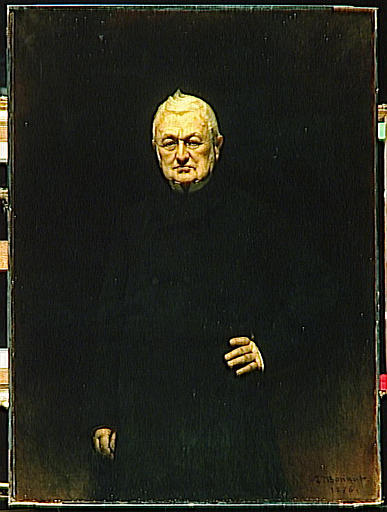
A Portrait of Statesmanship: Adolphe Thiers by Léon Bonnat
Léon Joseph Florentin Bonnat’s 1876 portrait of Adolphe Thiers is more than just a likeness; it's a carefully constructed tableau of power, dignity, and a subtle undercurrent of melancholy. Commissioned during the twilight years of the man who served as President of the Third Republic, this oil-on-canvas painting offers a profound glimpse into the character of a pivotal figure in French history, rendered with the meticulous realism and evocative atmosphere characteristic of Bonnat’s mature style.
Bonnat, deeply influenced by the Spanish masters – particularly Velázquez and Jusepe de Ribera – eschewed the prevailing academic trends of his time. He deliberately moved away from the overly polished and idealized portraits favored by artists like William-Adolphe Bouguereau, opting instead for a more direct engagement with his subject’s personality. This is immediately apparent in Thiers's gaze; it isn’t a vacant stare or a studied formality, but rather a quiet intensity that suggests both wisdom and the weight of responsibility. The artist masterfully captures this subtle nuance, inviting the viewer into a private moment of reflection.
The Language of Form and Shadow
Technically, Bonnat's approach is rooted in academic tradition, yet infused with a distinctly personal vision. He employs a carefully orchestrated palette dominated by deep browns, grays, and blacks – colors that immediately convey gravitas and authority. These dark tones are skillfully contrasted with subtle highlights on Thiers’s face and hands, drawing the eye to these points of focus and emphasizing his presence within the composition. The artist's brushwork is remarkably controlled, creating a sense of smooth transitions in skin textures and fabric folds. Notice how the meticulous rendering of the suit’s texture – the subtle variations in tone and direction – speaks volumes about Bonnat’s dedication to realism.
The painting’s composition adheres to a classic pyramidal structure, with Thiers positioned slightly off-center, creating a dynamic balance within the frame. The use of linear perspective is deliberately shallow, flattening the space and reinforcing the sense of formality and timelessness. There's no dramatic recession or attempt to create an illusion of depth; instead, Bonnat focuses on capturing the essence of the subject – his character and bearing – rather than a meticulously rendered spatial environment.
Symbolism and Historical Context
The portrait was painted during a turbulent period in French history. Thiers, having served as President from 1871 to 1873, navigated the aftermath of the Franco-Prussian War and the establishment of the Third Republic. His tenure was marked by political instability and social unrest, yet he remained a respected figure known for his integrity and commitment to republican ideals. Bonnat’s decision to portray Thiers in this somber, contemplative pose reflects the complex legacy of this statesman – acknowledging both his achievements and the challenges he faced.
The subtle hint of melancholy that permeates the portrait is particularly poignant. The downturned corners of Thiers' mouth, combined with the intensity of his gaze, suggest a weariness born of years spent in public service. It’s not a portrait of triumphant victory, but rather one of quiet reflection on a life dedicated to duty and responsibility. The choice of dark colors further amplifies this sense of introspection, creating an atmosphere of dignified sadness.
A Legacy of Realism
Léon Bonnat's portrait of Adolphe Thiers stands as a testament to his mastery of realism and his ability to capture the psychological depth of his subjects. It’s a painting that rewards careful observation, inviting viewers to contemplate not only the likeness of a historical figure but also the complexities of his character and the enduring legacy of his time. Reproductions of this work offer an exceptional opportunity to bring this powerful image into any setting, serving as both a conversation piece and a window into the heart of 19th-century France.