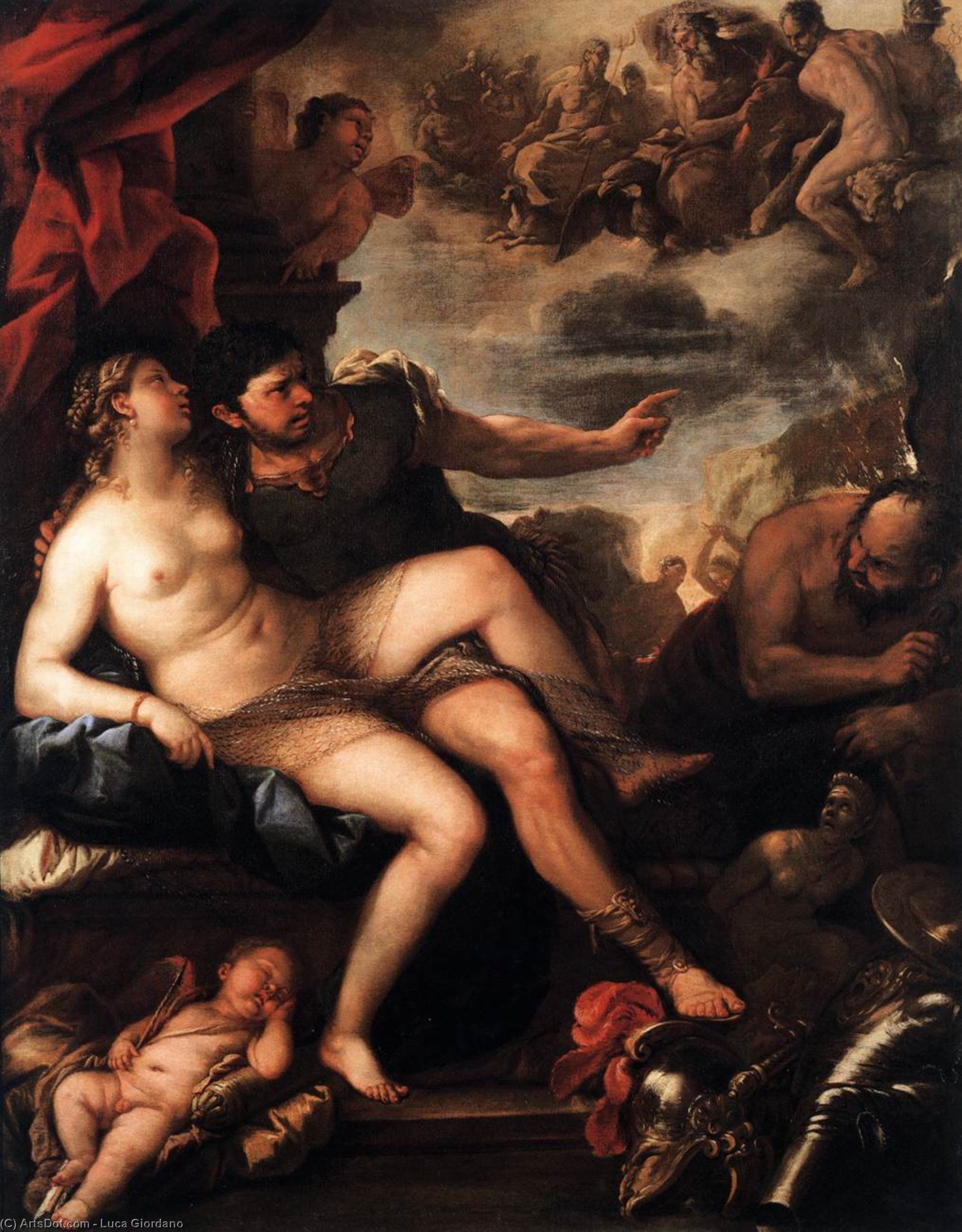
Luca Giordano’s Dramatic Narrative: Mars and Venus Caught by Vulcan
Luca Giordano's “Mars and Venus Caught by Vulcan” is more than just a painting; it’s a vibrant plunge into the heart of late Baroque drama. Measuring 232 x 182 cm, this monumental oil on canvas captures a pivotal moment from mythology – the clandestine encounter between Mars and Venus, interrupted by the watchful eye of Vulcan himself. Painted around the mid-17th century, it exemplifies Giordano’s remarkable ability to fuse classical grandeur with the distinctive fervor of Naples, creating a scene brimming with narrative tension and luminous color.
- Subject Matter: The painting centers on the myth of Vulcan, the god of fire, discovering Mars and Venus in a compromising position. This narrative is rich with symbolism – illicit love, divine intervention, and the inherent vulnerability even of immortal deities.
- Composition: Giordano masterfully employs a complex composition, layering figures within a shallow space to generate a sense of bustling activity and heightened drama. The arrangement is deliberately chaotic yet controlled, mirroring the tumultuous emotions at play.
- Color Palette: Characteristic of Giordano’s style, the painting boasts a rich, warm palette dominated by reds, golds, and browns – colors associated with passion, power, and divine fire. These hues are skillfully modulated to create dramatic contrasts and enhance the sense of movement.
A Synthesis of Influences: Technique and Style
Giordano’s technique is immediately recognizable as a potent synthesis of Ribera's influence and his own burgeoning artistic vision. Like Ribera, he demonstrates a remarkable command of anatomy and realism, particularly evident in the detailed rendering of the figures’ musculature and drapery. However, unlike Ribera’s often somber palette, Giordano possessed a natural inclination towards luminosity and movement—qualities that would ultimately define his unique style. This early apprenticeship under Jusepe de Ribera is clearly visible, yet Giordano quickly established his own distinctive voice, injecting a dynamism and emotional intensity into his work that set him apart.
Symbolism and Narrative Depth
Beyond the immediate depiction of the mythological scene, “Mars and Venus Caught by Vulcan” is laden with symbolic meaning. The figures are not merely lovers; they represent primal forces – war and love – locked in a struggle for dominance. Vulcan’s intervention underscores the precariousness of human desire and the unpredictable nature of fate. The crowded setting, filled with attendant figures, suggests the pervasive influence of divine power and the constant scrutiny of the gods. Giordano's skill lies not just in depicting the scene but in conveying its underlying narrative complexity.
Giordano’s Legacy: A Neapolitan Masterpiece
Luca Giordano, born in Naples in 1634, was a name that quickly became synonymous with the exuberant spirit of the late Baroque. He wasn't merely an artist; he was a force of nature, a whirlwind of creativity whose prolific output transformed both canvases and architectural spaces across Italy and Spain. His father, Antonio Giordano, laid the initial foundations of his artistic training, but it was under the stern yet masterful guidance of Jusepe de Ribera that the young Luca truly began to forge his distinctive path. This early apprenticeship left an indelible mark, evident in the dramatic intensity and realistic portrayal of figures characteristic of Giordano’s initial works. However, unlike Ribera's often somber palette, Giordano possessed a natural inclination towards luminosity and movement—qualities that would ultimately define his unique style. Even then, he earned the nickname “Luca fa presto”—Luca the quick one—a testament to his remarkable speed and talent.