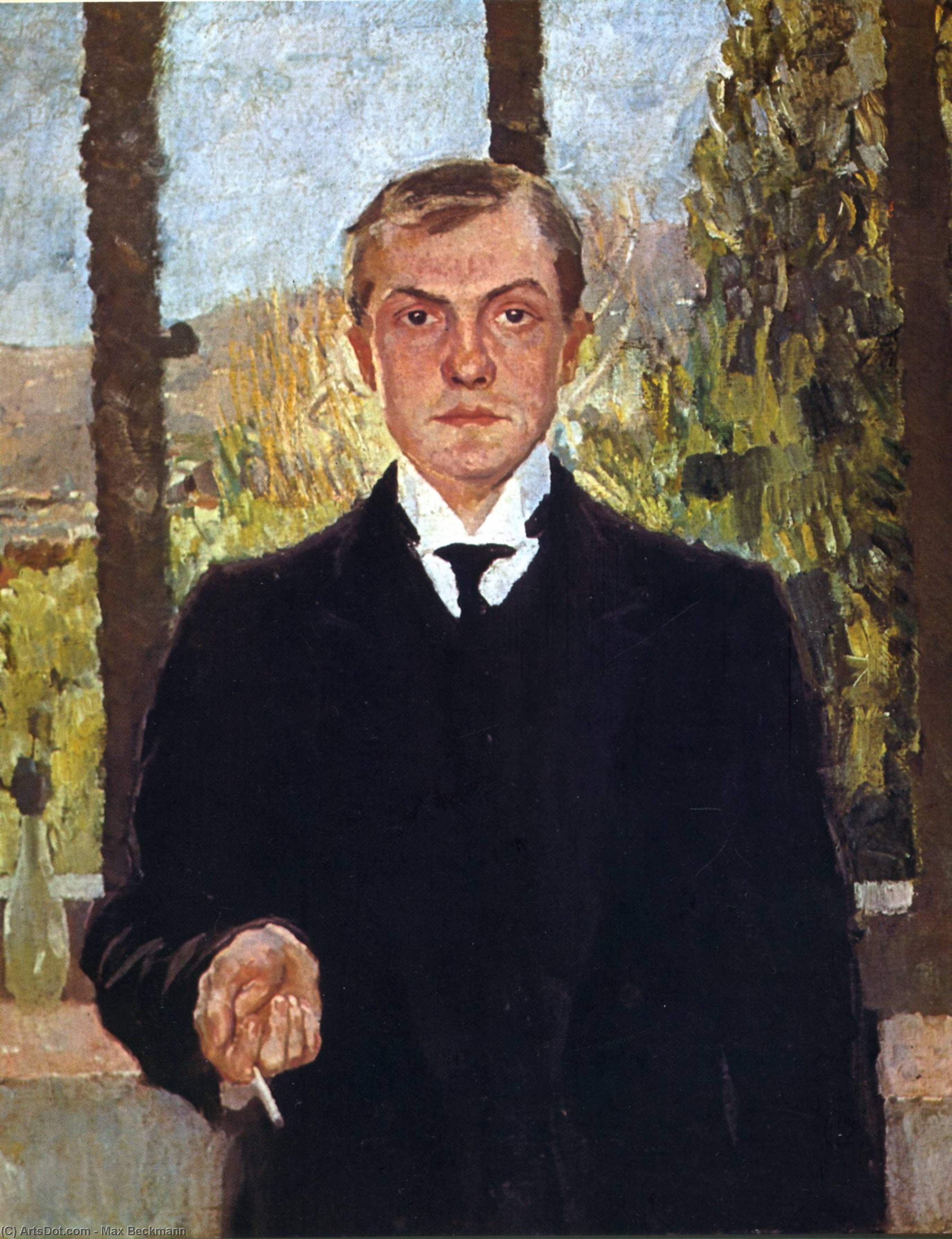
Expressionist self‑portrait of a stern man holding a cigarette, painted by Max Beckmann in 1907; explore this striking piece or bring it into your collection.
Entdecken Sie Max Beckmann (1884-1950), Schlüsselfigur des Expressionismus! Seine Gemälde zeigen verzerrte Figuren & eindringliche Landschaften, Spiegelbilder von Kriegstrauma und existenziellen Fragen. Erleben Sie sein Vermächtnis!
Subject and Composition
The canvas opens onto a man in a tailored suit, his white shirt crisp beneath a dark coat that drapes with quiet authority. In one hand he cradles a cigarette, the ember’s glow mirroring the faint light that spills through a window behind him. The background is a muted landscape of trees, their silhouettes softened by distance, suggesting an open Florentine courtyard. Beckmann places himself at the center, yet his gaze is not directed toward the viewer; it lingers on the horizon beyond the glass, hinting at introspection and the weight of unseen thoughts.
Style and Technique
Beckmann’s brushwork here is vigorous yet controlled, a hallmark of early expressionism that would later evolve into more distorted forms. The oil paint is applied in thick, impasto layers, giving texture to the coat’s folds and the cigarette’s ash. He uses a palette dominated by earthy browns and muted blues, punctuated by the stark white of the shirt and the subtle glow of the ember. The edges are softened with gentle blending, yet the overall composition retains a sense of solidity that anchors the figure against the hazy backdrop.
Historical Context and Symbolism
Painted in 1907, this self‑portrait emerges at a pivotal moment when Beckmann was transitioning from academic realism toward a more personal, expressive language. The cigarette—a symbol of modernity and perhaps the artist’s own anxieties—contrasts with the timeless setting of Florence, a city steeped in Renaissance heritage. The window frames a view that could represent both escape and confinement, suggesting the duality of an artist caught between tradition and innovation. In this light, the portrait becomes a dialogue between past and present, personal identity and broader cultural currents.
Emotional Resonance and Interior Design Appeal
The painting’s somber palette and contemplative mood invite viewers into a quiet space of reflection. Its size—90 by 98 centimeters—makes it an ideal focal point for living rooms or study areas where one seeks depth without overwhelming the room. The subtle interplay of light and shadow, coupled with Beckmann’s expressive brushwork, creates an atmosphere that feels both intimate and expansive. For collectors and interior designers alike, this work offers a timeless piece that speaks to the human condition while complementing sophisticated décor with its understated elegance.