A Window Into Bruges’ Artistic Soul
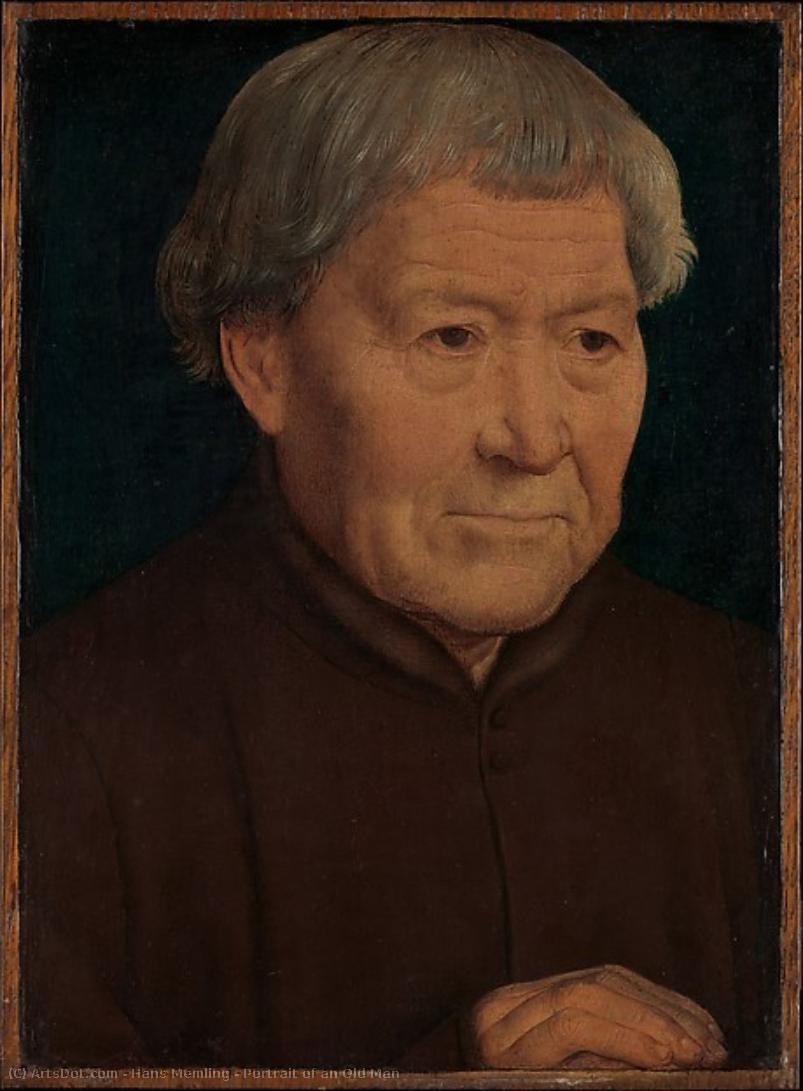
In the quiet, contemplative gaze of Hans Memling's "Portrait of an Old Man," we encounter more than just a masterful likeness; we step into the very heart of the Early Netherlandish tradition. Executed in 1475, this painting serves as a profound meditation on the passage of time and the enduring weight of memory. The subject, an elderly man with a countenance etched by years of experience, sits before the viewer with a downward cast to his eyes, suggesting a moment of deep introspection or perhaps a silent prayer. There is an intimate, almost sacred quality to his presence, as if we have stumbled upon a private moment of spiritual reflection. For the collector or the lover of fine art, this piece offers a rare opportunity to possess a fragment of the humanist spirit that once flourished in the vibrant streets of Bruges.
The emotional resonance of the work lies in its ability to transcend the boundaries of the canvas. Memling does not merely paint a face; he paints a life lived. The subtle tension in the subject's expression and the heavy, thoughtful atmosphere surrounding him evoke a sense of melancholy intertwined with dignity. It is a piece that demands slow observation, rewarding the viewer with a deepening connection to the human condition. For those looking to infuse a living space with character and depth, this portrait provides a sophisticated focal point that invites conversation and quiet contemplation.
The Mastery of Light and Texture
To behold this portrait is to witness the pinnacle of 15th-century technical achievement. Memling, a student of the legendary Rogier van der Weyden, utilized the relatively new medium of oil paint to achieve a level of realism that was nothing short of revolutionary. Through meticulous layers of glaze, he captured the delicate interplay of light and shadow, creating a luminous quality that seems to emanate from within the wood panel itself. Every detail is rendered with an almost supernatural precision: the soft, snowy texture of the man's white hair, the heavy, tactile folds of his brown robe, and the fine, weathered creases around his eyes are all brought to life with breathtaking fidelity.
The artist’s command over color and contrast further enhances the painting's dramatic impact. The deep, midnight blue of the background serves as a stark, velvety void that pushes the subject forward, making the warmth of the man's skin and the earthy tones of his attire appear strikingly three-dimensional. This deliberate use of negative space ensures that nothing distracts from the psychological depth of the sitter. For interior designers, the painting’s rich, dark palette and masterful tonal gradations offer a timeless elegance, making it an ideal centerpiece for classical, traditional, or even contemporary minimalist settings where a touch of historical gravity is desired.
A Legacy of Flemish Excellence
The historical significance of this work is inextricably linked to the golden age of Bruges. During the mid-fifteenth century, Bruges was a bustling crucible of commerce and culture, a city where wealth from the wool trade fueled an unprecedented era of artistic patronage. Memling’s workshop was at the center of this movement, producing works that were sought after by the burgeoning merchant class across Europe. This portrait, likely part of a larger diptych, reflects the period's obsession with capturing the essence of the individual and securing a visual legacy for generations to come.
Owning a high-quality reproduction of such a masterpiece allows one to bring this storied history into the modern home. It is an invitation to surround oneself with the craftsmanship of the Old Masters—a way to bridge the gap between the contemporary world and the profound, enduring beauty of the Northern Renaissance. Whether displayed in a private study, a grand library, or a curated gallery wall, Memling's "Portrait of an Old Man" remains a timeless testament to the power of art to preserve the soul of humanity.