A Divine Drama in Shadow and Light
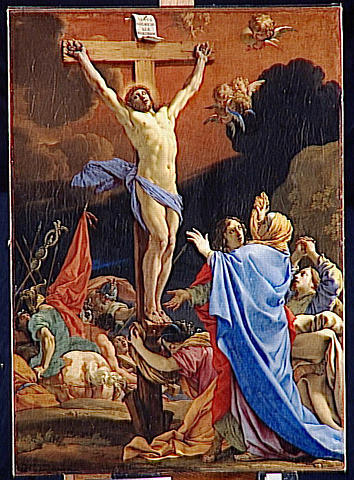
In the hallowed halls of the Louvre Museum, within the Richelieu Wing, resides a masterpiece that commands silence and stirs the soul: Le Christ en Croix by Michel Dorigny. Executed between 1648 and 1650, this monumental oil painting is far more than a mere religious depiction; it is a profound exploration of human suffering and divine sacrifice. As the eye meets the canvas, one is immediately struck by the sheer scale and the dramatic tension that radiates from the central figure of Christ. Dorigny, a master of the French Baroque tradition, utilizes a sophisticated pyramidal composition to anchor the viewer's gaze, placing the crucified Savior at the apex of an emotional hierarchy. This structural stability provides a haunting contrast to the turbulent grief unfolding at the foot of the cross, creating a visual rhythm that guides the observer through a landscape of both physical and spiritual agony.
The brilliance of this work lies in Dorigny’s masterful command of chiaroscuro, a technique heavily inspired by the revolutionary approach of Caravaggio. The painting is defined by its stark, theatrical lighting, where a singular, celestial light source seems to descend from above, piercing through the gloom to illuminate Christ’s pale, wounded form. This intense illumination carves the figures out of deep, velvety shadows, lending a sculptural three-dimensionality to the flesh and drapery. The color palette is intentionally somber, dominated by earthy ochres, deep browns, and muted reds that evoke the dust of Golgotha, yet these are punctuated by subtle blues in the sky and garments, offering a glimpse of the heavens amidst the earthly tragedy. Every brushstroke serves to heighten the tactile reality of the scene, from the rough texture of the wooden cross to the soft, agonizingly realistic rendering of skin.
Symbolism and the Baroque Spirit
Beyond its technical prowess, Le Christ en Croix is a tapestry of profound symbolism. The verticality of the cross acts as a bridge between the terrestrial and the divine, a literal and figurative axis mundi connecting the suffering of man to the promise of redemption. Surrounding the central figure, a crowd of mourners provides a window into the spectrum of human emotion—ranging from the quiet, stoic reverence of the saints to the raw, unbridled despair of the onlookers. The presence of celestial elements, such as subtle angelic figures, suggests that this moment of profound death is simultaneously an act of cosmic significance. For the collector or the enthusiast of classical art, the painting offers a window into the 17th-century mindset, where art served as a powerful tool for meditation and religious devotion.
For interior designers and connoisseurs of fine art reproductions, this piece represents the pinnacle of Baroque elegance and emotional depth. The artwork’s ability to anchor a room with its dramatic presence makes it an incomparable choice for spaces designed for contemplation or grand architectural statements. To possess a reproduction of such a work is to invite a sense of history, gravity, and timeless beauty into one's environment. It is not merely a decoration, but a conversation piece that speaks to the enduring power of the human spirit and the eternal struggle between light and darkness.