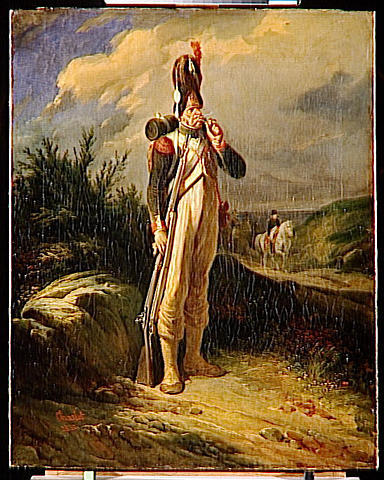
The Weight of Duty: Nicolas Toussaint Charlet’s Grenadier de la Garde
Nicolas Toussaint Charlet's "Grenadier de la Garde" isn’t merely a depiction of a soldier; it’s a carefully constructed embodiment of 19th-century French identity, steeped in the romanticism and patriotic fervor following the Napoleonic era. Painted around 1842, this lithograph captures a Grenadier of the Guard – an elite unit renowned for their unwavering loyalty and formidable presence – standing stoically against a dramatic landscape. The image transcends simple military portraiture, becoming a potent symbol of duty, resilience, and the enduring spirit of France itself. Charlet’s genius lies in his ability to imbue this single figure with layers of meaning, drawing upon historical context, artistic technique, and a keen understanding of human psychology.

A Master of Lithography: Technique and Detail
Charlet’s skill as a lithographer is immediately apparent. The image possesses a remarkable level of detail, achieved through the meticulous process of transferring ink from a stone to paper. Notice the subtle variations in texture – the rough, weathered surface of the rock beneath the Grenadier's feet, contrasted with the smoother fabric of his uniform. The artist’s loose brushstrokes, characteristic of the Romantic style, lend a sense of immediacy and dynamism to the scene. The layering of colors, particularly in the sky, creates an atmospheric depth that draws the viewer into the landscape. This technique wasn’t simply about replicating reality; it was about conveying emotion and atmosphere through carefully controlled marks and tones.
- Loose Brushwork: Reflecting Romantic ideals of emotional expression.
- Layered Colors: Creating atmospheric depth and a sense of drama.
- Detailed Textures: Evoking the tactile qualities of the subject matter – stone, fabric, foliage.
Symbolism in Form and Gesture
The Grenadier’s posture is crucial to understanding the artwork's meaning. He stands with a rigid yet controlled stance, his gaze fixed on the horizon—a gesture that speaks of duty, vigilance, and perhaps even a touch of melancholy. The solitary figure against the vast landscape symbolizes France itself – a nation facing challenges while maintaining its honor and integrity. The inclusion of the distant cavalry figures suggests both the grandeur of military power and the potential for conflict. Even the Grenadier’s simple uniform—a dark blue with red accents—holds symbolic weight, representing loyalty to the crown and the enduring traditions of French military service. The subtle hint of a pipe in his mouth adds an element of human vulnerability to this imposing figure, reminding us that even within the ranks of the elite, there is always a shared humanity.
Historical Context: A Nation Rebuilding
“Grenadier de la Garde” was created during a period of significant political and social upheaval in France. Following the fall of Napoleon, the country was grappling with the restoration of the monarchy and the challenges of rebuilding its economy and society. Charlet’s work reflects this atmosphere of both nostalgia for the past and hope for the future. The Grenadier, as an emblem of French military prowess, served to reinforce national pride and inspire confidence in the nation's ability to overcome adversity. The lithograph itself was a popular medium during this time, offering affordable access to art for a wider audience. It’s important to note that Charlet’s depiction of Napoleon is not overtly celebratory; rather, it presents him as a distant figure, emphasizing the enduring legacy of his reign and the ongoing responsibility of the French people.