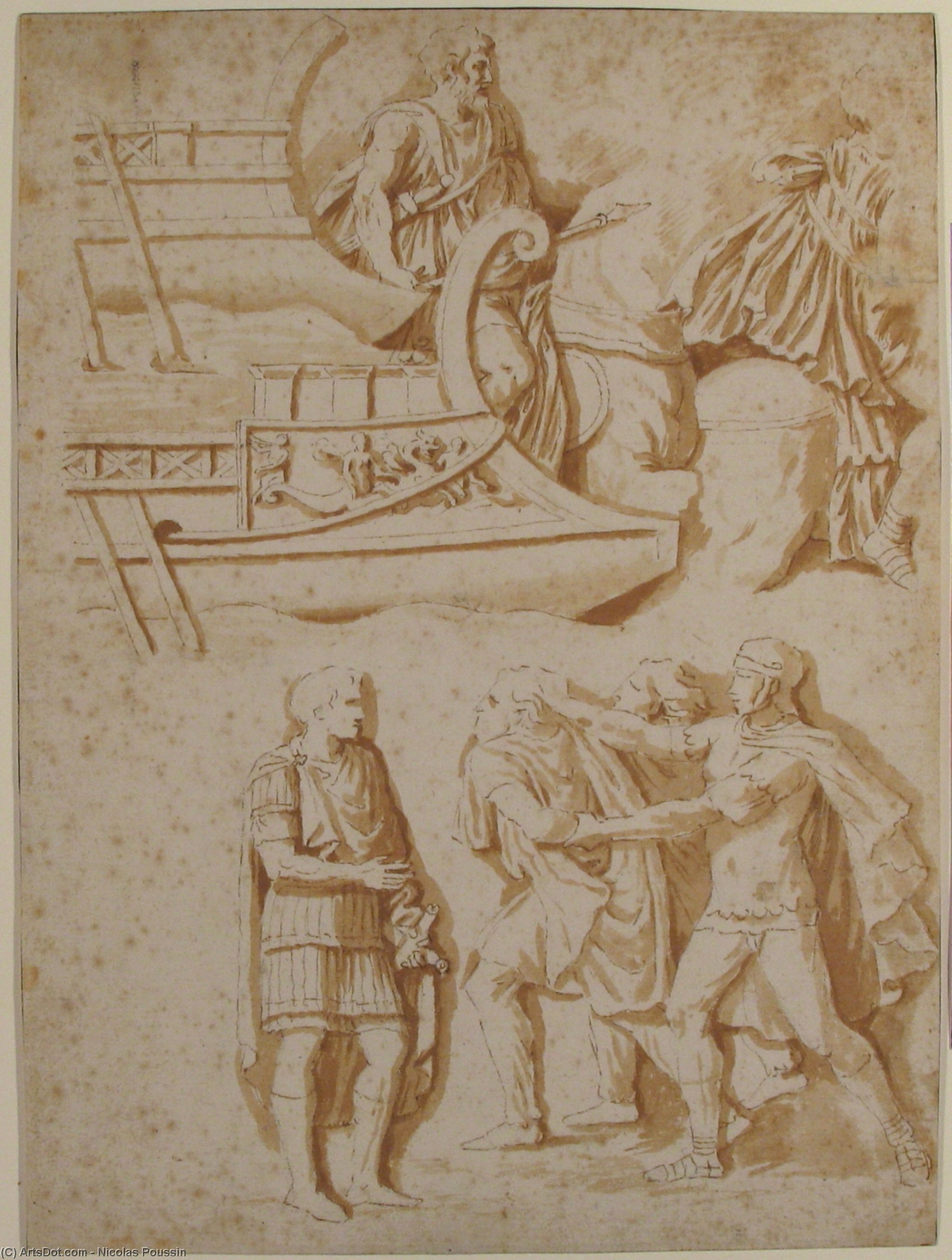
Studies of Details from Trajan's Column
The painting by Nicolas Poussin, “Studies of Details from Trajan’s Column,” stands as an exceptional testament to the artist’s unwavering dedication to classical ideals and his mastery of Baroque artistic principles. Created in approximately 1635 during his formative years in Rome—a city that served as a crucible for artistic innovation—this artwork transcends mere visual representation; it embodies a profound engagement with history, philosophy, and the very essence of human perception. As an art historian specializing in Baroque decoration and a seasoned salesman at ArtsDot.com, I recognize immediately the significance of this piece within Poussin’s oeuvre and its enduring influence on subsequent generations of artists. It's more than just pigment on canvas; it’s a distillation of intellectual curiosity and artistic virtuosity.
Composition and Symbolism: A Dialogue with Antiquity
Poussin meticulously crafted his composition to evoke the grandeur and solemn contemplation characteristic of Roman sculpture, specifically Trajan’s Column—a monumental edifice commemorating Emperor Trajan's victory over Dacia. The scene unfolds with a deliberate restraint, prioritizing clarity and geometric precision over flamboyant ornamentation. Figures are arranged in pyramidal groupings, mirroring the architectural structure itself, creating a harmonious visual rhythm that guides the viewer’s gaze. Notice the subtle interplay of light and shadow—a technique known as *chiaroscuro*—which sculpts volume and enhances dramatic effect. Beyond its formal beauty lies a rich tapestry of symbolism. The figures represent not merely individuals but archetypal roles within human experience: piety, courage, and contemplation. They engage in dialogue, conveying moral lessons rooted in Stoic philosophy – a cornerstone of Poussin’s intellectual worldview.
The Artist's Vision: Line Over Color
Nicolas Poussin’s artistic style is instantly recognizable for its preference for *line* over *color*. Unlike many contemporaries who embraced vibrant hues and expressive brushstrokes, Poussin favored muted tones—primarily ochre, umber, and ivory—allowing the contours of his figures to dominate the canvas. This stylistic choice reflects his belief that line possesses a superior capacity to convey emotion and intellectual thought. He meticulously rendered drapery folds with painstaking accuracy, capturing the subtle nuances of fabric texture and movement. The artist’s meticulous attention to detail is further evidenced by the rendering of architectural elements—particularly Trajan's Column itself—which appears as an almost palpable presence within the painting. This dedication to realism was not merely decorative; it served to elevate the artwork beyond mere visual pleasure, inviting viewers to contemplate its philosophical implications.
Influence and Legacy: Echoes in Later Art
Poussin’s influence extended far beyond his own lifetime, shaping the artistic sensibilities of artists such as Jacques-Louis David and Jean-Auguste-Dominique Ingres—figures who championed classical ideals in their respective eras. His compositional strategies—particularly the pyramidal structure—became a standard formula for portraying heroic narratives and conveying moral truths. Furthermore, Poussin’s exploration of landscape—evident in works like “The Pastoral” and “Landscape with Saint George and the Dragon”—established him as a pioneer of topographical painting and foreshadowed developments in Romantic art. The Musée du Louvre houses numerous masterpieces by Poussin, including "The Ecstasy of Saint Paul" and "Pieta," offering visitors an unparalleled opportunity to immerse themselves in the splendor of Baroque artistry and contemplate the enduring legacy of this singular genius. For deeper insights into Poussin’s life and artistic journey, explore ArtsDot.com or Wikipedia.
- “Studies of Details from Trajan’s Column” exemplifies Poussin's Baroque style through masterful *chiaroscuro* and sfumato techniques, creating a sense of depth and emotional resonance.
- The painting’s pyramidal composition reflects the architectural grandeur of Trajan’s Column and embodies Stoic philosophical principles—a hallmark of Poussin’s intellectual heritage.
- As a handmade oil painting reproduction available on ArtsDot.com, this artwork allows collectors to appreciate the intricate textures and subtle nuances of Poussin's artistic vision.
Handmade oil painting reproductions of “Studies of Details from Trajan’s Column” are obtainable at
ArtsDot.com, presenting art enthusiasts with a chance to own a piece of history—a visual embodiment of classical ideals and artistic excellence. Its harmonious composition and profound symbolism solidify its position as an iconic artwork deserving of admiration and contemplation.
The Santa Bibiana museum in Rome showcases artworks by Poussin, furthering the appreciation for his contribution to the Baroque movement. Visit
ArtsDot.com for more information on Poussin’s artistic achievements and the stylistic innovations of his time.
Additional Resources:
Explore Poussin's Artistic Legacy:
- Nicolas Poussin was a French painter who spent most of his working life in Rome.
- His work is characterized by clarity, logic, and order—a deliberate departure from the flamboyant styles prevalent at the time.
- The Musée du Louvre houses many of his notable works, including The Ecstasy of St. Paul and Pieta.
Further Investigation:
- Nicolas Poussin's influence on subsequent artists is undeniable—David and Cézanne among them.
- Visit Wikipedia for comprehensive biographical information and scholarly analyses.
ArtsDot.com:
- Nicolas Poussin’s artistic vision—rooted in classical ideals and meticulous observation—continues to inspire artists today.
- Discover more about Baroque art and its enduring impact on Western culture at ArtsDot.com.
Santa Bibiana Museum:
- Admire artworks by Poussin alongside other masterpieces of the Baroque era at The Santa Bibiana museum in Rome, Italy.
- Learn about Poussin’s artistic techniques and his contribution to shaping the aesthetic sensibilities of his time.
- Explore ArtsDot.com for detailed information on Poussin’s oeuvre and its historical context.