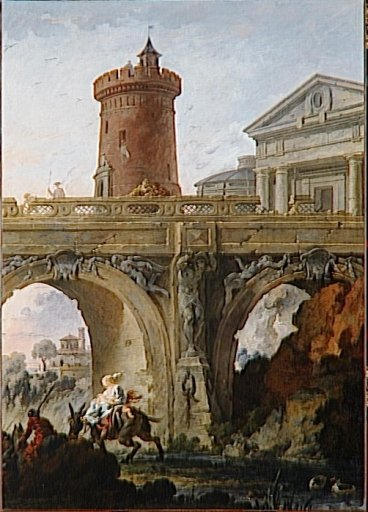
Noël Hallé’s “Paysage avec architecture et figures”: A Vision of Classical Harmony
Noël Hallé's "Paysage avec architecture et figures," painted circa 1770-1775, is more than just a picturesque landscape; it’s a carefully constructed tableau of idealized beauty and restrained grandeur, embodying the spirit of late Baroque and early Neoclassical French art. Born in Paris in 1711 and passing away in 1781, Hallé's artistic journey was deeply intertwined with the patronage system of the era, culminating in his prestigious Prix de Rome award and subsequent years spent honing his craft within the hallowed halls of the Académie Royale Française in Rome. This formative period profoundly shaped his style, imbuing it with a reverence for classical forms, meticulous detail, and an almost dreamlike quality – a legacy evident powerfully in this captivating work.
The scene unfolds across a vast, gently rolling landscape dominated by a dramatic gorge spanned by a substantial bridge. Towering above the bridge is a monumental structure, reminiscent of Roman architecture yet subtly softened with Rococo flourishes, suggesting a harmonious blend of classical inspiration and French artistic sensibilities. A small group of elegantly dressed riders on horseback traverse the bridge, their figures rendered with a sense of poised movement and aristocratic bearing. Beyond them, hazy mountains recede into the distance, creating an atmospheric depth that draws the eye into the heart of the composition. The overall effect is one of serene contemplation – a carefully orchestrated vista designed to evoke feelings of peace, order, and the sublime.
A Symphony of Color and Line
Hallé’s masterful use of color establishes a foundational mood of understated elegance. The palette leans heavily on muted earth tones—ochres, browns, and greens—creating a sense of atmospheric perspective where colors gradually soften and fade with distance. Subtle touches of red and blue punctuate the scene, adding visual interest without disrupting the overall harmony. The artist’s brushwork is deliberately loose yet controlled, layering pigments to build depth and texture – visible strokes contribute to the painting's tactile quality. Strong horizontal lines, particularly those defined by the bridge, anchor the composition, while vertical elements—the tower and distant mountains—add a sense of scale and grandeur. Diagonal lines created by the riders’ movement introduce a dynamic element, preventing the scene from feeling static.
Symbolism and Context: Echoes of Rome
“Paysage avec architecture et figures” is deeply rooted in the artistic traditions of classical antiquity, particularly those cultivated during Hallé's time in Rome. The monumental bridge and tower are clear references to Roman architectural achievements, while the idealized landscape evokes the pastoral settings favored by artists like Claude Lorrain, a key influence on Hallé’s style. The riders themselves can be interpreted as symbols of nobility or travelers exploring the beauty of nature – figures engaged in leisurely pursuits within a carefully constructed world of order and harmony. The scene subtly reflects Enlightenment ideals, celebrating human reason and the pursuit of knowledge through an appreciation for natural beauty and classical forms.
Technique and Materials: A Master’s Craft
The painting is executed in oil on canvas, utilizing a technique characterized by meticulous layering and glazing. Hallé skillfully employed these methods to achieve subtle color transitions, luminous effects, and a remarkable sense of depth. The smooth surfaces of the buildings contrast with the rougher textures of the landscape, creating visual interest and reinforcing the spatial relationships within the composition. The diffused lighting—suggesting an overcast day or indirect sunlight—further enhances the painting’s atmospheric quality. It's a testament to Hallé’s technical mastery that this work retains its beauty and impact centuries after its creation.
A Timeless Vision
“Paysage avec architecture et figures” stands as a compelling example of 18th-century French landscape painting—a synthesis of classical ideals, artistic innovation, and the demands of royal patronage. Its enduring appeal lies in its ability to transport the viewer to a world of serene beauty, carefully constructed harmony, and timeless elegance. Whether viewed as a historical artifact or a source of inspiration for interior design, this captivating work continues to resonate with audiences today.