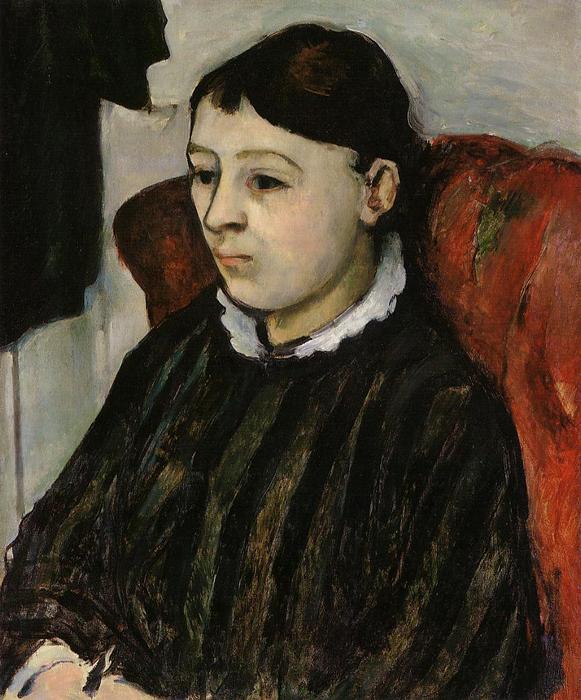
Madame Cézanne in a Striped Robe: A Synthesis of Impressionism and Cubist Vision
Paul Cézanne’s “Madame Cézanne in a Striped Robe,” painted in 1882, stands as an emblem of the pivotal moment when Impressionism relinquished its grip on artistic sensibilities and yielded to the burgeoning influence of Cubism. More than just a portrait, it embodies Cézanne's relentless pursuit of geometric abstraction while retaining the palpable warmth of his beloved wife’s presence—a duality that continues to fascinate art historians and collectors alike.
- Subject Matter: The painting depicts Marie Cézanne, Paul Cézanne’s wife, seated comfortably in a red armchair. Her gaze is directed inward, conveying a profound sense of contemplation and serenity.
- Composition: Cézanne meticulously crafted the scene with careful consideration for spatial relationships. A couch and dining table flank the chair on the left, strategically positioned to create depth and balance within the frame. Two vases—one prominent in the center-left corner and another subtly placed on the right—serve as focal points, guiding the viewer’s eye across the canvas.
- Style: “Madame Cézanne” exemplifies Cézanne's distinctive Post-Impressionist style. Unlike Impressionists who sought to capture fleeting moments of light and color, Cézanne prioritized structural solidity and geometric simplification. Brushstrokes are deliberately roughened, emphasizing form over illusion—a technique that foreshadowed the revolutionary developments of Cubism.
The painting’s stylistic choices resonate deeply with the artistic currents of its time. Cézanne was profoundly influenced by Impressionists like Monet and Renoir, yet he rejected their preoccupation with optical realism. Instead, he drew inspiration from Japanese prints—particularly those featuring flattened perspectives and bold color palettes—which encouraged him to explore alternative ways of representing space and form. This fascination with Japanese aesthetics is evident in the painting’s understated elegance and its deliberate rejection of conventional decorative conventions. Cézanne's aim wasn't merely to depict Marie Cézanne; he sought to distill her essence into a simplified geometric framework, capturing not just what she looked like but also how she felt—a testament to his artistic genius.
- Color Palette: Cézanne employed a restrained color palette dominated by muted reds and browns, punctuated by touches of white and yellow. These colors contribute to the painting’s atmosphere of quiet introspection and imbue it with a sense of warmth and solidity.
- Technique: Cézanne utilized thick impasto—applying paint in heavy layers—to sculpt the surfaces of his canvases. This technique creates textural richness and enhances the illusion of three-dimensionality, mirroring Cézanne’s belief that painting should strive to capture the underlying structure of reality.
“Madame Cézanne in a Striped Robe” occupies a crucial position within art history—a transitional artwork between Impressionism and Cubism that anticipates the radical innovations of Picasso and Braque. Its enduring appeal lies not only in its aesthetic beauty but also in its profound psychological depth, inviting viewers to contemplate themes of domestic tranquility, inner reflection, and the artist’s unwavering commitment to exploring new artistic horizons. For those seeking a piece of Cézanne's visionary spirit, reproductions from ArtsDot.com offer exceptional quality and authenticity—a chance to experience this masterpiece firsthand. Explore more of Cézanne’s oeuvre at
Victor Chocquet and
Peaches, Pears and Grapes. Furthermore, consider visiting the
Scottish National Portrait Gallery to immerse yourself in Scotland’s artistic heritage.