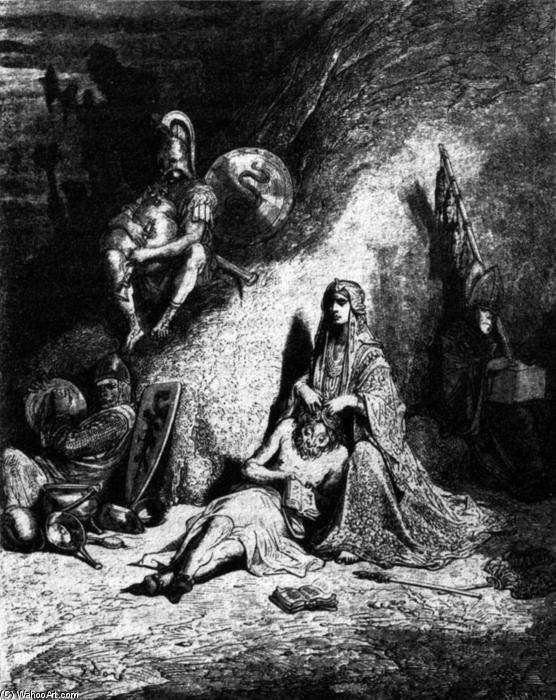
Semiramide, Spidocchiatrice di Straccioni – A Dramatic Portrait of Despair
Paul Gustave Doré’s “Semiramide, Spidocchiatrice di Straccioni” (1854) stands as a haunting testament to Romanticism's preoccupation with suffering and moral decay. Executed in meticulous detail using the technique of wood engraving—a process favored by Doré for its ability to capture tonal nuances and textural subtleties—the artwork depicts a scene steeped in melancholy, resonating powerfully with viewers even today. It’s more than just an image; it's a carefully crafted narrative designed to evoke profound emotion.
- Subject Matter & Narrative Context: The engraving portrays Semiramide, Queen of Babylon and biblical figure known for her tragic tale of betrayal and remorse, kneeling beside a man lying prone on the ground. This juxtaposition immediately establishes a dynamic tension—a visual representation of vulnerability confronting resilience—likely inspired by Dante’s Inferno, reflecting Doré's fascination with exploring themes of torment and redemption.
- Style & Technique: Doré’s mastery lies in his masterful manipulation of wood engraving. The process involved carving intricate lines into a copper plate using specialized tools, followed by applying ink and pressing it onto paper to produce the image. This technique allowed for exceptional precision in capturing light and shadow—a cornerstone of Romantic art—resulting in dramatic chiaroscuro effects that heighten the emotional impact.
- Composition & Visual Elements: The central figure dominates the composition, positioned prominently against a rocky outcrop where a soldier observes the scene. Linear perspective guides the eye into the background, creating depth and reinforcing the sense of isolation experienced by Semiramide. Hatching and cross-hatching techniques are skillfully employed to build up tonal values, simulating fabric folds and conveying the palpable weight of despair.
- Color Palette & Lighting: As an engraving, “Semiramide” eschews color entirely, relying solely on shades of gray and black. However, Doré’s masterful use of lighting—casting shadows from an unseen source—transforms the image into a theatrical tableau. Highlights accentuate Semiramide's face, emphasizing her sorrowful gaze, while underscoring the solemn atmosphere.
- Symbolism & Emotional Impact: The kneeling posture of Semiramide symbolizes humility and compassion amidst profound grief. The man’s vulnerability underscores the devastating consequences of betrayal. Doré’s deliberate choice of imagery—the soldier's watchful gaze, the desolate landscape—contributes to a pervasive sense of unease and reinforces the artwork’s exploration of moral responsibility and psychological torment. It remains a poignant reminder of Romantic art's capacity to confront uncomfortable truths about human experience.
Additional Research Links:
Inspired by Dante’s Inferno, Doré’s engraving captures the essence of Romanticism’s preoccupation with suffering and moral decay.