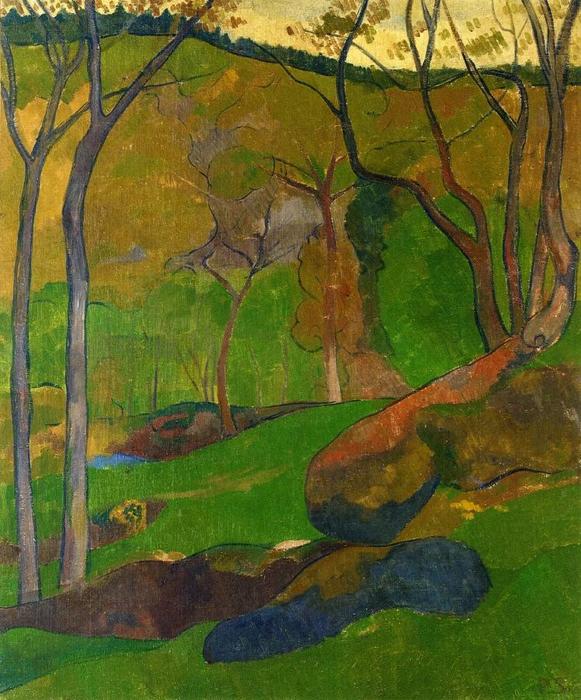
The painting
Undergrowth at Huelgoat by
Paul Serusier is a beautiful representation of the outdoors, created in 1905. This oil on canvas piece is a prime example of the
Synthetism style, characterized by bold and flat forms separated by dark contours. As seen in other works by
Paul Serusier, such as
Celtic Tale and
Mother and Child on a Breton Landscape, this painting showcases the artist's innovative style and artistic vision.
Artistic Background
Paul Serusier was born in Paris on November 9, 1864, and studied at the
Académie Julian. He became a monitor there in the mid-1880s and later traveled to Pont-Aven in 1888, where he joined a group of artists who would become known as the Nabis. This movement was characterized by its emphasis on
Cloisonnism, a style that emerged in the late 19th century. More information about
Paul Serusier and his work can be found at https://ArtsDot.com/@/Paul-Serusier.
Painting Style and Technique
The painting
Undergrowth at Huelgoat features a beautiful landscape of trees with green leaves and brown branches. The trees are scattered throughout the scene, creating a sense of depth in the forest. The use of bold and flat forms, separated by dark contours, is reminiscent of the technique of cloisonné. This style, known as
Cloisonnism, was popularized by artists such as
Paul Serusier and can be seen in other works, such as those found at /art/list/?Filter=A@D3CQS3-The-Cloisonnism-Art-Movement.
- The painting measures 72 x 59 cm and is created with oil on canvas.
- The style of the painting is Synthetism, characterized by bold and flat forms separated by dark contours.
- The painting features a beautiful landscape of trees with green leaves and brown branches.
BR For more information about
Paul Serusier and his work, including
Undergrowth at Huelgoat, visit /art/list/?Filter=8YE6BF-Paul-Serusier-Undergrowth-at-Huelgoat. Additionally, more information about the
Dallas Museum of Art and its collection can be found on Wikipedia: https://en.wikipedia.org/wiki/Dallas_Museum_of_Art.