Erkunden Sie die Renaissance-Meisterwerke von Piero della Francesca (1415-1492). Bekannt für seine geometrische Präzision, bahnbrechende Perspektive und ruhige Humanismus in Fresken wie 'Das Heilige Kreuz'. Entdecken Sie einen Meister, der Kunst, Mathematik und Spiritualität verbindet. #Renaissance
Erkunden Sie die San Francesco Basilika in Arezzo, Italien! Zeugen Sie von Piero della Francescas atemberaubenden Fresken aus dem 15. Jahrhundert, die die Legende vom Heiligen Kreuz in einer wunderschönen gotischen Kirche darstellen. Entdecken Sie Renaissancekunst und toskanische Geschichte.
Piero della Francesca: A Renaissance Visionary
Piero della Francesca (c. 1415 – 1492), born Pietro di Benedetto dei Franceschi in San Sepolcro, Tuscany, stands as one of the most influential artists of the Early Renaissance—a figure whose meticulous observation and groundbreaking use of perspective continue to inspire awe centuries later. His legacy resides not merely in his impressive output but in a profound reimagining of artistic principles that fundamentally altered the course of Western art history. Unlike many contemporaries preoccupied with imitating Gothic grandeur, Della Francesca sought to capture the essence of human experience through geometric precision and luminous realism—a stylistic hallmark that distinguishes him from his peers and secures his place among the titans of Renaissance innovation.
The Legend of the True Cross: A Narrative Masterpiece
Della Francesca’s artistic journey began in Sansepolcro, where he honed his skills under local masters before embarking on a formative period in Florence around 1439. This Florentine sojourn exposed him to the burgeoning humanist spirit and the rediscovery of classical ideals—influences that irrevocably shaped his worldview and fueled his ambition to elevate art beyond mere decorative embellishment. His most celebrated achievement is undoubtedly “The Legend of the True Cross,” a monumental fresco cycle commissioned for the Basilica of San Francesco in Arezzo, Italy. This ambitious project demanded an unprecedented level of technical mastery and conceptual depth—a challenge Della Francesca embraced with unwavering dedication.
Geometric Precision and Spatial Illusionism: The Foundations of Renaissance Art
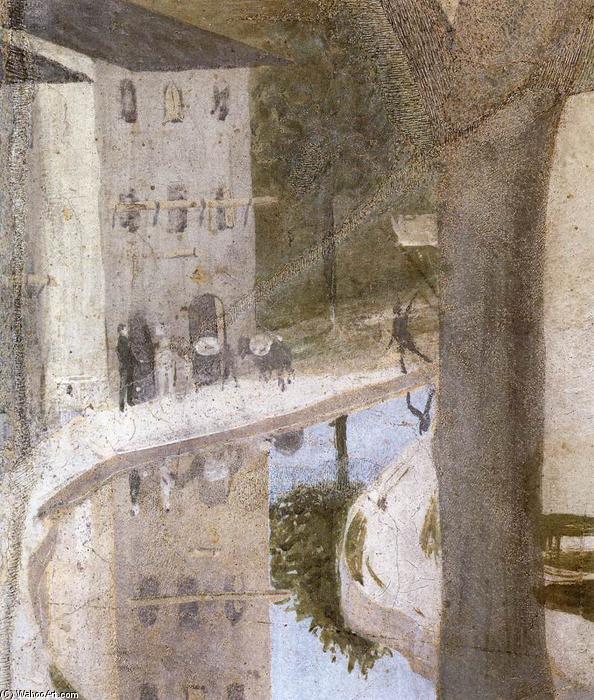
What distinguishes Della Francesca’s work from that of his contemporaries is his revolutionary approach to perspective—a technique he perfected through rigorous mathematical calculations and a profound understanding of optics. Unlike artists who relied on atmospheric haze to create depth, Della Francesca employed linear perspective with unwavering accuracy, constructing illusionistic spaces that convincingly replicate the observable world. This method wasn't merely about creating realistic images; it was about conveying an intellectual conviction that the universe operates according to discernible laws—a cornerstone of humanist thought and a defining characteristic of Renaissance aesthetics. As evidenced in “5. Constantine’s Victory over Maxentius (detail)”, Della Francesca meticulously renders figures and architectural elements within a carefully constructed grid, achieving unparalleled spatial coherence and visual impact. The artist's meticulous attention to detail—from the subtle gradations of color to the precise positioning of shadows—transformed painting into a tool for intellectual exploration and spiritual contemplation.
Symbolism Embedded in Detail
Beyond its technical brilliance, "5. Constantine's Victory over Maxentius (detail)" is rich in symbolic significance—reflecting the broader narrative of “The Legend of the True Cross.” The fresco depicts Emperor Constantine triumphantly defeating his rival Maxentius at the Battle of Milvian Bridge, a pivotal moment in Christian history marking the legalization of Christianity in Rome. However, Della Francesca’s artistic choices transcend mere historical representation; he employs light and color to convey spiritual truths—the bright illumination emanating from Constantine's armor symbolizes divine grace overcoming darkness and despair. The positioning of the soldiers and the architectural elements contributes to a carefully orchestrated visual dialogue that underscores the overarching theme of faith conquering adversity. This masterful use of symbolism elevates the artwork beyond a simple depiction of an event, inviting viewers to ponder questions of morality, power, and redemption.
A Timeless Resonance: Influence Beyond Its Time
Piero della Francesca’s influence extended far beyond his own lifetime, shaping the artistic sensibilities of subsequent generations—including Leonardo da Vinci and Raphael. His unwavering commitment to geometric precision and luminous realism established a paradigm for Renaissance painting that continues to resonate with artists today. “5. Constantine's Victory over Maxentius (detail)” stands as a testament to Della Francesca’s genius—a masterpiece that embodies the ideals of humanist inquiry and artistic innovation—and exemplifies why it remains one of the most revered images in Western art history. Its enduring appeal lies not only in its visual beauty but also in its profound contemplation of human experience and spiritual aspiration. The fresco's impact can still be felt in contemporary art, demonstrating the lasting legacy of Della Francesca’s pioneering approach to artistic representation.
- Painting by 'Piero Della Francesca' | Piero Della Francesca: 5. Constantine’s Victory over Maxentius (detail)
- The Museum San Francesco in Arezzo, Italy
- Basilica of San Francesco, Arezzo - Wikipedia
Experience the beauty and historical significance of “5. Constantine's Victory over Maxentius (detail)” through a handmade oil painting reproduction available at https://ArtsDot.com. By embracing the artistic legacy of Piero Della Francesca, we not only appreciate the past but also enrich our present with the timeless beauty of Renaissance art.