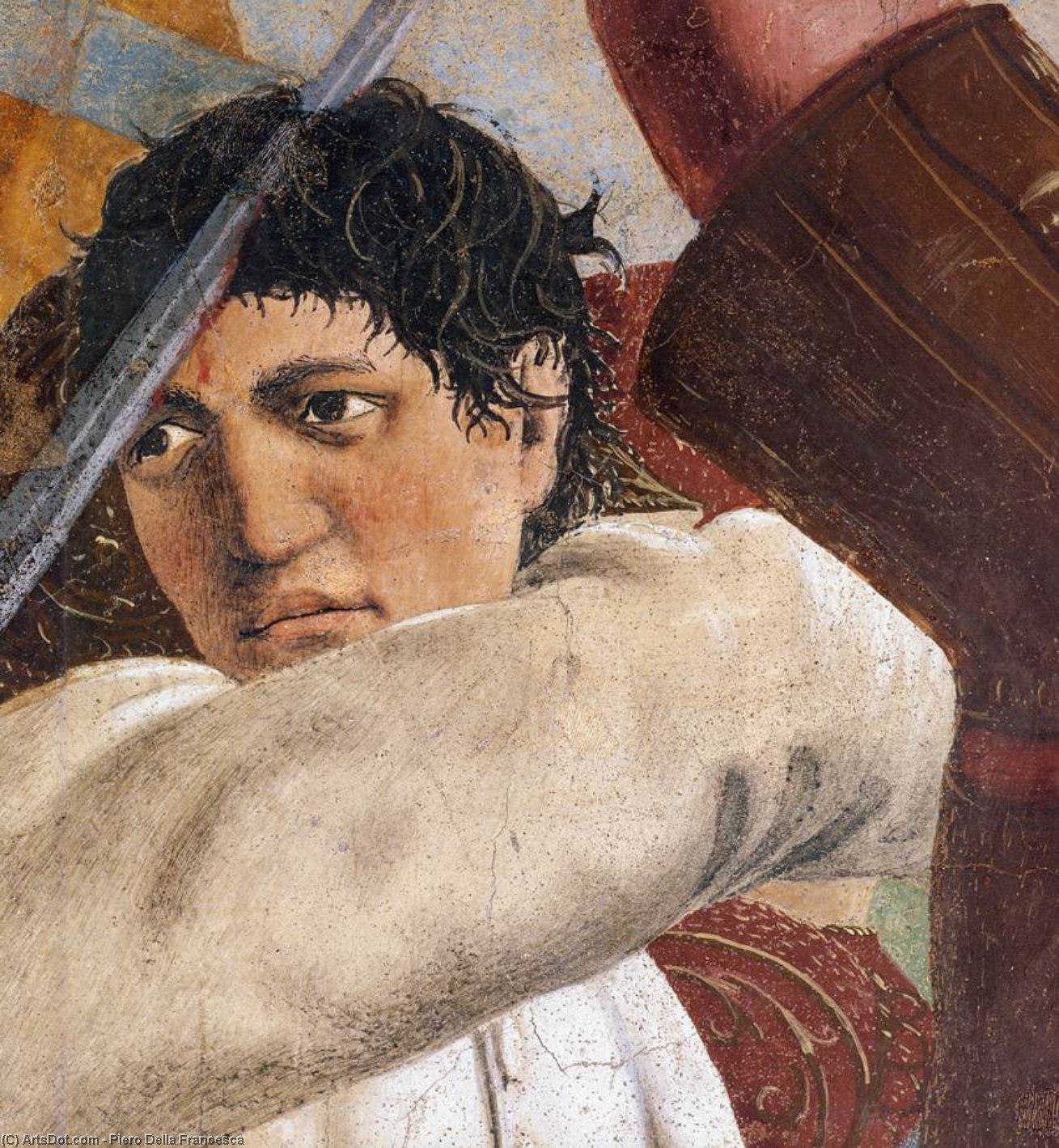
8. Battle between Heraclius and Chosroes (detail)
Piero della Francesca’s frescoes in the Basilica of San Francesco in Arezzo stand as monuments to Renaissance artistic achievement—a testament to perspective, composition, and storytelling that continues zu captivate audiences centuries later. Among these masterpieces shines ‘8. Battle between Heraclius and Chosroes (detail)’—a poignant fragment from *The Legend of the True Cross*, capturing a pivotal moment in Christian history: the confrontation between Emperor Heraclius and King Chosroes, marking the decisive victory over Persia’s dominion over Jerusalem.
The Historical Context
This fresco isn't merely an aesthetic exercise; it’s deeply rooted in the religious fervor of its time. The narrative recounts the arduous pilgrimage of the Holy Cross from Eden to Jerusalem—a journey fraught with peril and divine intervention. The battle itself symbolizes the clash between pagan idolatry and Christian faith, encapsulating the anxieties surrounding the preservation of sacred relics during the turbulent 7th century CE. Piero’s meticulous attention to detail reflects the humanist preoccupation with accurately portraying historical events and conveying their significance. Understanding this backdrop—the political tensions between Byzantium and Persia, the fervent devotion to religious symbols—enhances our appreciation for the artwork’s profound message.
Artistic Techniques and Composition
Piero Della Francesca's mastery lies in his groundbreaking use of linear perspective—a technique that revolutionized painting by creating an illusion of depth and space within a flat surface. The arrangement of figures—those dominating the foreground appearing larger than those receding into the distance—is characteristic of Early Renaissance principles designed to convey spatial relationships with unparalleled realism. Furthermore, Della Francesca’s restrained color palette, punctuated by vibrant hues like crimson and gold, lends gravitas to the scene and underscores its solemn importance. The artist skillfully employs geometric forms—particularly squares and rectangles—to structure the composition, mirroring classical ideals of harmony and order. This masterful manipulation of perspective isn’t just visually impressive; it serves as a deliberate tool for conveying theological ideas about God's omnipresence and the sacredness of Jerusalem.
Historical Accuracy and Emotional Capture
Della Francesca’s dedication to historical accuracy is evident in his depiction of armor, clothing, and facial expressions—reflecting meticulous research into contemporary sources. Yet, beyond mere representation, he succeeds in conveying profound emotion: the palpable tension between warriors locked in combat, the solemn dignity of Heraclius’s posture, and the poignant vulnerability of the fallen soldier beneath the rearing horse. These elements resonate with universal themes of courage, faith, and mortality—transforming a historical narrative into an enduring meditation on human experience. The artist’s ability to capture these psychological nuances distinguishes him from many of his contemporaries and elevates ‘8. Battle between Heraclius and Chosroes (detail)’ beyond a simple depiction of warfare.
Relevance and Legacy
‘8. Battle between Heraclius and Chosroes (detail)’ transcends its immediate context as a depiction of a military confrontation; it embodies the Renaissance’s fascination with classical ideals and its commitment to portraying human figures with anatomical precision. Its influence can be seen in subsequent artistic endeavors, inspiring artists to explore similar compositional strategies and psychological depth. For those seeking to immerse themselves in the grandeur of Renaissance art or desiring a stunning reproduction of this iconic fresco, visit
https://ArtsDot.com for exceptional hand-painted oil painting reproductions—bringing Piero Della Francesca’s vision to life with breathtaking fidelity. Additionally, delve into the captivating tale of *The Legend of the True Cross* at
The Legend of the True Cross on Wikipedia.
Experience the beauty and significance of these artworks through high-quality reproductions available at
https://ArtsDot.com.
Photo Description: The image is a painting of a man holding two swords in his hands. The man appears to be wearing a white shirt and has short hair. He seems to be looking at the viewer with an intense expression on his face. In addition to the main subject, there are several other elements present in the image. There is another person visible towards the left side of the painting, although only a small portion of their body can be seen. Above the man holding the swords, there is a shield that appears to be part of his armor. The overall scene gives off an impression of a battle or intense confrontation between two individuals.
Size: Unknown
Date: 1452
ARTIST INFORMATION:
==================
Artist: Piero della Francesca
Birth Year: 1415
Death Year: 1492
Birth City: San Sepolcro
Birth Country: Italy
Biography:
A Tuscan Visionary: The Life and Art of Piero della Francesca
Born around 1415 in the quiet Umbrian town of Sansepolcro, Piero di Benedetto de’ Franceschi – known to history as Piero della Francesca – emerged from a relatively obscure background to become one of the most intellectually rigorous and profoundly influential painters of the Early Renaissance. Unlike many of his contemporaries whose lives are richly documented, Piero remains somewhat enigmatic; details about his family and early training are scarce. What *is* certain is that he possessed an extraordinary mind, equally captivated by the emerging artistic currents of Florence and the precise languages of mathematics and geometry. His father was a shoemaker and tanner, providing Piero with a stable if unostentatious upbringing, and it’s believed his initial artistic education occurred locally, absorbing the traditions of central Italian painting before the seismic shifts initiated by Masaccio and Brunelleschi. This