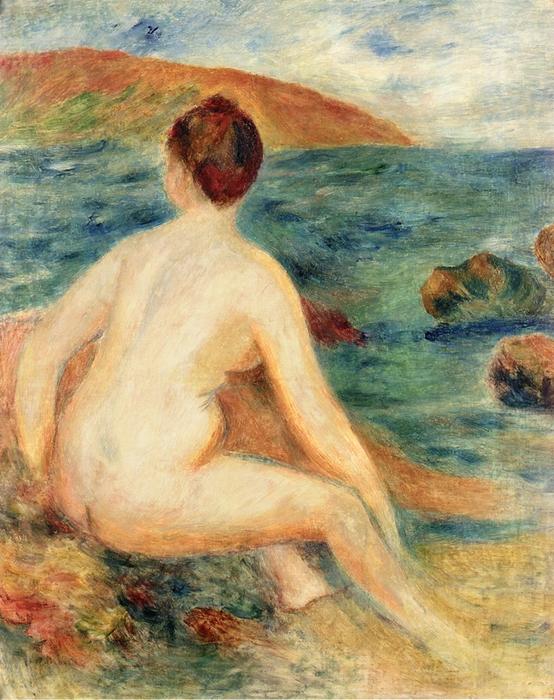
Pierre-Auguste Renoir’s „Nude Bather Seated by the Sea“ (1882) embodies Impressionist serenity! Explore light, color & classical influences in this iconic masterpiece – reproduced beautifully at ArtsDot.com.
Erkunden Sie die lebendige Welt von Pierre-Auguste Renoir (1841–1919), einem führenden Impressionistenmaler, der für seine leuchtenden Porträts, Szenen des Pariser Lebens und weibliche Schönheit bekannt ist. Entdecken Sie sein Erbe und die künstlerischen Beiträge seiner Familie.
Nude Bather Seated by the Sea
Pierre Auguste Renoir’s “Nude Bather Seated by the Sea,” completed in 1882, stands as an emblem of Impressionist artistry—a testament to light, color, and a profound appreciation for the human form intertwined with the serenity of nature. This oil on canvas masterpiece resides within the Sterling and Francine Clark Art Institute in Williamstown, Massachusetts, captivating viewers with its timeless beauty and masterful execution.
The Composition: An Idyllic Encounter
Renoir skillfully orchestrates a scene bathed in dappled sunlight—a woman gracefully positioned by the shore, her back turned towards the observer. Scattered rocks punctuate the landscape, adding textural depth to the composition and subtly directing the eye’s gaze. The artist deliberately avoids dramatic contrasts, favoring instead an atmosphere of tranquil contemplation that invites introspection. This deliberate choice reflects Renoir's fascination with capturing fleeting moments of beauty—a core principle of Impressionism itself.
Artistic Techniques: Light as Divine Inspiration
Renoir’s technique is characterized by loose brushstrokes—a hallmark of Impressionist painting—that prioritize the depiction of light and color over precise detail. The artist meticulously renders the woman's skin tones with delicate hues, capturing the luminescence of sunlight filtering through foliage. Furthermore, Renoir employs sfumato—a blurring technique—to soften contours and create an ethereal quality, enhancing the overall sense of atmosphere. This masterful manipulation of pigment demonstrates Renoir’s unwavering commitment to conveying emotion and sensation rather than merely representing reality.
Historical Context: Proto-Cubism's Influence
“Nude Bather Seated by the Sea” emerges from a pivotal moment in art history—the Proto-Cubist phase, which began around 1906. Artists like Cézanne and Braque were experimenting with geometric forms and fracturing perspectives, paving the way for radical artistic innovations. Renoir’s work anticipates these developments, subtly hinting at the stylistic shifts that would soon reshape European painting. However, unlike his contemporaries who embraced abstraction, Renoir remained firmly rooted in Impressionism—preserving its sensual richness and luminous palette.
Symbolism: Serenity and Feminine Beauty
The painting transcends mere visual representation; it embodies profound symbolic meanings. The woman’s posture conveys grace and repose—a celebration of feminine beauty and tranquility. Simultaneously, the sea symbolizes purity and renewal—reflecting Renoir's belief in the transformative power of nature. These elements coalesce to create an image that resonates with spiritual contemplation—capturing the essence of Impressionist ideals.
Emotional Impact: A Moment Frozen in Time
“Nude Bather Seated by the Sea” evokes a palpable sense of peace and nostalgia—transporting viewers back to a bygone era. Renoir’s ability to capture light and emotion is unparalleled, creating an artwork that continues to inspire admiration and fascination. Its enduring appeal lies in its capacity to evoke feelings of serenity and beauty—a timeless masterpiece that embodies the spirit of Impressionism.