Pierre-Auguste Renoir’s “Pierre Henri Renoir”: A Moment of Quiet Reflection
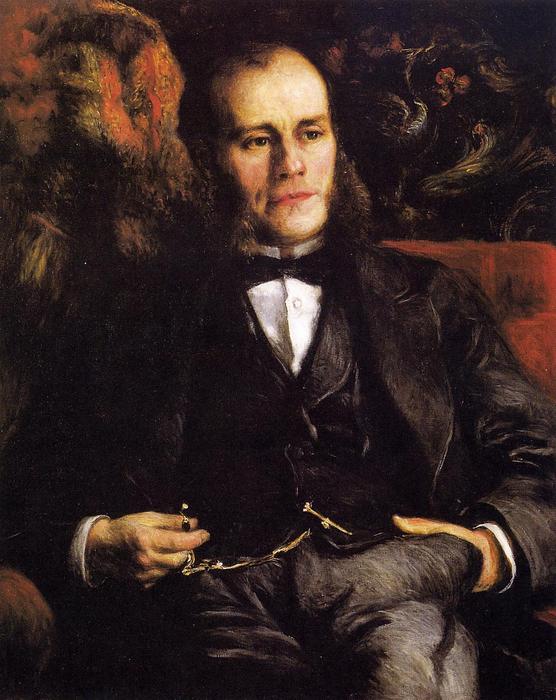
Pierre-Auguste Renoir's "Pierre Henri Renoir," painted in 1870, is more than just a portrait; it’s a carefully constructed tableau of domestic tranquility and understated elegance. This oil-on-canvas work, measuring a modest 81 x 64 cm, offers a glimpse into the private world of a man – likely Pierre Henri Renoir himself, as the painting's subject – seated in contemplative repose within a richly furnished room. The scene unfolds with a remarkable sense of stillness, inviting the viewer to step into this intimate moment and share in the quiet observation of the depicted figure.
Renoir’s masterful technique is immediately apparent. He eschews dramatic lighting or dynamic poses, instead favoring a soft, diffused light that gently illuminates the subject's face and hands. The brushstrokes are loose yet controlled, creating a shimmering surface texture – a hallmark of Impressionism. Notice how Renoir captures the subtle nuances of light reflecting off the upholstery, the velvet cushions, and even the polished wood of the furniture. This meticulous attention to detail isn’t about photographic realism; it's about conveying the *impression* of light and atmosphere, capturing the ephemeral quality of a fleeting moment.
The Composition: A Study in Restraint
The composition itself is remarkably simple yet profoundly effective. The seated man dominates the foreground, his posture suggesting both relaxation and a certain reserve. His clasped hands – a gesture often associated with thoughtfulness or prayer – draw our attention to his face, revealing a subtle expression of serenity. Behind him, a plush couch and another chair establish a sense of comfortable familiarity, while a bird perched on a nearby shelf adds an unexpected element of life and vibrancy to the scene. This seemingly minor detail—the inclusion of the bird—hints at themes of freedom, observation, and perhaps even a connection to nature.
The color palette is restrained yet harmonious. Renoir employs muted tones – browns, creams, and subtle greens – creating a sense of warmth and intimacy. The use of complementary colors, such as the deep reds in the upholstery, adds visual interest without disrupting the overall mood of quiet contemplation. It’s a testament to Renoir's ability to evoke emotion through color alone.
Influences and Artistic Context
“Pierre Henri Renoir” firmly places Renoir within the context of Realism, an artistic movement that sought to depict everyday life with honesty and accuracy. However, it also reveals his engagement with the burgeoning Impressionist style, which prioritized capturing fleeting moments and subjective experiences. Notably, Renoir’s early works often explored themes of couples, as evidenced by “A Couple (Les Fiancés),” now housed at the Wallraf-Richartz Museum in Cologne. This earlier piece showcases Renoir's talent for portraying intimate relationships with a delicate sensitivity.
Furthermore, Renoir was influenced by artists like Paul Cézanne, whose innovative approach to representation—emphasizing underlying structure and geometric forms—significantly impacted the development of modern art. Cézanne’s influence is subtly present in “Pierre Henri Renoir,” particularly in the careful arrangement of objects within the composition and the attention to spatial relationships.
A Legacy of Quiet Beauty
“Pierre Henri Renoir” stands as a poignant example of Renoir's ability to capture not just likeness, but also mood and emotion. It’s a painting that invites us to pause, reflect, and appreciate the beauty of ordinary moments. The work resonates with a sense of timelessness, offering a glimpse into a world of quiet contemplation—a world that continues to captivate viewers today. The painting's enduring appeal lies in its ability to evoke a feeling of serenity and intimacy, reminding us of the simple pleasures of life.
For those seeking to delve deeper into Renoir’s artistic journey or explore other influential figures in art history, resources such as Wikipedia (Pierre-Auguste Renoir) and the Museu Nacional D'arte de Catalunya (Pierre Henri Renoir) offer invaluable insights.