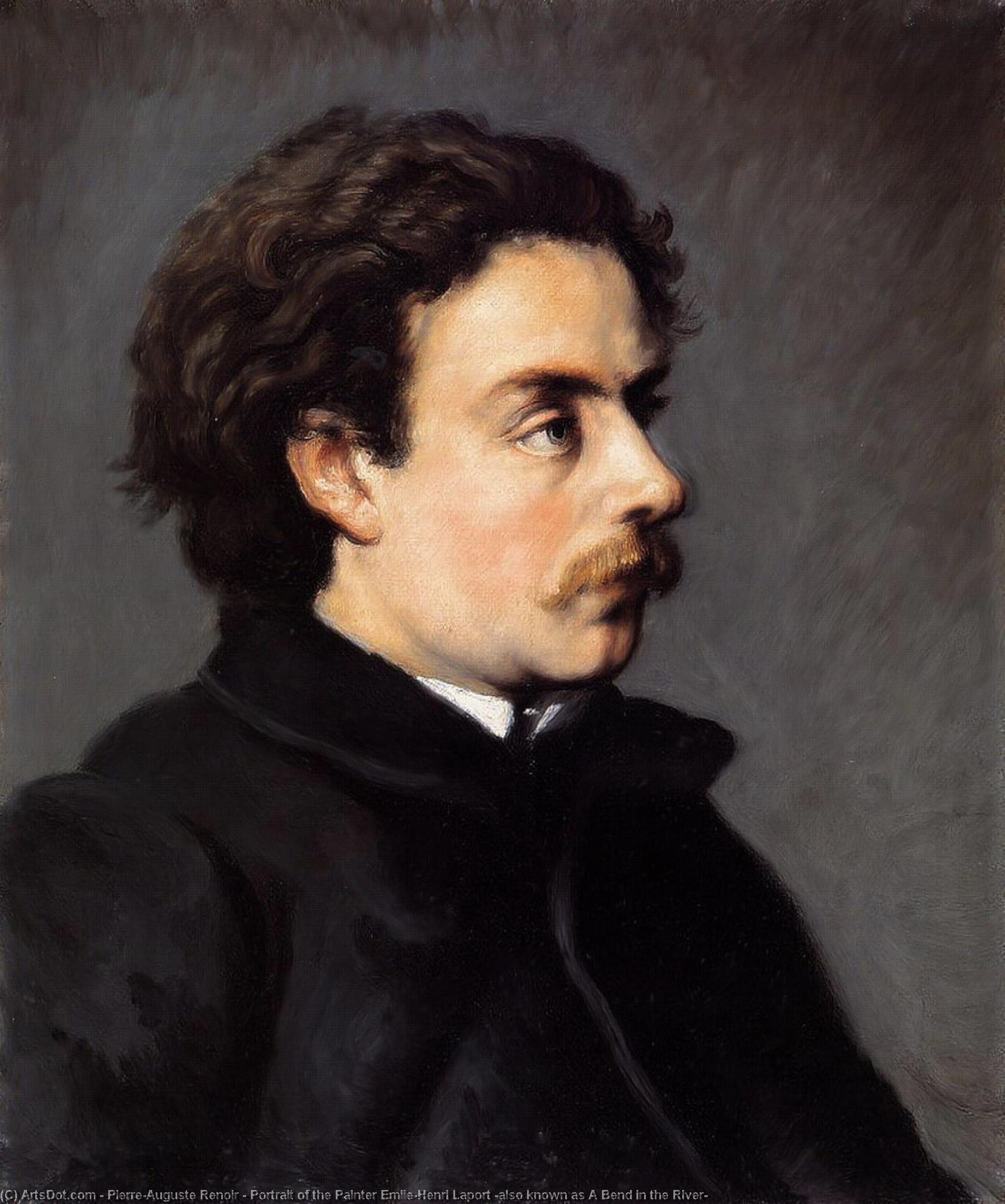
Portrait of Emile-Henri Laport: A Window Into Impressionistic Sensibility
The
Portrait of Emile-Henri Laport, also known as
A Bend in the River, stands as a testament to Pierre-Auguste Renoir’s mastery of capturing fleeting moments and conveying profound emotion—characteristics quintessential to Impressionism. Painted around 1879 or 1880, this oil on canvas masterpiece isn't merely a depiction of his fellow artist; it’s an exploration of light, atmosphere, and the subtle nuances of human expression.
Renoir, deeply influenced by artists like Rubens and Watteau, sought to portray beauty not as static grandeur but as experienced in everyday life. He recognized the transformative power of Impressionism—a movement that rejected academic conventions in favor of capturing the immediacy of sensory perception. This approach is vividly realized in “Portrait of Emile-Henri Laport,” where Renoir skillfully blends warm hues with cooler shades, creating a harmonious interplay that draws the viewer into the scene.
The Artist: Pierre-Auguste Renoir – A Pioneer of Light
Pierre-Auguste Renoir was undeniably a pivotal figure in the Impressionist movement. Born in Limoges in 1841, he embarked on his artistic journey by adorning porcelain with delicate floral motifs—a practice that honed his observational skills and instilled in him an appreciation for meticulous detail. However, it was his encounter with Claude Monet and Frédéric Bazille at École des Beaux Arts that cemented his commitment to Impressionistic ideals.
Renoir’s canvases pulsate with vibrant colors—a deliberate departure from the muted palettes favored by earlier artists. His brushstrokes are loose and expressive, conveying movement and texture without striving for photographic realism. This technique wasn't merely stylistic; it reflected Renoir’s belief that art should strive to capture the essence of experience, rather than simply reproducing its appearance.
A Study in Light and Gesture
The portrait itself is remarkable for its understated elegance. Emile-Henri Laport—a respected painter in his own right—appears seated calmly before a gray wall, bathed in diffused light. Renoir’s attention to detail extends beyond mere representation; he captures the subtle contours of Laport's face and torso, conveying a sense of quiet dignity. The artist’s gaze is direct yet contemplative, inviting the viewer into an intimate dialogue.
Considered one of Renoir’s finest works, “Portrait of Emile-Henri Laport” exemplifies the Impressionist preoccupation with capturing fleeting moments of beauty and emotion. It's a painting that speaks volumes about Renoir’s artistic vision—a vision rooted in observation, sensitivity, and an unwavering belief in the transformative power of art.
The Musée des Collettes: Preserving Renoir’s Legacy
The Musée des Collettes, nestled in Cagnes-sur-Mer, France—once Renoir’s home—houses fifteen of his paintings that meticulously trace the evolution of his artistic themes. Visiting this museum offers a unique opportunity to immerse oneself in the world of Impressionism and appreciate the enduring beauty of Renoir's oeuvre.
Explore our collection of Impressionist artworks, including other masterpieces by Pierre-Auguste Renoir. Discover more about the life and work of Renoir on ArtsDot.com.
Learn about the Musée des Collettes and its Impressionist art collection on ArtsDot.com.
At
Wahoo Art, we offer high-quality reproductions of famous artworks, including Renoir's
Portrait of Emile-Henri Laport. Our skilled artists meticulously recreate each brushstroke and color to bring you a stunning replica that captures the essence of the original masterpiece.