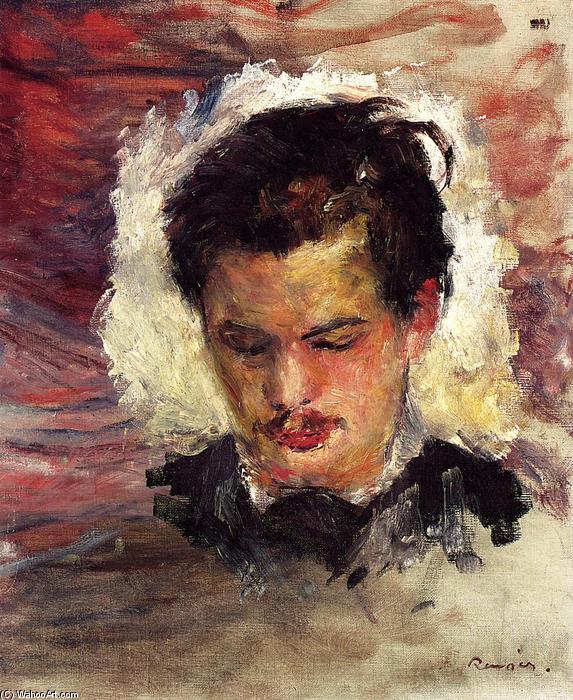
Ein Meisterwerk des Impressionismus: Pierre-Auguste Renoirs „Porträt von Georges Rivière“
Pierre-Auguste Renoir’s “Portrait of Georges Rivière,” painted in 1880, stands as a cornerstone of Impressionist art—a testament to the movement's fascination with capturing fleeting moments and conveying emotion through luminous color. More than just a likeness, it embodies Renoir’s groundbreaking approach to portraiture, reflecting his profound understanding of human psychology and establishing him as one of the era’s foremost artists.
### Der Modell: Georges Rivière
Georges Rivière was no mere subject; he was a cherished companion and confidant of Renoir—a figure who frequently graced the artist's studio as a model. Their friendship fostered an invaluable creative dialogue, particularly crucial during Renoir’s formative years when Rivière actively championed his work, securing commissions amidst challenging artistic circumstances. Rivière’s presence wasn’t merely practical; he represented Renoir’s circle of intellectual peers—individuals who shared a passion for exploring the complexities of human experience.
### Künstlerischer Stil und Technik: Die Sprache des Lichts
Renoir's Impressionist style is immediately discernible in the painting’s loose brushwork and masterful manipulation of light and color. Unlike academic traditions prioritizing meticulous detail, Renoir prioritized capturing the atmosphere—the subtle nuances of illumination that transform a scene into an emotional experience. The vibrant contrast between Rivière’s complexion and the richly toned background generates a palpable sense of movement, mirroring the dynamism inherent in Impressionism itself. Renoir's fluid brushstrokes convey not merely visual information but also an introspective gaze, emphasizing the artist’s ability to express profound feelings through his art. This technique—characterized by visible strokes and blended hues—was revolutionary for its time, rejecting illusionistic representation in favor of subjective perception.
### Historischer Kontext und Bedeutung
“Portrait of Georges Rivière” emerged during a pivotal period in French artistic history—the zenith of Impressionism’s influence. The painting reflects the broader cultural currents of the late 1870s and early 1880s, when artists like Renoir were actively reshaping perceptions of beauty and challenging established conventions. It aligns with Renoir's broader oeuvre, demonstrating his unwavering commitment to portraying human emotion authentically—a pursuit that cemented Impressionism’s legacy as a movement devoted to capturing the essence of life itself. The painting’s inclusion in prestigious exhibitions—the Galerie Bernheim-Jeune in Paris and the Galerie des Beaux-Arts—underscored its significance within the artistic landscape of the era, securing Renoir's place among the most celebrated painters of his generation.
### Provenienz und Ausstellung
The artwork has traversed several notable collections throughout history, culminating in its acquisition by a discerning collector in 1993. Its journey through exhibitions—including appearances at the Galerie Bernheim-Jeune and the Galerie des Beaux-Arts—further solidified its reputation as an exemplar of Impressionist art. These showings ensured that “Portrait of Georges Rivière” would continue to inspire admiration and scholarly discussion for decades to come, cementing Renoir’s enduring influence on subsequent artistic styles.
### Schlussfolgerung: Ein Blick auf die Seele
“Portrait of Georges Rivière” transcends mere visual representation; it embodies the very spirit of Impressionist portraiture—a genre that prioritized capturing inner emotion over precise likeness. Its enduring appeal lies not only in Renoir's technical brilliance but also in the painting’s profound connection to its historical context and the artist’s personal relationship with his subject. For those seeking a glimpse into the soul of Impressionism, this masterpiece remains an unforgettable testament to Pierre-Auguste Renoir’s genius—a captivating exploration of light, color, and human feeling.
Für weitere Informationen über Pierre Auguste Renoir und andere impressionistische Künstler besuchen Sie ArtsDot.