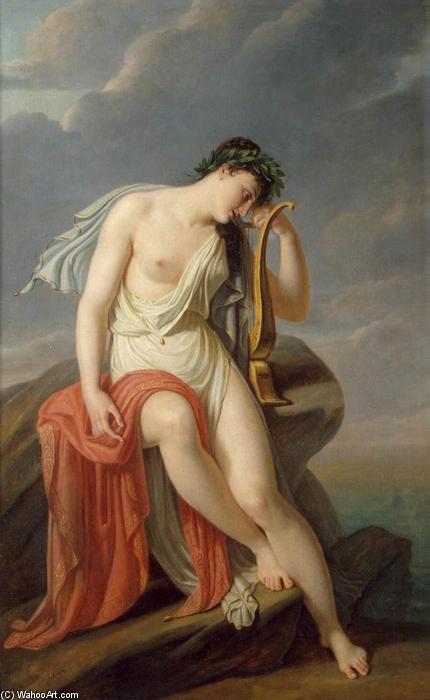
A Poetic Descent: The Melancholy of Sappho
In the quiet, heavy moments before a tragedy unfolds, there exists a profound stillness that captures the heart. This is the essence of Pierre Narcisse Guérin’s masterpiece, Sappho on the Leucadian Cliff. Created in 1800, this monumental oil on canvas invites the viewer into a world where classical myth meets raw, human vulnerability. The painting depicts the legendary Greek poetess, Sappho, perched precariously upon the rugged rocks of the Leucadian cliffside. As she gazes out toward the vast, churning Aegean Sea, her posture—head resting pensively on one hand while the other cradles a lyre—speaks of a soul suspended between the beauty of her art and the crushing weight of despair. It is not merely a depiction of a mythological event; it is an intimate portrait of a spirit on the precipeless edge of transformation.
The narrative strength of the work lies in its ability to evoke the legend of Sappho’s tragic leap, a moment born from the sting of rejection by either the god Apollo or a mortal lover. Guérin does not show us the fall; instead, he captures the agonizing prelude. Through his masterful use of composition, the artist places the figure centrally, framed by the dramatic, turbulent sky and the jagged stone, creating a sense of isolation that is both haunting and deeply moving. For the collector or the lover of classical tragedy, this piece offers a window into the eternal human struggle with love, loss, and the pursuit of poetic immortality.
Neoclassical Mastery and the Dawn of Romanticism
Technically, Sappho on the Leucadian Cliff serves as a breathtaking bridge between two of history's most significant artistic eras. Guérin, a student of the esteemed Jean-Baptiste Regnault, utilizes the disciplined, refined techniques of Neoclassicism to render the figure with anatomical precision and idealized grace. The drapery of her classical attire flows with a sculptural quality, reminiscent of ancient Greek statuary, while the play of light across her skin provides a luminous, lifelike texture that commands attention. Every brushstroke is calculated to maintain a sense of formal harmony and balance, characteristic of the era's reverence for order and clarity.
Yet, beneath this polished surface, one can feel the burgeoning pulse of Romanticism. The atmospheric depth of the background—the swirling, heavy clouds and the restless sea below—introduces an element of the sublime, a hallmark of the Romantic movement that Guérin helped pioneer alongside his famous pupils, Eugène Delacroix and Théodore Géricault. This tension between classical restraint and emotional turbulence gives the painting its enduring power. For interior designers seeking to add a sense of intellectual depth and dramatic flair to a space, this work provides a sophisticated focal point that balances serene elegance with profound narrative intensity.
An Eternal Legacy for the Discerning Collector
To possess a reproduction of such a significant work is to bring a piece of the Hermitage Museum into one's own sanctuary. Guérin’s ability to weave together historical accuracy, mythological weight, and technical brilliance makes this painting more than just an ornament; it is a conversation piece that invites contemplation. The subtle color palette, dominated by earthy tones and the cool blues of the sea, allows the work to integrate seamlessly into diverse decor styles, from traditional manor aesthetics to modern, minimalist galleries.
Whether you are drawn to the historical significance of the Neoclassical period or the evocative, lyrical beauty of Sappho’s story, this painting offers an unparalleled emotional resonance. It stands as a testament to a time when art sought to capture the very essence of the human condition—the heights of poetic inspiration and the depths of mortal sorrow. Investing in such a high-quality reproduction ensures that the timeless elegance and the haunting beauty of Guérin’s vision continue to inspire generations to come.