A Symphony of Geometric Harmony
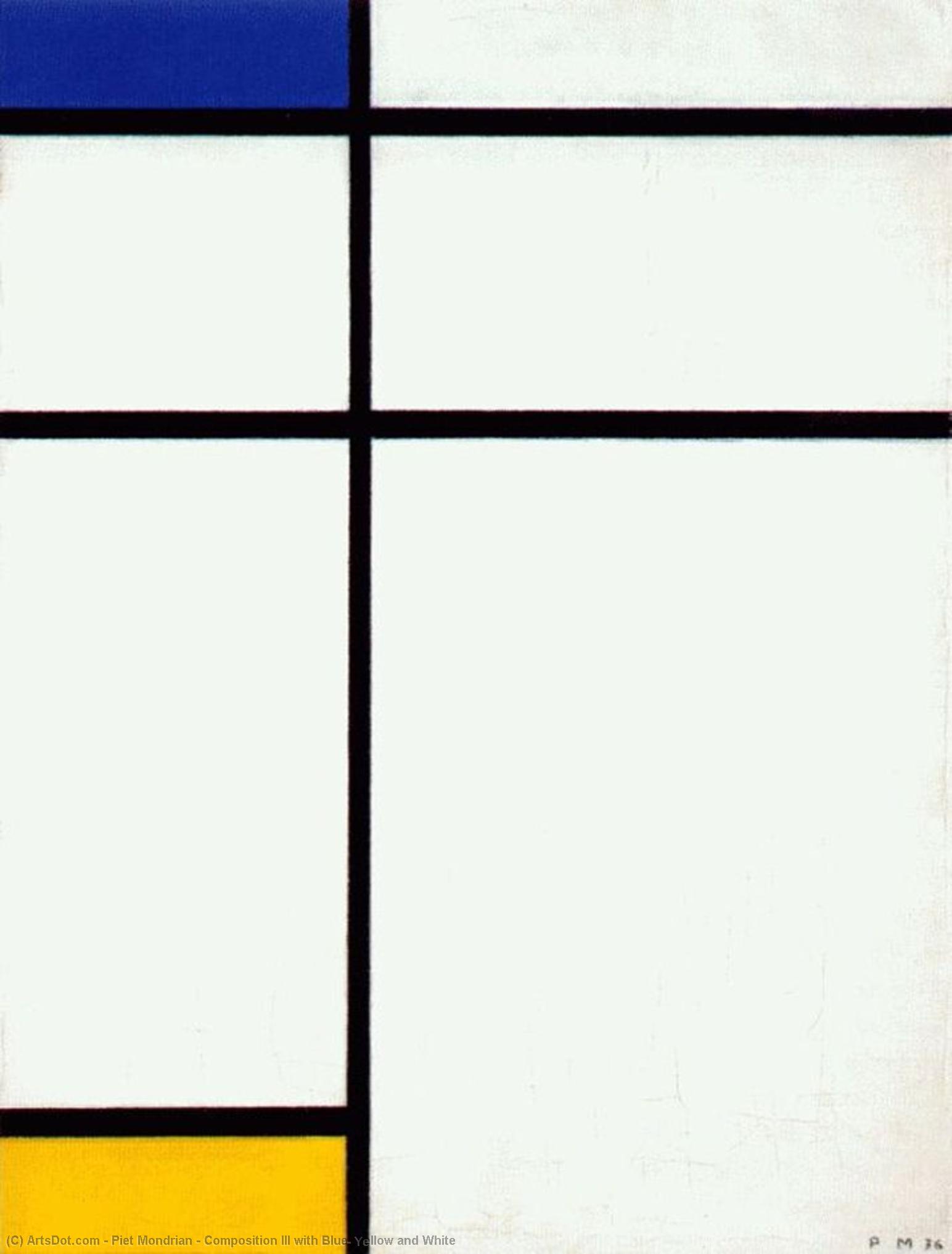
In the vast landscape of twentieth-century abstraction, few works command the same quiet authority as Piet Mondrian’s Composition III with Blue, Yellow and White. Created in 1936, this masterpiece serves as a profound testament to the power of reduction. At first glance, the viewer is met with a rigorous, almost mathematical precision—a grid of black lines that partitions the canvas into a rhythmic dance of rectangles. Yet, beneath this structured surface lies a deeply emotive experience. The interplay between the cool, expansive blues and the sudden, energetic punctuations of yellow creates a visual pulse, a heartbeat of color that breathes life into the geometric stillness. It is not merely a painting of shapes; it is an exploration of equilibrium, where every line and hue exists in a state of perfect, tension-filled balance.
To understand the soul of this work, one must look toward the De Stijl movement and the philosophy of Neoplasticism. Mondrian, once a painter of lush Dutch landscapes, underwent a radical spiritual and artistic transformation. He sought to strip away the "accidental" details of the physical world to reveal the universal truths beneath. In this composition, there is no horizon line, no shadow, and no representational subject to distract the eye. Instead, Mondrican utilizes the most fundamental elements of visual language: the vertical and the horizontal, the primary colors, and the stark contrast of white. This deliberate simplification was intended to evoke a sense of cosmic order, offering a sanctuary of clarity in an increasingly chaotic modern era.
The Art of Precision and Visual Rhythm
The technique employed in this oil on canvas is a masterclass in controlled execution. While the final appearance suggests a flat, unmodulated surface, the meticulous placement of each color plane requires an incredible level of foresight. The artist carefully orchestrated the distribution of blue, yellow, and white to ensure that no single area overwhelms another. The way the white spaces act as a breath between the more saturated tones prevents the composition from feeling heavy, instead allowing it to feel light and architectural. For the discerning collector or interior designer, this quality of balance makes the piece exceptionally versatile; it possesses a structural integrity that can anchor a minimalist modern room or provide a sophisticated focal point in a contemporary gallery setting.
Beyond its aesthetic merits, Composition III offers an emotional resonance that transcends time. There is a profound sense of peace to be found in its symmetry, yet the subtle variations in the size and position of the colored squares prevent it from ever feeling static. It invites the viewer into a meditative state, encouraging a slow reading of its parts. As light interacts with the perceived depth of these overlapping planes, the painting reveals new nuances, making it a living piece of art. Owning a high-quality reproduction of such a seminal work is more than an act of decoration; it is an invitation to surround oneself with the enduring pursuit of harmony, logic, and pure, unadulterated beauty.