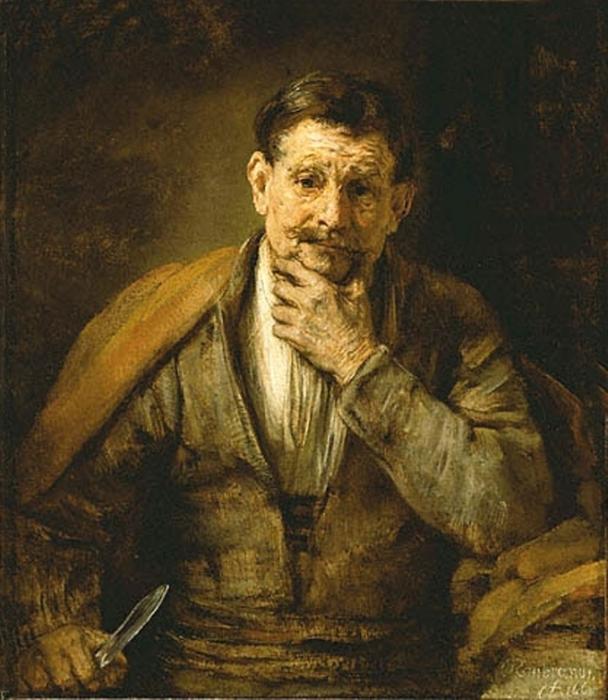
Entdecken Sie Rembrandts 'Der Apostel Bartholomäus'! Meisterhafter Chiaroscuro, filigrane Details und symbolische Tiefe in diesem ikonischen Porträt des 17. Jahrhunderts. Erfahren Sie mehr über seine Geschichte im Timken Museum.
Erkunden Sie Rembrandt van Rijn (1606-1669), den niederländischen Barockmeister des Lichts und der Schatten! Entdecken Sie ikonische Selbstporträts, biblische Szenen und bahnbrechende Radierungen. Erleben Sie die goldene Ära der Niederlande.
A Masterful Study in Faith and Introspection: Rembrandt’s The Apostle Bartholomew
Rembrandt Harmenszoon van Rijn's 1657 oil painting, *The Apostle Bartholomew*, currently residing at the Timken Museum of Art in San Diego, is a profoundly moving work that exemplifies the artist’s unparalleled skill in capturing human emotion and spiritual depth. This isn’t merely a portrait; it’s an intimate encounter with a figure central to Christian faith, rendered with breathtaking realism and psychological insight. The painting immediately draws the viewer into a contemplative space—a deliberate choice by Rembrandt reflecting his artistic trajectory during this pivotal period of his life.
Artistic Style & Technique: The Power of Chiaroscuro
Rembrandt, a leading figure of the Dutch Golden Age, was renowned for his mastery of *chiaroscuro* – the dramatic interplay of light and shadow. In *The Apostle Bartholomew*, this technique is deployed to stunning effect. A soft, diffused light illuminates Bartholomew’s face and hands, drawing our attention to his weathered features and thoughtful expression. The surrounding darkness doesn't feel empty but rather serves to heighten the sense of intimacy and contemplation. Rembrandt’s brushwork is equally remarkable; visible strokes build texture and form, particularly in the folds of Bartholomew’s simple robe and the subtle lines etched on his forehead – evidence of a life lived with conviction. He achieved this extraordinary effect by applying paint thickly onto the canvas—a technique known as *impasto*—creating palpable surface irregularities that capture the very essence of materiality. The artist's use of color is restrained yet impactful, relying heavily on earth tones to create a sense of grounded realism. This palette contributes to the painting’s solemn mood and underscores its focus on inner reflection.
Historical Context & Rembrandt’s Late Period
Created towards the end of Rembrandt’s career, *The Apostle Bartholomew* reflects a shift in his artistic focus. Having experienced both great success and personal tragedy – including financial difficulties and the loss of loved ones – Rembrandt increasingly turned to introspective portraits and biblical scenes. This period saw him prioritizing emotional truth over superficial detail, resulting in works of profound psychological complexity. He was moving away from large-scale commissions towards more intimate studies of character, often focusing on figures like apostles and prophets. The painting’s genesis coincides with a time of considerable upheaval in Rembrandt's life—a period marked by mounting debts and the disintegration of his marriage to Saskia van Uylenburgh. Yet amidst these challenges, Rembrandt persevered in his artistic endeavors, producing masterpieces that continue to resonate with audiences centuries later. His unwavering dedication to portraying human emotion is palpable throughout *The Apostle Bartholomew*, cementing his legacy as one of history’s greatest painters.
Symbolism & Meaning: Beyond the Surface
The painting presents Bartholomew as a man deeply immersed in thought. He holds a book, symbolizing his role as a disciple and teacher spreading the word of God. However, it’s the presence of two knives that sparks intriguing debate among art historians. While some interpret them as alluding to Bartholomew's traditional martyrdom – flayed alive – others suggest they represent tools for intellectual or artistic pursuit, hinting at the apostle’s role in interpreting scripture and conveying its message. Rembrandt skillfully captures this duality—the contemplation of faith juxtaposed with the awareness of mortality—creating a portrait that transcends mere representation. The artist’s gaze is directed upwards, suggesting an aspiration toward spiritual enlightenment. This subtle gesture speaks volumes about Rembrandt's artistic vision and his desire to explore the complexities of human experience.
Emotional Impact & Lasting Legacy
*The Apostle Bartholomew* is not a painting that shouts for attention; it whispers. Its power lies in its quiet intensity, inviting viewers to connect with the subject on a deeply personal level. The melancholic yet dignified expression on Bartholomew’s face evokes feelings of empathy and reverence. It's a work that encourages introspection, prompting us to consider our own beliefs and values. Rembrandt’s masterful use of *chiaroscuro*, combined with his meticulous attention to detail—particularly in the rendering of skin texture and facial features—creates an unforgettable visual experience. *The Apostle Bartholomew* stands as a testament to Rembrandt’s genius – his ability to transform religious iconography into profoundly human portraits that continue to inspire awe and contemplation. Its enduring appeal lies in its capacity to communicate universal themes of faith, humility, and the pursuit of wisdom.