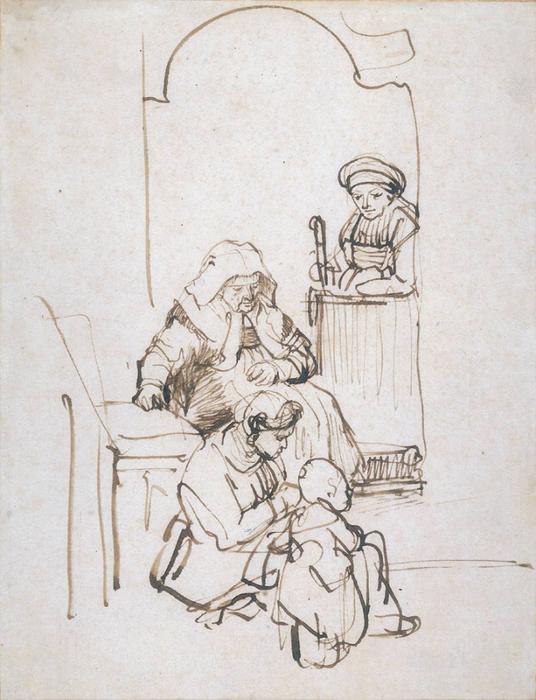
Rembrandt’s Intimate Tableau: “Three Women and a Child at the Door” – A Window into Dutch Domesticity
Rembrandt van Rijn's "Three Women and a Child at the Door" is not merely a depiction of a domestic scene; it’s a profound meditation on human connection, quiet contemplation, and the subtle dramas that unfold within the walls of a home. Painted during a pivotal period in his career – roughly between 1640 and 1650 – this work offers a rare glimpse into the lives of ordinary people, rendered with Rembrandt's signature mastery of light and shadow, a technique he would later elevate to an unparalleled level of expressive power. The painting’s enduring appeal lies not in grand historical narratives or heroic figures, but in its intimate portrayal of everyday life, capturing a fleeting moment of shared experience within a seemingly unremarkable setting.
The Master's Technique: Light and Shadow – A Dance of Emotion
Rembrandt’s genius resided fundamentally in his manipulation of *licht en schaduw* (light and shadow), a technique he called “chiaroscuro.” In "Three Women and a Child," this is not simply an aesthetic choice; it's the very language through which Rembrandt conveys emotion. Notice how the light, originating from an unseen source – perhaps a window or doorway – dramatically illuminates the faces of the women, drawing our attention to their expressions and gestures. The shadows, conversely, envelop portions of the scene, creating a sense of mystery and depth. The use of impasto—thickly applied paint—further enhances this effect, adding texture and physicality to the figures and background. This deliberate layering of light and dark isn’t just about visual representation; it's about imbuing the painting with a palpable atmosphere – a feeling of warmth, intimacy, and perhaps even melancholy.
Symbolism Within the Domestic Sphere: A Tapestry of Meaning
Beyond its technical brilliance, the painting is rich in symbolic detail. The three women, likely representing aspects of female companionship and domesticity, are engaged in a quiet conversation. One woman holds a book, suggesting intellectual pursuits or perhaps a shared discussion – a subtle nod to the importance of education and knowledge within the household. The gesture of one woman pointing towards something outside the frame hints at a world beyond their immediate surroundings, a longing for experience or perhaps a reflection on the past. The child, seated attentively, embodies innocence and vulnerability, absorbing the wisdom and stories being shared around him. The presence of the bench suggests a space for rest, contemplation, and connection – a sanctuary within the home.
Historical Context: A Portrait of Dutch Society
To understand “Three Women and a Child,” it’s crucial to consider the historical context in which Rembrandt painted it. The mid-17th century was a period of immense social and economic change in the Netherlands, following its independence from Spain. The rise of the merchant class brought prosperity and a burgeoning middle class, leading to an increased emphasis on domestic life and family values. Rembrandt’s work reflects this shift, moving away from the grand historical commissions that had characterized his earlier career towards more intimate subjects – portraits of ordinary people, scenes of everyday life, and biblical narratives imbued with human emotion. This painting exemplifies his evolving artistic vision, showcasing a deep empathy for the lives of those around him.
Bringing Rembrandt Home: A High-Quality Reproduction
ArtsDot offers meticulously crafted reproductions of “Three Women and a Child at the Door,” ensuring that you can experience the full beauty and emotional resonance of this iconic masterpiece in your own home. Our hand-painted reproductions utilize archival-quality materials and techniques, faithfully recreating Rembrandt’s masterful use of light, shadow, and color. Whether adorning a study, hallway, or living room, this reproduction will serve as a timeless reminder of Rembrandt's profound insights into the human condition – a window into Dutch domesticity and a testament to the enduring power of art.