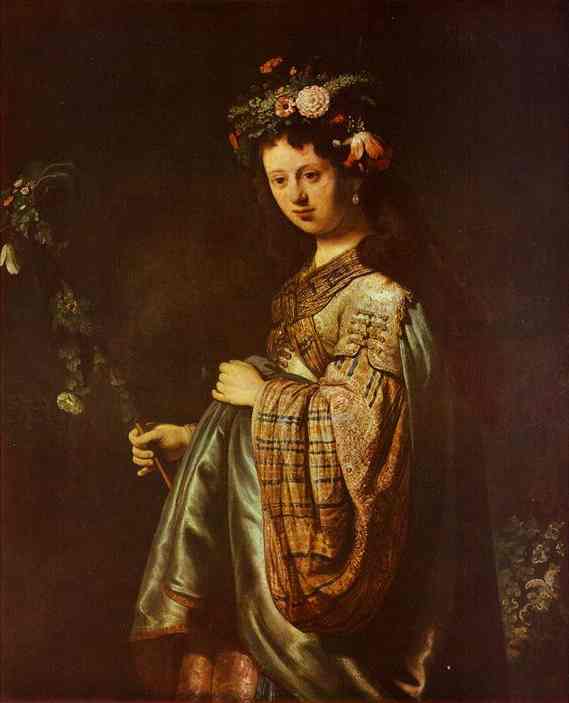
Saskia as Flora – A Portrait Steeped in Symbolism and Light
Rembrandt van Rijn is undeniably one of the titans of Dutch Baroque art, his mastery of chiaroscuro—the dramatic interplay of light and shadow—forever altering the landscape of painting. His masterpiece,
Saskia as Flora, created in 1634, transcends mere representation; it embodies a profound meditation on femininity, fertility, and the ephemeral beauty of springtime. Now housed in the
Hermitage Museum in St. Petersburg, this painting continues to captivate audiences with its exquisite detail and emotional resonance.
The artwork depicts Saskia van Uylenburgh—Rembrandt’s beloved wife—transformed into Flora, the Roman goddess of flowers and springtime. This deliberate choice wasn't simply decorative; it speaks volumes about Rembrandt’s artistic vision and his desire to elevate Saskia beyond the confines of ordinary portraiture.
The Painting's Composition and Technique
Measuring 125 x 101 cm,
Saskia as Flora is executed in oil on canvas—a technique Rembrandt perfected during his formative years in Amsterdam. He employs a masterful use of chiaroscuro to sculpt Saskia’s figure with luminous light and deep shadows, creating an illusionistic depth that draws the viewer into the scene. The artist's meticulous brushwork captures the texture of Flora’s gown, the delicate petals of her floral crown, and the subtle nuances of her expression.
- Color Palette: Rembrandt utilizes a restrained palette dominated by muted reds, blues, and greens—colors associated with passion, tranquility, and renewal.
- Brushwork: Rembrandt’s characteristic impasto technique—thickly applied paint—adds textural richness to the canvas, emphasizing the contours of Saskia's form and conveying a sense of immediacy.
- Light & Shadow: The dramatic chiaroscuro is central to the painting's impact, highlighting Saskia’s face and torso while enveloping her surroundings in darkness—a stylistic hallmark of Rembrandt’s oeuvre.
Historical Context and Symbolism
Painted during the zenith of the Dutch Golden Age—a period characterized by unprecedented artistic innovation and economic prosperity—
Saskia as Flora reflects the prevailing humanist ideals of its time. The selection of Flora as a subject aligns with Renaissance artistic conventions—particularly those championed by Titian—which sought to depict mythological figures in a psychologically realistic manner.
Flora’s Symbolism: Representing springtime and fertility, Flora embodies Saskia's potential motherhood and symbolizes the blossoming of love between Rembrandt and his wife.
Rembrandt’s Artistic Intent: Rembrandt aimed not merely to portray Saskia as she appeared but to elevate her image—to transform her into a symbol of beauty, grace, and spiritual contemplation.
Availability at ArtsDot.com
At
ArtsDot.com, we offer exceptional hand-painted reproductions of
Saskia as Flora and other masterpieces by Rembrandt Van Rijn. Our skilled artists utilize traditional techniques to recreate the painting's luminous beauty with unparalleled accuracy. Visit our website today to explore our extensive collection and discover the transformative power of owning a genuine artwork.
- Explore Rembrandt Van Rijn’s other iconic works at ArtsDot.com
- Delve into the Dutch Golden Age and its artistic legacy at ArtsDot.com
- Learn more about the Hermitage Museum’s impressive collection and its role in preserving artistic heritage at Wikipedia
Experience Rembrandt's Genius – Order Your Reproduction Now! Immerse yourself in the splendor of Baroque art with ArtsDot.com’s meticulously crafted reproductions—a testament to artistic excellence and timeless beauty.