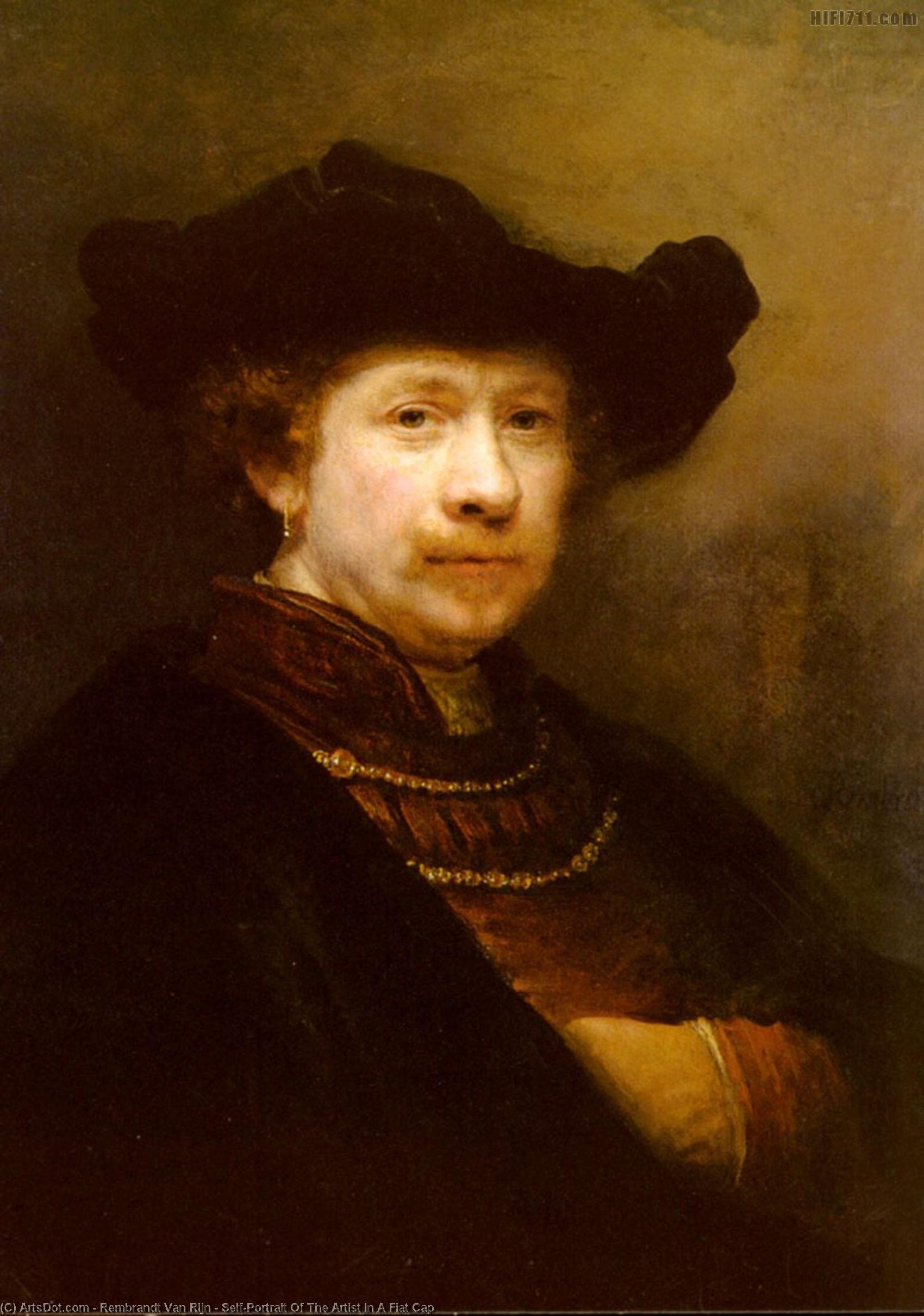
Rembrandt’s Introspective Gaze: A Deep Dive into “Self-Portrait in a Flat Cap”
Rembrandt van Rijn, one of the most profoundly influential figures in Western art history, possessed an uncanny ability to distill the very essence of human experience onto canvas. His self-portraits are not merely depictions of his own likeness; they’re windows into his soul—a meticulously crafted exploration of identity, emotion, and the fleeting nature of time. Among these remarkable works, “Self-Portrait in a Flat Cap” (circa 1642), currently residing within the hallowed halls of the Mauritshuis in The Hague, stands as a particularly poignant example of his genius. This painting transcends the simple act of self-representation, offering a glimpse into the artist’s inner world and showcasing his mastery of light, shadow, and psychological depth.
The scene itself is deceptively straightforward: Rembrandt, clad in a dark, unassuming flat cap – a detail that immediately draws the eye and lends an air of quiet dignity – confronts the viewer with an intense, unwavering gaze. His face, etched with the subtle lines of age and experience, is illuminated by a dramatic light source originating from above, casting deep, theatrical shadows across his features. This masterful manipulation of chiaroscuro—the interplay between light and dark—is not merely a technical flourish; it’s fundamental to the painting's emotional impact. The stark contrast emphasizes Rembrandt’s brow, highlighting his thoughtful expression, while simultaneously concealing much of his face in shadow, creating an aura of mystery and introspection.
- The Composition: The arrangement is remarkably simple yet powerfully effective. Rembrandt deliberately positions himself slightly off-center, drawing the viewer's attention to his eyes – the focal point of the entire composition.
- The Clothing: The flat cap itself is a significant element. It’s not an ostentatious accessory but rather a symbol of practicality and perhaps even a touch of melancholy—a subtle acknowledgment of the realities of life beyond the studio.
- The Background: A blurred, indistinct painting in the background adds to the sense of depth and suggests a world outside Rembrandt's immediate focus, hinting at his thoughts and reflections.
A Masterclass in Light and Shadow – The Technique
Rembrandt’s genius lay not just in capturing likeness but in conveying atmosphere and emotion through his innovative use of light and shadow. In “Self-Portrait in a Flat Cap,” he employs a technique known as *tenebrism*, where strong contrasts between light and dark dominate the scene, creating a dramatic and theatrical effect. He achieves this by layering thin glazes of paint, building up color gradually to create subtle gradations of tone. The brushstrokes themselves are loose and expressive, contributing to the painting’s overall sense of movement and vitality.
Notice how Rembrandt uses light not just to illuminate but also to sculpt his features. The highlights on his cheekbones and forehead give them volume and definition, while the shadows deepen the recesses of his eyes and mouth, conveying a profound sense of sadness or contemplation. This masterful control over light is what elevates this painting from a simple portrait to a powerful psychological study.
Historical Context and Rembrandt’s Life
To fully appreciate “Self-Portrait in a Flat Cap,” it's essential to understand the historical context in which it was created. The painting dates back to a period of significant personal and professional upheaval for Rembrandt. He had recently moved from Leiden to Amsterdam, seeking greater opportunities as a painter, and his marriage to Saskia van Uylenburgh was proving challenging. Despite these difficulties, Rembrandt continued to produce some of his most iconic works during this time—a testament to his unwavering artistic spirit.
Rembrandt’s self-portraits are particularly revealing of this period. They offer a glimpse into the artist's evolving sense of self and his complex emotional landscape. “Self-Portrait in a Flat Cap” is often interpreted as a reflection on aging, mortality, and the burdens of fame—themes that preoccupied Rembrandt throughout his life.
Owning a Piece of Art History – High-Quality Reproductions
At ArtsDot.com, we are dedicated to preserving and celebrating the legacy of master artists like Rembrandt. We offer meticulously crafted hand-painted oil reproductions of “Self-Portrait in a Flat Cap,” capturing every nuance and detail of the original painting with unparalleled accuracy. Our skilled artisans use only the finest materials – archival-quality canvas, pigments, and brushes – to create stunning replicas that will grace your home or office for generations to come.
These reproductions are not mere copies; they are works of art in their own right, imbued with the spirit and emotion of Rembrandt’s original masterpiece. Explore our collection at https://ArtsDot.com and bring a touch of Dutch Golden Age brilliance into your life.