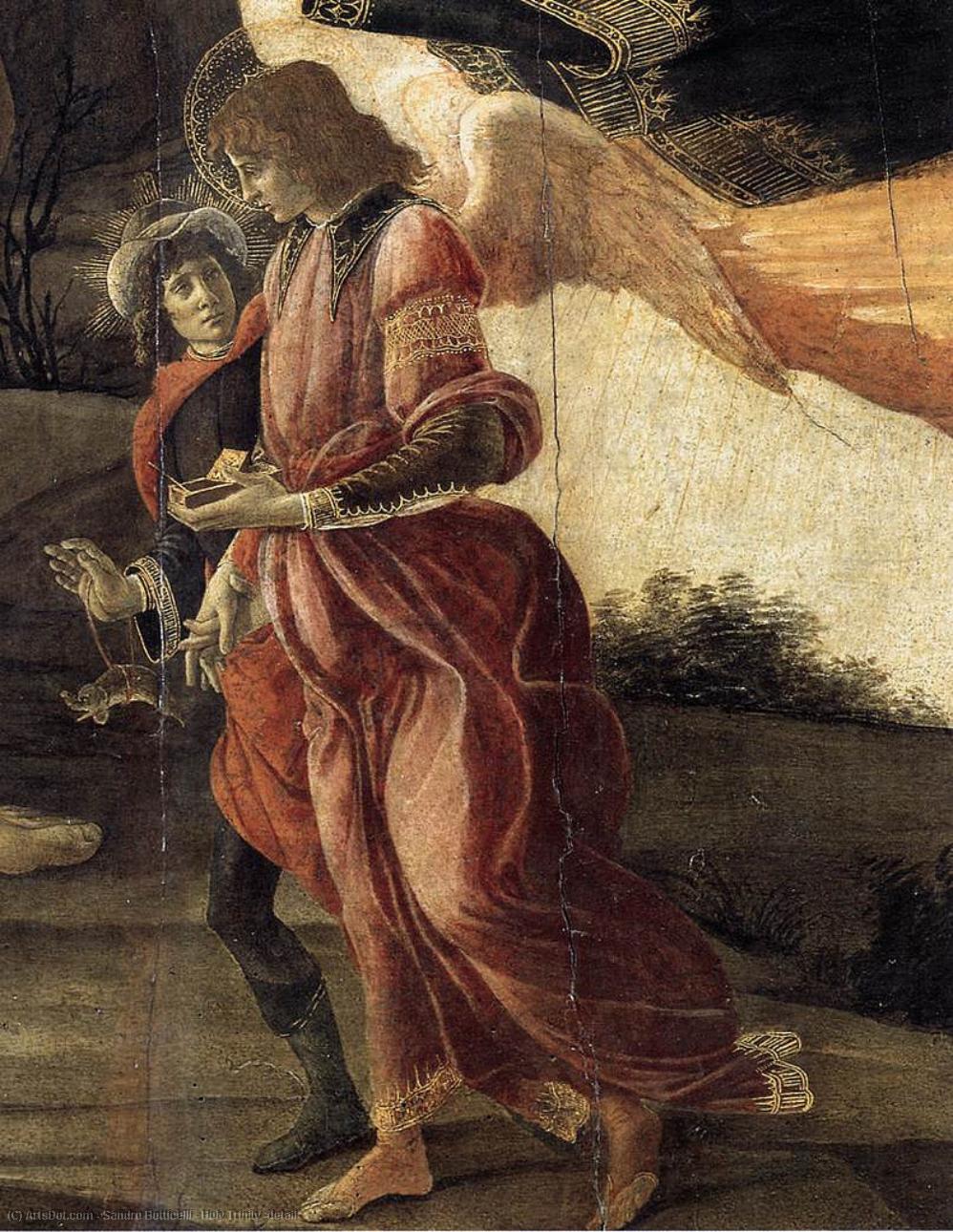
Botticelli’s Holy Trinity masterpiece captures ethereal grace with its delicately rendered figures—God the Father, Jesus Christ, and the Holy Spirit—a hallmark of Florentine Renaissance art. Explore this iconic depiction and bring Botticelli's timeless beauty into your home.
Entdecken Sie die fesselnde Kunst von Sandro Botticelli (1445-1510), einem Meister der Frührenaissance. Bekannt für seine elegante Linienführung, ikonische Werke wie 'Die Geburt des Venus' & 'Primavera' und die Brücke zwischen gotischen und Renaissance-Stilen. Erfahren Sie mehr über sein Vermächtnis!
A Window Into Divine Harmony: Exploring Botticelli’s Holy Trinity
The painting “Holy Trinity” by Sandro Botticelli stands as an emblem of Florentine Renaissance idealism—a breathtaking depiction that transcends mere representation to embody profound theological concepts and artistic mastery. Created sometime between 1480 and 1500, this masterpiece resides within the Galleria Nazionale di Palazzo Pitti in Florence, offering visitors a rare glimpse into the spiritual fervor of its era. While precise details regarding its commission remain elusive, it’s widely accepted that Botticelli executed it for Lorenzo de Medici—the Magnificent—a testament to the artist's renown and patronage during his lifetime.
The Style of Graceful Linearity
Botticelli’s signature style is instantly recognizable: characterized by delicate lines, luminous colors, and an ethereal quality that distinguishes him from many of his contemporaries. Unlike the monumental grandeur favored by artists like Michelangelo or Raphael, Botticelli prioritized elegance and grace—a stylistic choice reflecting humanist ideals that championed beauty and proportion as expressions of divine order. The painting’s figures are rendered with astonishing precision, yet they possess a fluidity and softness that imbues them with an otherworldly aura. This deliberate avoidance of harsh contours contributes significantly to the artwork's serene atmosphere.
Technique: Tempera on Canvas – A Laborious Process
Botticelli employed tempera paint—a medium known for its brilliance and permanence—on canvas, marking a departure from fresco painting which was dominant in Florence at the time. Tempera involves mixing pigment with egg yolk and resin, creating a durable binder that adheres to the surface of the canvas without cracking over centuries. The painstaking process demanded meticulous layering and blending techniques, resulting in surfaces that shimmer with subtle variations in tone—a characteristic feature of Botticelli’s oeuvre. Careful observation reveals minute details in drapery folds and facial expressions, demonstrating Botticelli's unwavering commitment to realism within a stylized framework.
Historical Context: Renaissance Spirituality and Medici Patronage
The Holy Trinity emerged during the High Renaissance, a period marked by renewed interest in classical ideals alongside burgeoning Christian piety. Lorenzo de Medici’s patronage played an instrumental role in fostering artistic innovation—encouraging artists like Botticelli to explore ambitious themes and experiment with groundbreaking techniques. The painting reflects the humanist preoccupation with understanding God's creation through observation and contemplation—a core belief underpinning Renaissance philosophy. Furthermore, it speaks to the broader cultural landscape of Florence during this time, where religious iconography served as a powerful means of conveying spiritual truths and commemorating important events.
Symbolism: Representing Divine Unity
The composition itself is laden with symbolic significance. The three figures – God the Father, Jesus Christ, and the Holy Spirit – represent the Trinity—the cornerstone of Christian theology—affirming the belief in one God manifested in three distinct persons. Each figure occupies a specific position within the frame, mirroring theological hierarchies and conveying a sense of cosmic harmony. The radiant halo surrounding Jesus Christ symbolizes divine glory, while the descending dove represents the Holy Spirit—often interpreted as embodying grace and illumination. The subtle gestures and expressions of each saint communicate profound spiritual contemplation—inviting viewers to contemplate the mysteries of faith.
Emotional Impact: Tranquility and Reverence
“Holy Trinity” transcends mere visual beauty; it evokes a palpable sense of tranquility and reverence. Its luminous colors, balanced composition, and graceful lines inspire awe and contemplation—transporting the viewer into a realm of spiritual serenity. Botticelli’s masterful depiction captures not only the theological essence of the Holy Trinity but also the humanist aspiration for achieving inner harmony—a legacy that continues to resonate with audiences today. A high-quality reproduction allows admirers to experience this timeless masterpiece, fostering appreciation for both artistic brilliance and profound spiritual contemplation.