A Serene Vision of Faith and Family
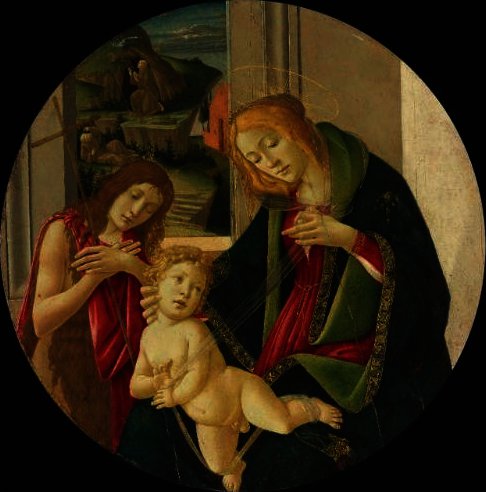
Sandro Botticelli’s “Madonna and Child with the Young Baptist, Saint Francis Receiving the Stigmata in the Distance” is a quietly profound work that encapsulates the spirit of the Early Renaissance. Executed with the meticulous detail and graceful linearity characteristic of Botticelli's style, this circular oil painting offers a tender glimpse into the divine family – Mary cradling the infant Jesus, attended by the young John the Baptist. The composition isn’t merely a depiction of religious figures; it is an invitation to contemplation, a visual poem about faith, maternal love, and spiritual devotion.
Botticelli's Florentine World
Born Alessandro di Mariano di Vanni Filipepi in Florence around 1445, Botticelli lived his entire life within the vibrant artistic heart of Italy. His early training as a goldsmith instilled in him an appreciation for precision and detail that would become hallmarks of his paintings. Florence during the Renaissance was a crucible of innovation, where artists were rediscovering classical ideals while simultaneously forging new paths in realism and humanism. Botticelli absorbed these influences, blending them with a uniquely lyrical style that set him apart. He moved between the late Gothic traditions and the emerging Renaissance aesthetic, creating works that are both spiritually evocative and remarkably grounded in earthly beauty. The painting reflects this Florentine sensibility – a harmonious balance of idealism and observation.
Decoding the Symbolism
Beyond its immediate visual appeal, “Madonna and Child…” is rich with symbolic meaning. The triangular arrangement of the figures—Mary at the apex, holding Jesus—is a traditional compositional device representing the Holy Trinity. The inclusion of the young John the Baptist foreshadows his role as Christ’s herald, while in the distance, the subtle depiction of Saint Francis receiving the stigmata adds another layer of spiritual resonance. This isn't simply a scene frozen in time; it is a narrative unfolding before our eyes, connecting past prophecies with present grace and future sacrifice. The soft, diffused lighting further enhances this sense of reverence, illuminating the central figures while allowing the background to recede into a contemplative haze. The landscape glimpsed through an arched window isn’t merely decorative; it symbolizes the earthly realm blessed by divine presence.
A Masterful Technique
Botticelli's technique in this work is exemplary of his skill and artistry. He employed oil paints on a wood panel, building up layers of color with meticulous precision. The use of glazes—thin, translucent layers of paint—creates a luminosity and depth that are captivating. The flowing drapery of the figures isn’t just visually pleasing; it demonstrates Botticelli's mastery of line and form. His attention to detail is evident in every aspect of the painting, from the delicate features of Mary’s face to the subtle textures of the landscape. The warm earth tones—reds, browns, and ochres—are accented with touches of green and gold, creating a harmonious palette that evokes a sense of serenity and warmth. The overall effect is one of quiet elegance and profound spiritual depth, making this painting a timeless treasure for any collection or interior space.