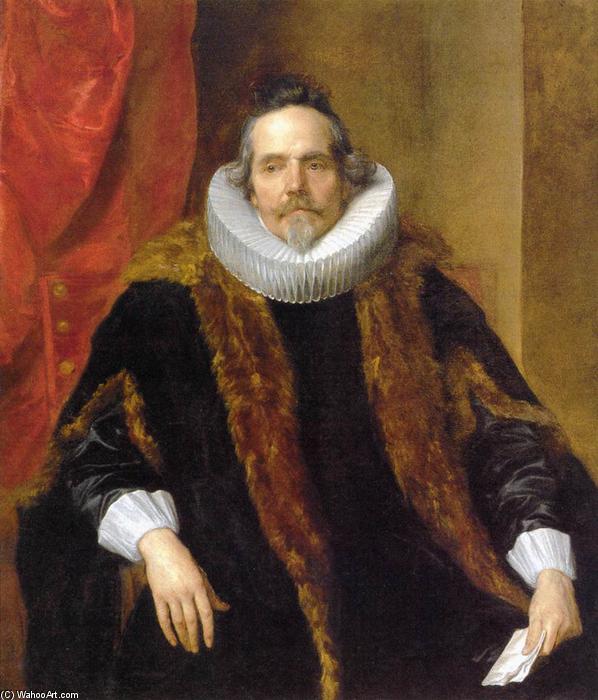
Portrait of Jacques Le Roy – A Masterpiece of Baroque Elegance
Sir Anthony van Dyck’s “Portrait of Jacques Le Roy,” painted in 1631, stands as a testament to the artistic fervor and refined sensibilities of the Baroque era. Executed during his Antwerp period—a formative stage marked by collaboration with Rubens—this portrait transcends mere likeness; it embodies an ideal of aristocratic dignity and intellectual prowess.
- Subject Matter: The painting depicts Jacques Le Roy, a prominent figure in Flemish society and administrator within the Spanish Netherlands. His commanding presence is conveyed through meticulous detail – a stately white collar, a dark suit adorned with a crimson cape—elements that speak to his status and authority.
- Style & Technique: Van Dyck’s signature Baroque style is evident in every brushstroke. The artist skillfully employs chiaroscuro—the dramatic interplay of light and shadow—to sculpt the sitter's form, emphasizing musculature and conveying an aura of confidence. The use of rich pigments contributes to a luminous surface that captures the subtle nuances of color.
- Historical Context: Created amidst the political tensions of the Thirty Years’ War, “Portrait of Jacques Le Roy” reflects the grandeur and formality characteristic of royal courts during this turbulent period. Van Dyck's patronage by influential figures like Philippe Le Roy underscores the importance of portraiture as a tool for asserting social prestige.
- Composition & Symbolism: The composition is carefully balanced, with Le Roy positioned centrally against a muted red curtain and wall—a backdrop that reinforces his noble bearing. The drapery adds depth to the scene and contributes to the overall sense of elegance. The pose itself suggests contemplation and composure, reflecting the humanist ideals prevalent in Baroque art.
- Emotional Impact: More than just an image of a man, “Portrait of Jacques Le Roy” communicates a profound understanding of human psychology. Van Dyck’s masterful rendering captures not only physical appearance but also inner character—a quiet dignity and intellectual curiosity that resonate with viewers centuries later.
Provenance & Artistic Influences
The painting's journey through history began in Antwerp, where Van Dyck honed his craft under Rubens’ guidance. This formative experience instilled in him a profound appreciation for dynamic compositions and expressive color palettes—elements that would become hallmarks of his distinctive style. The print after Lommelin, published in 1654, served as an important reference point for subsequent reproductions.
Rediscovery & Reproduction
Acquired by the Thyssen-Bornemisza Collection prior to 1930, “Portrait of Jacques Le Roy” has captivated audiences worldwide. Today, high-quality reproductions offer art enthusiasts a chance to experience the beauty and sophistication of Van Dyck’s masterpiece in their own homes.
Resources for Further Exploration