A Study in Victorian Dignity
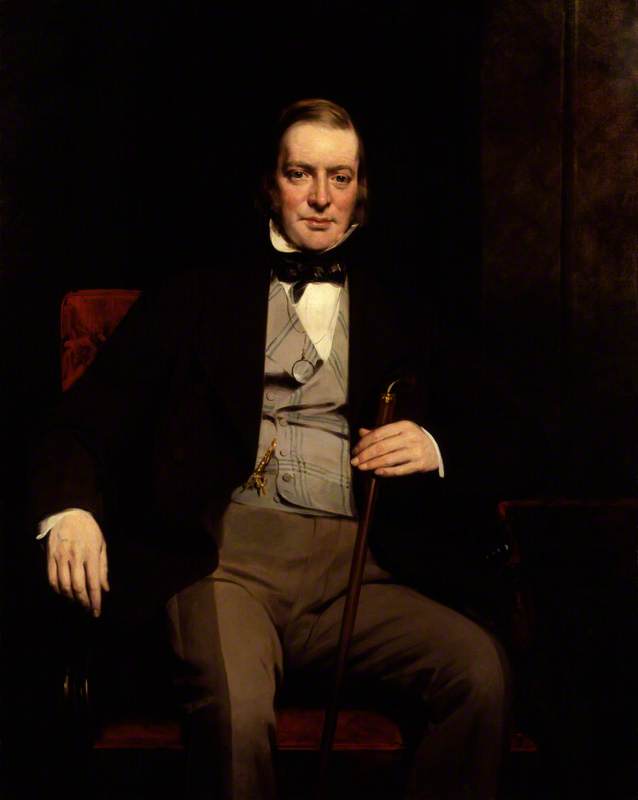
In the quiet, commanding presence of Sir William Molesworth, 8th Bt, we encounter more than just a likeness; we enter the structured, dignified world of the mid-19th century. Painted in 1854 by the esteemed Scottish master Sir John Watson Gordon, this portrait serves as a profound window into an era defined by social hierarchy and the meticulous cultivation of character. The subject sits with a poised, centered gravity, his form anchored within a composition that radiates stability and established prestige. Through Gordon's lens, Molesworth is not merely a man, but a symbol of the Victorian ideal—a figure of intellect and unshakeable social standing.
The artistry of this piece lies in its masterful command of chiaroscuro. Gordon employs a dramatic, directional light that sweeps across the subject’s face and upper torso, pulling him forward from a deep, atmospheric void. This technique does more than create three-dimensional volume; it creates a psychological depth, casting much of the background into shadow to ensure that the viewer's gaze remains locked upon the sitter's expression. The interplay between the luminous highlights on the skin and the heavy, enveloping darkness of the surroundings evokes a sense of quiet contemplation, as if we have stumbled upon a private moment of reflection within a grand, silent study.
Mastery of Texture and Technique
For the discerning collector or interior designer, the technical brilliance of this work offers endless visual delight. Gordon, a practitioner of academic realism, demonstrates an extraordinary ability to manipulate oil paint to mimic the diverse textures of high-society life. One can almost feel the weight of the heavy fabrics composing his attire, the crispness of the linen, and the subtle, weathered texture of the skin. The artist utilizes sophisticated layering and glazing techniques to achieve a polished sheen that catches the light, lending the portrait a lifelike vitality that transcends the flat surface of the canvas.
The color palette is intentionally restrained, favoring muted, earthy tones and deep shadows that allow the subtle nuances of flesh tones and fabric highlights to sing. This sophisticated use of color ensures that the painting remains timeless, possessing an elegance that avoids the garishness of more modern movements. The geometric precision in the rendering of the clothing folds and the structural elements of the chair provides a rhythmic stability to the work, making it a piece that commands attention without overwhelming its environment.
An Icon for the Refined Interior
Integrating a reproduction of such caliber into a contemporary or classical space offers an immediate infusion of historical soul. This portrait is particularly suited for grand libraries, formal dining rooms, or sophisticated study areas where one wishes to evoke a sense of heritage and intellectual rigor. The artwork’s ability to anchor a room through its dark, moody tones makes it an ideal focal point for designers looking to create "moody" or "dark academia" aesthetics.
Beyond its aesthetic value, the painting carries an emotional weight of respectability and permanence. It is a piece that invites long periods of observation, rewarding the viewer with new details in every glance—from the subtle glint in the eye to the intricate shadows within the drapery. To possess such a work is to hold a fragment of 19th-century British history, bringing the enduring legacy of Sir John Watson Gordon’s mastery into the modern home.