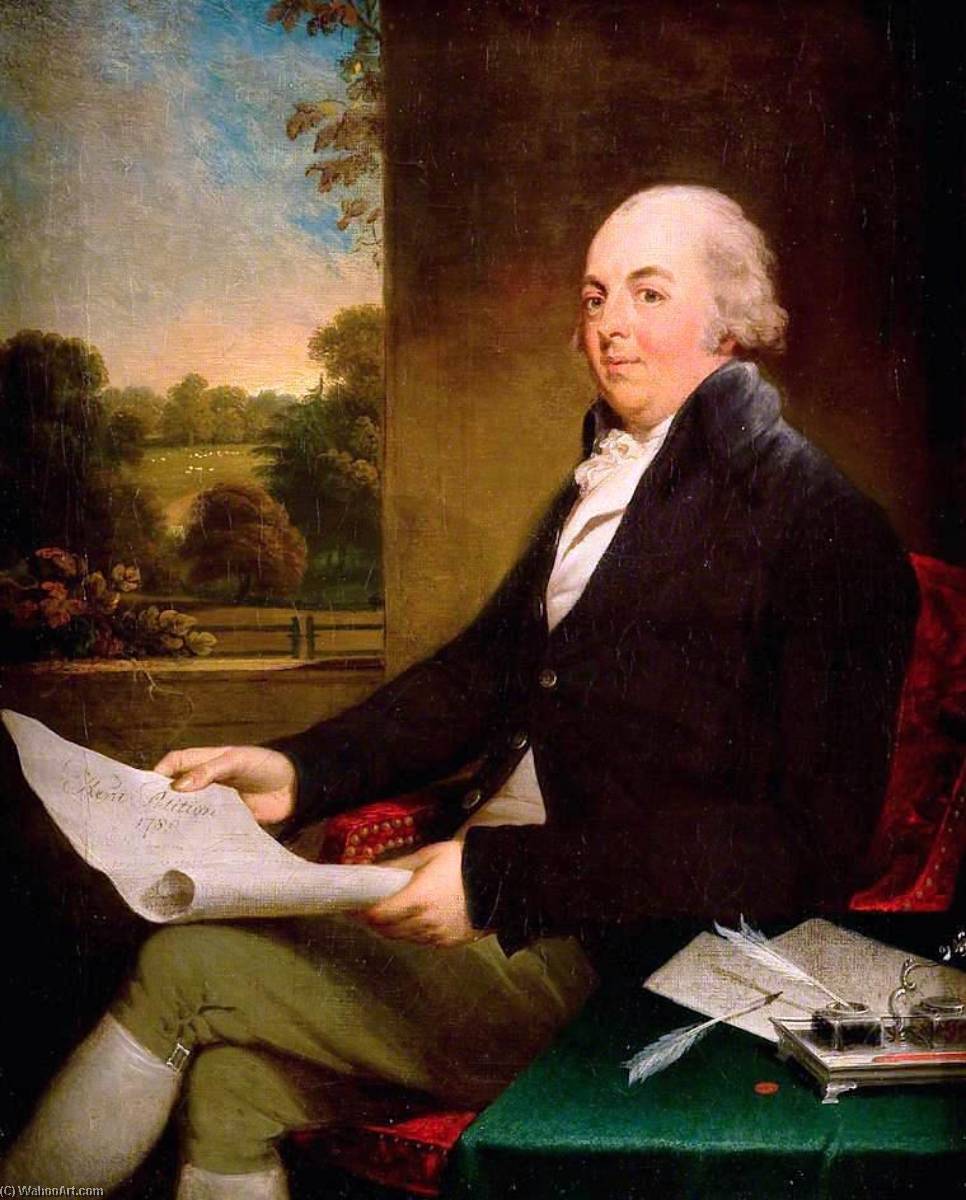
A Portrait of Refined Dignity: Filmer Honywood by Sir William Beechey
Sir William Beechey’s “Filmer Honywood,” painted circa 1795, is more than a simple likeness; it's a carefully constructed tableau of Georgian society, imbued with the subtle elegance and restrained power characteristic of the artist’s style. The portrait captures Filmer Honywood, an MP who represented Steyning from 1774 to 1806, seated in a pose that speaks volumes about his status and character – a man of quiet authority and considered intellect.
Beechey's approach is distinctly neoclassical, favoring a balanced composition and a palette dominated by earthy tones. The muted browns, greens, and reds create an atmosphere of understated luxury, reflecting the wealth and influence of Honywood’s position. Notice how Beechey masterfully employs chiaroscuro – the dramatic contrast between light and shadow – to sculpt the sitter's form and draw attention to his face. The lighting, originating from a window subtly visible in the background, illuminates his features with a gentle warmth, highlighting the seriousness of his gaze.
A Study in Formal Pose and Subtle Detail
Honywood’s posture is deliberately formal, reflecting the conventions of portraiture during this period. He sits upright, hands clasped gently before him, holding what appears to be a document or book – an emblem of his scholarly pursuits and civic engagement. The rich fabric of his dark coat, adorned with intricate embroidery, speaks to his social standing, while the crisp white shirt and cravat demonstrate attention to detail and a commitment to appearances. Beechey’s skill lies not just in capturing likeness but in conveying personality through gesture and expression.
The background landscape, glimpsed through the window, adds depth and context to the scene. It's a carefully rendered vista – likely inspired by the English countryside – suggesting Honywood’s connection to his estate and perhaps hinting at a life of leisure beyond the confines of Parliament. The inclusion of this natural element softens the formality of the portrait, grounding it in a broader sense of place and experience.
Symbolism and the Portrait as Social Commentary
Beyond mere representation, “Filmer Honywood” operates on several symbolic levels. The seated pose itself suggests contemplation and wisdom – qualities highly valued in an MP. The document or book held by Honywood could represent his legal expertise or his engagement with intellectual discourse. Furthermore, the portrait serves as a visual marker of social status, subtly reinforcing the hierarchical structure of Georgian society.
Beechey’s meticulous attention to detail – from the texture of the fabric to the subtle nuances of expression – elevates this portrait beyond a simple likeness. It's a sophisticated work that reveals not only the appearance of Filmer Honywood but also his character, his position within society, and the artistic conventions of his time. The painting offers a fascinating glimpse into the world of 18th-century England, inviting us to contemplate the complexities of power, status, and representation.
A Legacy of Elegance: Beechey’s Enduring Influence
Sir William Beechey was a pivotal figure in British portraiture during the late 18th and early 19th centuries. His work, characterized by its elegance, restraint, and psychological insight, profoundly influenced generations of artists. “Filmer Honywood” stands as a testament to his skill and vision, demonstrating his ability to capture not just physical likeness but also the essence of his subjects. Today, reproductions of this captivating portrait continue to resonate with art lovers and collectors alike, offering a tangible connection to a bygone era.