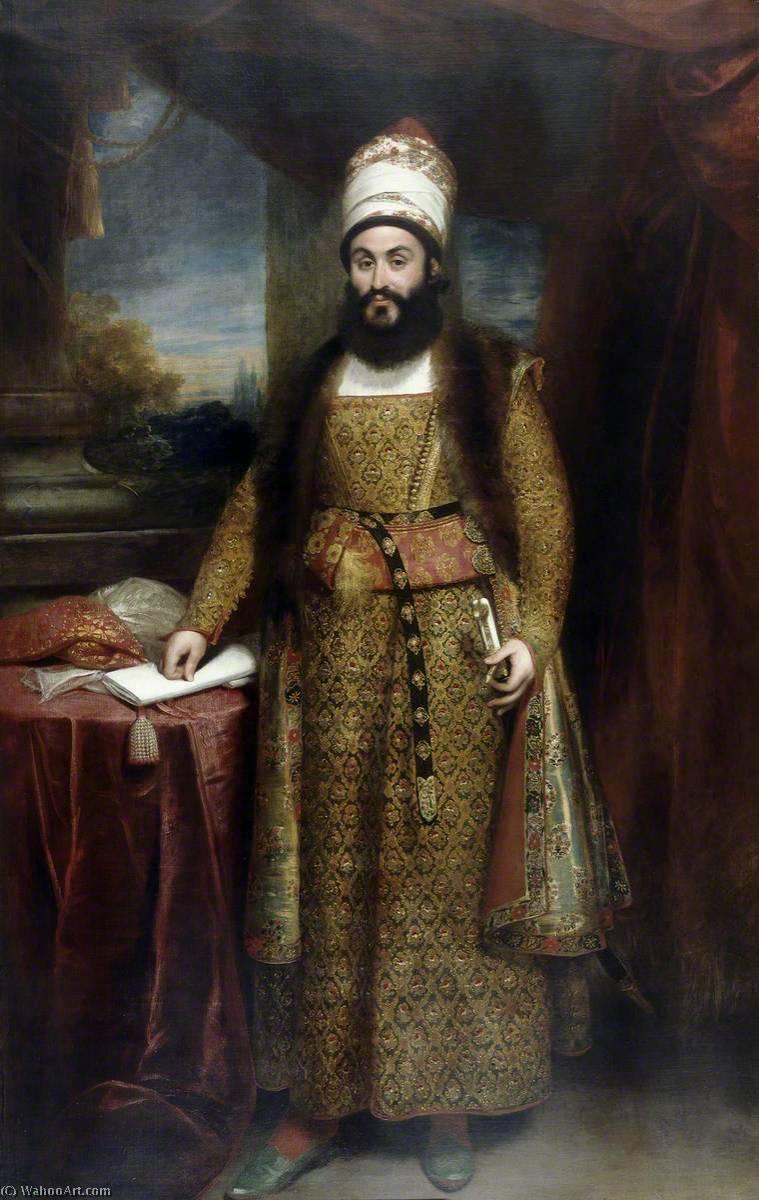
A Regal Portrait Amidst Intellectual Pursuits: Exploring Sir William Beechey’s Depiction of Mirza Abu'l Hasan Khan
The portrait of Mirza Abu'l Hasan Khan, Envoy Extraordinary from the King of Persia to the Court of George III, commissioned in 1810 by Lord Bathurst, stands as a testament to both artistic skill and the burgeoning intellectual climate of Regency England. Painted by Sir William Beechey, a celebrated Royal Academician known for his meticulous portraits of aristocratic families, this artwork transcends mere likeness; it embodies a carefully constructed narrative reflecting the aspirations of its subject and the broader cultural landscape of the era.
- Subject Matter & Context: Mirza Abu'l Hasan Khan was a diplomat dispatched by Persia to negotiate with Britain regarding territorial disputes stemming from the Napoleonic Wars. The portrait captures him in a formal pose, seated at a table laden with documents – symbols of his diplomatic mission and representing the weighty responsibilities entrusted upon him. This deliberate inclusion underscores the importance of international relations during this period, highlighting Khan’s role as a conduit between two powerful nations.
- Style & Technique: Beechey's style is characterized by its realism tempered with elegance. He employed oil paint on canvas, utilizing glazing techniques to achieve subtle tonal variations and capturing the textures of fabric and skin with remarkable accuracy. The artist’s meticulous attention to detail—evident in the rendering of Khan’s beard, mustache, and clothing—demonstrates a commitment to portraying his subject with dignity and respect.
- Symbolism & Composition: Beyond the immediate depiction of Khan, the surrounding elements contribute to a richer symbolic tapestry. The books positioned near the table represent intellectual pursuits – Khan's engagement in scholarly endeavors alongside his diplomatic duties. This juxtaposition speaks to the Enlightenment ideals prevalent at the time, emphasizing the value of knowledge and reasoned discourse.
- Emotional Impact: Beechey skillfully conveys Khan’s composure and gravitas through facial expression and posture. The gaze directs outwards, conveying confidence and determination—qualities essential for navigating complex diplomatic negotiations. Simultaneously, there's an underlying sense of thoughtfulness, hinting at the profound considerations weighing upon Khan’s mind.
- Legacy & Reproduction: Today, reproductions of this portrait offer collectors and interior designers alike a glimpse into Regency grandeur. The artwork’s enduring appeal lies in its ability to capture not only a historical figure but also the spirit of an era defined by ambition, intellect, and artistic refinement. Its meticulous detail ensures that admirers can appreciate Beechey's mastery and experience the emotional resonance of this iconic image.
Dimensions: 234 x 143 cm
Date Painted: 1810