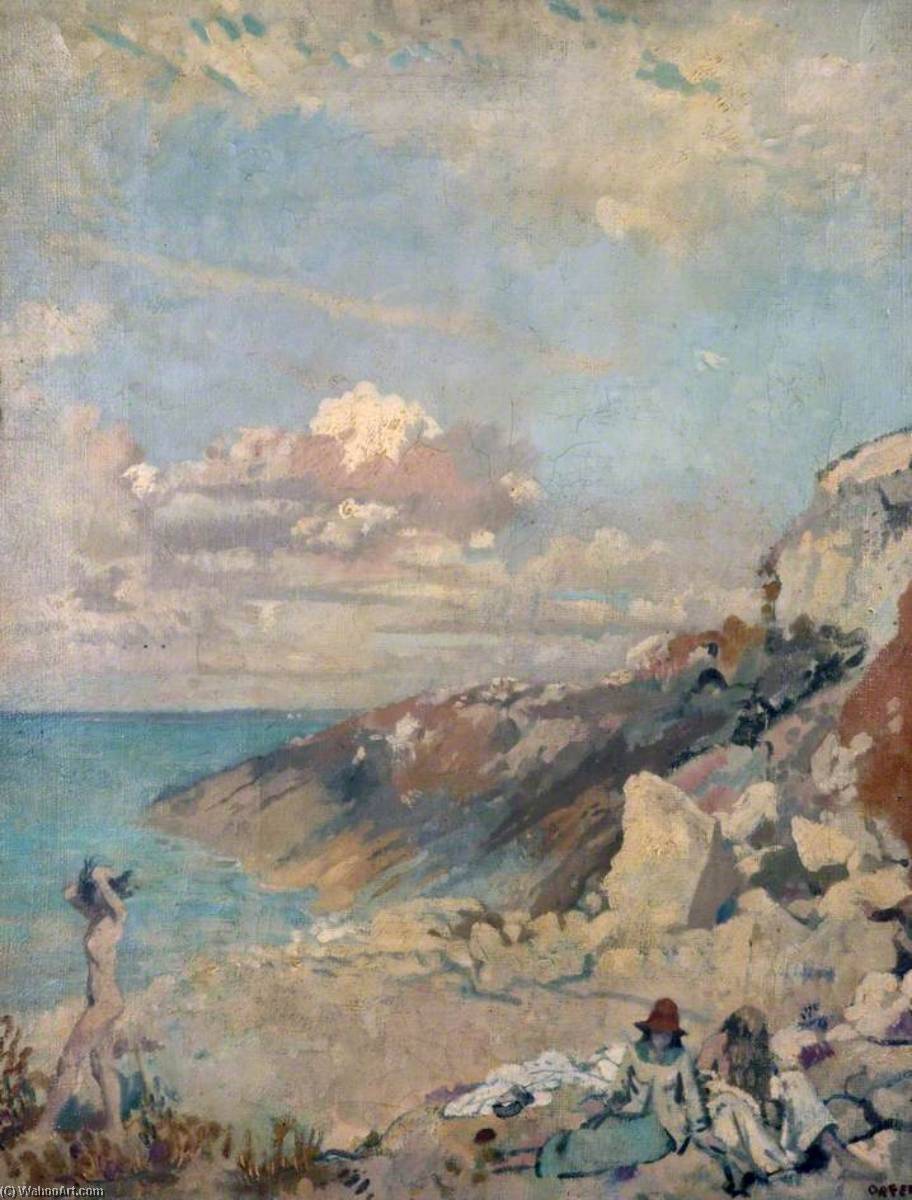
Landscape

Explore the powerful portraits & poignant war art of Sir William Orpen (1878-1931). Witness his masterful realism, capturing Edwardian society and the horrors of WWI in stunning detail.


Sir William Newenham Montague Orpen (1878 - 1931)

Sir William Orpen (1878-1931): Irischer Porträtkünstler & Kriegskünstler des Ersten Weltkriegs. Meister der Darstellung, bekannt für Edwardianische Portraits und eindringliche Kriegsszenen. Entdecken Sie sein Werk auf ArtsDot!

Walker Art Gallery (Liverpool, Vereinigtes Königreich)

Entdecken Sie Meisterwerke in der Walker Art Gallery in Liverpool! Erforschen Sie Pre-Raphaelitische Schätze, Renaissance-Kunst und britische Gemälde vom 13. Jahrhundert bis zur Gegenwart. Kostenloser Eintritt.

A Tranquil Vista: Exploring Sir William Orpen’s Landscape

  • Subject Matter & Composition The painting captures a quintessential seaside landscape, presenting two figures seated upon a rocky outcrop overlooking the ocean. This deliberate placement emphasizes human presence within the grandeur of nature—a recurring motif in Impressionist art—and invites contemplation on themes of solitude and connection to the environment.
  • Impressionistic Style Orpen’s work exemplifies the Impressionist movement, prioritizing fleeting moments of light and color over precise representation. Characteristic loose brushstrokes dominate the canvas, dissolving forms into shimmering patches of pastel hues. This technique eschews academic conventions in favor of capturing the sensory experience of observing a scene directly.
  • Technique & Materials Executed in 1926, the painting utilizes oil paints on canvas—a standard medium for Impressionist artists—allowing for layering and blending to achieve luminosity. The artist skillfully employs glazing techniques, applying thin translucent layers of color over underlying tones to enhance depth and vibrancy. Careful attention is paid to capturing the subtle nuances of light reflecting off the water and clouds.
  • Historical Context Painted during the interwar period, “Landscape” reflects a broader artistic preoccupation with depicting natural beauty amidst uncertainty. Impressionism emerged as a reaction against Romantic idealism, prioritizing subjective perception and emotional resonance over idealized narratives. Orpen’s work aligns with this trend, conveying a sense of serenity and optimism despite the anxieties of his time.
  • Symbolism & Emotional Impact The expansive sky filled with fluffy clouds symbolizes both dawn and dusk—representing transitions and hinting at an ethereal quality. The rocky outcrop serves as a grounding element, anchoring the figures amidst the boundless expanse of nature. Ultimately, “Landscape” evokes feelings of peace, tranquility, and contemplation—a testament to Orpen’s ability to translate visual impressions into emotionally evocative art.