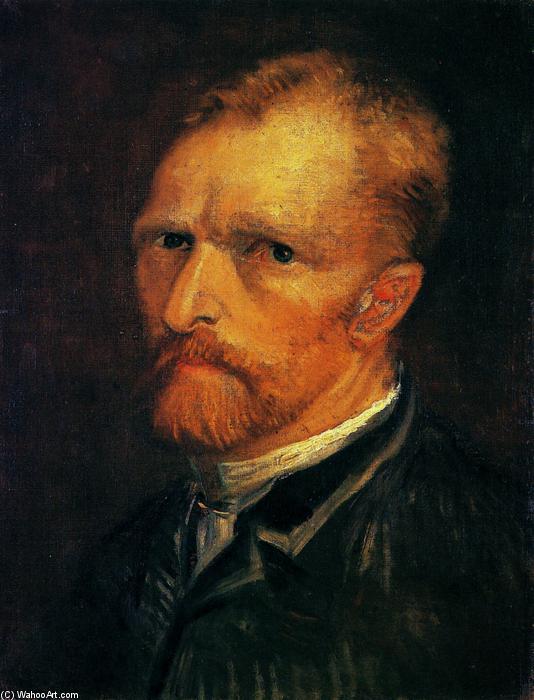
Self-Portrait (14) – A Window Into Van Gogh’s Soul
Vincent van Gogh's “Self-Portrait (14),” painted in 1886 during his Parisian sojourn, stands as a cornerstone of Post-Impressionist art and an enduring testament to the artist’s profound introspection. More than just a depiction of his physical appearance—a man with a thoughtful gaze framed by dark hair and a neatly trimmed beard—the painting delves into the turbulent emotional landscape that characterized Van Gogh's life during this pivotal period.
The Artistic Style and Technique: Bold Strokes, Vivid Color
Van Gogh’s masterful use of oil on canvas distinguishes “Self-Portrait (14)” from many contemporary portraits. He eschewed academic conventions in favor of a style characterized by expressive brushstrokes—thick, impasto marks that convey palpable energy and movement. These bold strokes aren't merely decorative; they serve as conduits for emotion, mirroring the artist’s inner turmoil.
The color palette is equally striking: dominated by earthy browns and greens, punctuated by flashes of vibrant yellow – notably in his shirt collar—the hues resonate with both melancholy and optimism. This deliberate juxtaposition reflects Van Gogh's preoccupation with capturing not just what he saw but how he *felt*, aligning him firmly within the burgeoning movement toward emotional realism.
Inspired By Cézanne: A Dialogue With Modernity
“Self-Portrait (14)” owes considerable debt to Paul Cézanne, whose geometric approach to landscape and portraiture profoundly influenced Van Gogh’s artistic vision. Cézanne's insistence on simplifying forms and flattening perspective—evident in paintings like “Still Life with Apples” and “Mont Sainte-Victoire”—challenged the prevailing Impressionist obsession with capturing fleeting moments of light and color.
Van Gogh adopted Cézanne’s principles, albeit subtly, to imbue his self-portrait with a sense of solidity and stability. The careful positioning of his gaze—direct yet slightly averted—and the deliberate framing of the composition contribute to this effect, signaling a conscious effort to transcend mere visual representation.
A Reflection of Provence: Symbolism and Atmosphere
Painted during Van Gogh’s time in Arles, France – a location infused with inspiration from Japanese woodblock prints – “Self-Portrait (14)” embodies the atmosphere of Provence. The muted colors evoke the stillness of the countryside, while the inclusion of a Japanese print serves as a visual reminder of Cézanne's influence and Van Gogh’s fascination with innovative artistic techniques.
The painting’s overall mood is contemplative—a gaze inward that speaks to the artist’s struggle for self-understanding. It’s a portrait not merely of a man, but of a soul grappling with existential questions, cementing “Self-Portrait (14)” as an iconic masterpiece of expressive art.
Further Exploration: You can discover more about Vincent van Gogh and his artistic legacy on The Art Media Oil On Canvas page on ArtsDot. Also, immerse yourself in the history of painting at History of Painting on Wikipedia.