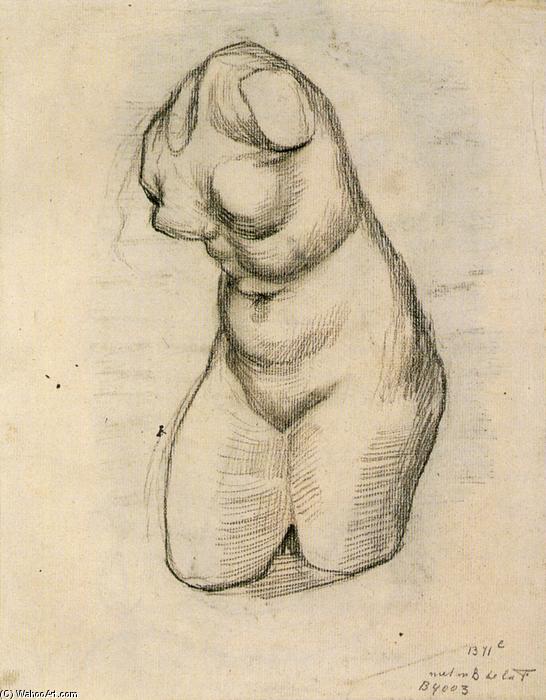
Vincent van Gogh’s ‘Torso of Venus’ – a striking black & white drawing showcasing anatomical realism & subtle shading. Explore this iconic masterpiece!
Vincent van Gogh (1853-1890): Niederländischer Postimpressionistischer Meister, der für kräftige Farben, emotionale Landschaften und ikonische Werke wie 'Sternennacht' bekannt ist. Erkunden Sie seine Sonnenblumen, Porträts und seinen bleibenden Einfluss auf die moderne Kunst bei ArtsDot.
A Study in Form and Shadow: Vincent van Gogh’s Torso of Venus
The year is 1887. Vincent van Gogh, battling inner demons and grappling with the burgeoning anxieties of modern life, finds solace – and perhaps a path toward artistic liberation – in meticulous anatomical studies. *Torso of Venus*, housed within the Musée d'Orsay in Paris, stands as a testament to his unwavering dedication to capturing the essence of human form with unparalleled precision. More than just a depiction of flesh and bone, it’s an exploration of light, texture, and psychological depth—a cornerstone of Van Gogh’s oeuvre and a pivotal moment in the evolution of Impressionism toward Expressionism.
The Anatomy Revealed: Technique and Style
Executed in pen and ink on paper with remarkable detail, *Torso of Venus* exemplifies Van Gogh's mastery of academic drawing traditions blended seamlessly with his distinctive stylistic vision. The artist employs hatching techniques—dense areas of parallel lines—to sculpt the contours of the torso, creating a palpable illusion of volume and simulating the subtle gradations of light and shadow that define anatomical realism. Heavy linework dominates the composition, emphasizing the musculature beneath the skin and conveying an unwavering commitment to accurate representation. Unlike Impressionists who sought to capture fleeting moments of visual sensation, Van Gogh prioritized capturing the underlying structure of the human body—a deliberate choice reflecting his belief in the importance of intellectual understanding alongside aesthetic beauty.
Historical Context: Bridging Impressionism and Expressionism
Painted during a period of intense artistic experimentation, *Torso of Venus* represents a crucial juncture between Impressionism and Expressionism. While influenced by Monet’s explorations of light and color—particularly evident in his landscapes—Van Gogh transcends the limitations of purely optical observation. He delves into the realm of emotion, channeling his personal struggles and anxieties into the artwork's expressive qualities. The study aligns with Van Gogh’s broader preoccupation with portraying human vulnerability and confronting existential questions—themes that would become hallmarks of Expressionist art. It marks a decisive departure from Impressionistic idealism toward a more psychologically charged engagement with subject matter.
Symbolism Beyond Representation
Though seemingly straightforward in its depiction, *Torso of Venus* carries subtle symbolic resonances rooted in classical mythology. The Venus figure embodies ideals of beauty and femininity—a deliberate reference to the Greco-Roman tradition of artistic representation. However, Van Gogh’s approach transcends mere homage to established conventions. He imbues the anatomical study with a palpable sense of melancholy—perhaps reflecting his own feelings of isolation and disillusionment. The darkened tones contribute to this emotional atmosphere, underscoring the artist's desire to convey not just what he sees but also what he feels—a profound statement about the human condition that resonates powerfully across time.
Emotional Resonance: A Window into Van Gogh’s Soul
Ultimately, *Torso of Venus* transcends its formal qualities to offer a glimpse into Vincent van Gogh’s inner landscape. It's a portrait not just of flesh and bone but also of spirit—a testament to the artist’s unwavering belief in the transformative power of art. The artwork compels viewers to contemplate questions of beauty, vulnerability, and psychological depth—inviting us to engage with Van Gogh’s profound exploration of human experience. Its enduring appeal lies in its ability to communicate emotion without resorting to explicit narrative or symbolism—a remarkable achievement that secures its place as one of the most emotionally resonant pieces of art from the late nineteenth century.