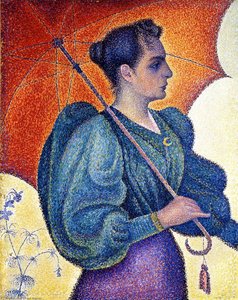
The Genesis of Neo-Impressionism: Moving Beyond Spontaneity
 Georges Seurat: Pointillism, Perception & the Scientific Foundations of Modern Art
The Genesis of Pointillism: From Impressionism to Scientific Inquiry The late 19th century was a period of profound upheaval, not just in the socio-political landscape but also within the artistic realm. The established norms of academic painting wer...
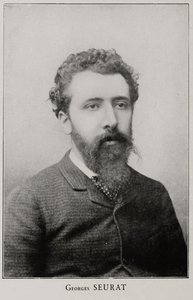
The late nineteenth century was a period of profound upheaval, not just in the socio-political landscape but within the very soul of the artistic realm. As the established norms of academic painting were challenged by a new generation seeking to capture the fleeting moments of modern life, Impressionism had already begun to dismantle traditional techniques through its emphasis on light and color. However, for visionaries like Georges Seurat, the spontaneous, almost random brushstrokes of the Impressionists felt incomplete. He perceived a lack of underlying structure, a certain arbitrarical application of paint that lacked a cohesive foundation. This dissatisfaction did not stem from a rejection of the Impressionist goals, but rather from a desire to elevate them, to ground the subjective experience of light within an objective, measurable framework.
This movement, which would come to be known as Neo-Impressionism, emerged as a calculated response to the perceived chaos of its predecessor. While the Impressionists sought to capture the transient effects of a passing cloud or a shimmering reflection, the Neo-Impressionist circle—including figures such as Seurat, Paul Signac, and even Camille Pissarro—sought a more measured approach. They renounced the random spontaneity of the brush in favor of a technique grounded in science and the rigorous study of optics. It was an era where artists were no longer merely observers of nature, but investigators of the very mechanics of vision, attempting to systematize the act of painting itself.
The Science of Sight: Optics, Color Theory, and the Laws of Contrast
--- title: Neo-impressionism | Tate url: https://www.tate.org.uk/art/art-terms/n/neo-impressionism hostname: tate.org.uk description: Tate glossary definition for neo-impressionism: The name given to the post-impressionist work of Georges Seurat, Pau...
To understand the revolution brought about by Seurat and Signac, one must look beyond the canvas and into the laboratories of contemporary science. The movement was deeply influenced by the treatises of scientists such as Michel Eugène Chevreul, whose work on the law of simultaneous contrast of colors provided a roadmap for a new visual language. Chevreul demonstrated how colors interact with one another when placed in proximity, revealing that the perception of a hue is inextricably linked to its neighbors. This scientific revelation was further expanded by the explorations of Ogden Rood, whose studies in optics provided the essential groundwork for what would become a radical new method of pigment application.
These scientists proved that the human eye possesses a remarkable ability to blend colors optically rather than physically. For traditional painters, mixing pigments on a palette often resulted in a loss of intensity and a muddied appearance. The Neo-Impressionists, however, realized that by placing separate touches of interwoven pigment directly onto the canvas, they could achieve a much greater vibrancy. They were no longer just painting objects; they were manipulating the physiological response of the spectator's retina. This intersection of art and science allowed them to harness the power of human vision, turning the act of looking into an active, participatory experience where light was not merely depicted but reconstructed within the mind of the viewer.
Chromoluminarism: Seurat’s Method of Optical Mixing
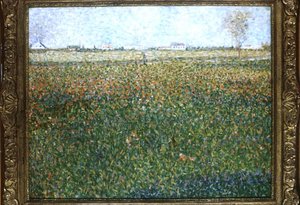 The Poppy Field, 1884
Introduction to the Painting and its Artist Georges Pierre Seurat , a French Post-Impressionist artist, is renowned for his innovative technique known as Pointillism. This method involves applying small dots of pure color onto the canvas, which blend...
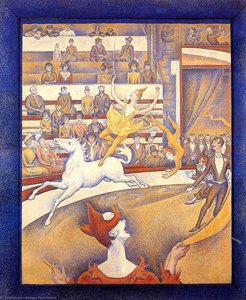
Georges Seurat termed his revolutionary technique chromoluminarism, a name that perfectly encapsulates its scientific and luminous essence. At its heart lay the concept of mélange optique, or optical mixture. Instead of the conventional blending of oils, Seurat applied small, distinct dots of pure color onto the canvas. When viewed from a distance, these individual points of pigment would coalesce in the viewer's perception, creating a shimmering, pulsating effect that traditional methods could never replicate. This was not merely an aesthetic choice; it was a deliberate attempt to achieve a higher level of luminosity and brilliance.
In masterpieces such as The Poppy Field (1884), one can witness the profound impact of this method. The painting features a tranquil pathway lined with vibrant poppies, where the light seems to emanates from within the canvas itself. By placing dots of contrasting colors next to each other, Seurat achieved an intense visual vibration. This technique allowed him to capture the essence of sunlight and atmosphere with a precision that felt almost architectural. Through chromoluminarism, the artist transformed the canvas into a laboratory of light, where every dot served as a building block for a more radiant reality.
Paul Signac and the Expansion of the Pointillist Vision
 Paul Signac
The Harmonious Vision of Paul Signac Paul Victor Jules Signac, born in Paris in 1863, emerged as a pivotal figure in the evolution of modern art, inextricably linked to the birth and development of Neo-Impressionism. Initially drawn to architecture, ...
While Seurat provided the foundational theory, Paul Signac emerged as the movement's great explorer and its most dedicated communicator. Initially drawn to architecture, Signac’s encounter with the works of Claude Monet ignited a passion for painting that would eventually lead him to redefine color theory. The meeting between Signac and Seurat in 1884 proved transformative; together, they embarked on a rigorous investigation into the emotional impact of hue and the complexities of complementary contrasts, drawing inspiration from the writings of Eugène Delacroix.
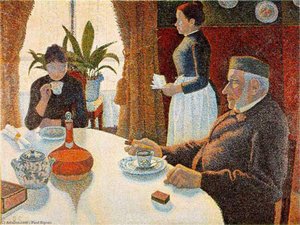
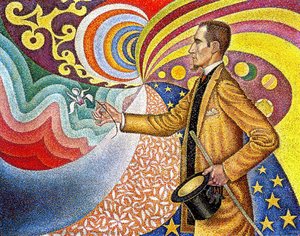
Signac’s contribution was characterized by a profound commitment to the systematic application of color. While he is often associated with the term Pointillism—a term Paul Signac himself actually repudiated in favor of Divisionism—his work pushed the boundaries of the movement toward a more expansive, rhythmic vision. His paintings, such as Boulevard de Clichy (1886), showcased a meticulous style that captured the vibrancy of urban life through a scientific lens. Signac viewed the separation of color into individual strokes as a way to ensure that the elements would be reconstituted into brilliantly colored lights, acting as a bridge between the structured precision of Neo-Impressionism and the more emotive, liberated styles that would follow.
The Technical Execution: From Meticulous Dots to Luminous Landscapes
--- title: Georges Seurat (1859–1891) and Neo-Impressionism - The Metropolitan Museum of Art author: Dita Amory url: https://www.metmuseum.org/essays/georges-seurat-1859-1891-and-neo-impressionism hostname: metmuseum.org description: Artists of the N...
The technical execution required for such a style was nothing short of Herculean. Unlike the rapid, gestural strokes of the Impressionists, the Neo-Impressionist method demanded immense patience and mathematical precision. The artist had to carefully calculate the placement of every dot, considering how each primary color component would interact with its neighbors to create the desired secondary or tertiary effect. This process was less about spontaneous expression and perhaps more about a disciplined, almost meditative application of pigment.
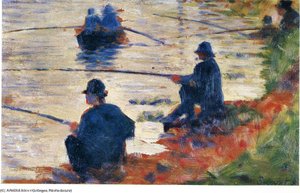
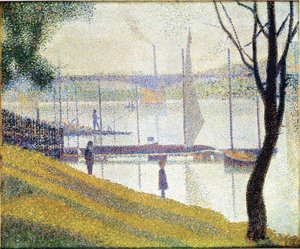
This meticulousness extended to the very texture of the work. While some artists utilized the tiny, adjacent dabs characteristic of Pointillism, others explored the Divisionist technique, using slightly larger, more distinct strokes to allow the canvas to breathe. The goal remained constant: to achieve a greater intensity of color than could be achieved through physical mixing on the palette. This method allowed for a unique way of capturing landscapes and urban scenes, where the interplay of light and air through foliage or across water could evoke a profound sense of tranquility and movement, turning a static image into a living, breathing symphony of light.
The Enduring Legacy: How Scientific Precision Redefined Modern Art
 Neo-Impressionism
Neo-Impressionism is a term coined by French art critic Félix Fénéon in 1886 to describe an art movement founded by Georges Seurat. Seurat's most renowned masterpiece, A Sunday Afternoon on the Island of La Grande Jatte, marked the beginning of this ...
The impact of Seurat and Signac extends far beyond the late nineteenth century. By introducing a scientific rigor to the application of color, they laid the groundwork for much of the modern art that followed. Their exploration of color theory and optical perception served as a precursor to the raw, emotive liberation of Fauvism and even influenced the structural experiments of Cubism. The rhythmic application of color seen in their work began to dissolve the boundaries of reality, moving toward a more abstract, mosaic-like dreamscape where light transcends form.
Today, we continue to find inspiration in their ability to harmonize the analytical with the aesthetic. Their legacy reminds us that art is not merely a reflection of what we see, but an exploration of how we perceive. Whether through the structured precision of a hand-painted reproduction or the contemporary reimagining of classical styles, the revolution of Pointillism remains a testament to the power of light, color, and the enduring human quest to understand the science of beauty.
At ArtsDot.com, we celebrate this rich history of artistic innovation. We specialize in providing high-quality, hand-painted oil reproductions that capture the very essence of masters like Seurat and Signac. Our professional artists use 100% cotton canvas and meticulous techniques to ensure that the vibrant luminosity and textured brushstrokes of the Neo-Impressionists are preserved in every piece. Whether you are looking for a large-scale masterpiece for a corporate space or a custom commission that transforms a personal photo into a classical treasure, we offer reliable, professional service for collectors and professionals alike. Explore our extensive catalog today and bring the science of light into your own collection.