

The Post-War Pivot: From Abstract Emotion to Pop Iconography
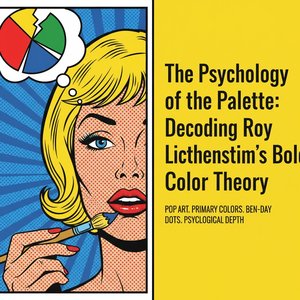 The Psychology of the Palette: Decoding Roy Lichtenstein's Bold Color Theory
The Post-War Shift: From Abstract Expressionist Emotion to Pop Iconography The Psychology of the Palette: Decoding Roy Lichtenstein’s Bold Color Theory The Post-War Shift: Moving from Emotion to Iconography The Psychology of the Palette: Decoding Roy...
To understand the seismic shift triggered by Roy Lichtenstein, one must first visualize the heavy, almost suffocating atmosphere of the post-war art world. Before his arrival, the canvas was a site of existential struggle. The era was dominated by Abstract Expressionism, a movement where titans like Jackson Pollock and Mark Rothko utilized spontaneous gestures and turbulent, non-representational forms to channel deep, subjective emotions. Every drip of paint and sweep of color served as a direct conduit to the artist's internal psyche, creating an art that felt intensely private and often inaccessible.
However, by the mid-1950s, a subtle undercurrent of dissatisfaction began to ripple through the creative community. There was a growing yearning for an aesthetic that could reflect the tangible realities of a rapidly modernizing America—a world defined by burgeoning consumerism, mass media, and a new, vibrant youth culture. While pioneers like Jasper Johns and Robert Rauschenberg had begun introducing recognizable symbols such as flags and maps into their work, it was Lichtenstein who truly dismantled the hierarchy between high and low art. He moved the focus away from the internal world of the artist’s struggle toward the external, electric energy of the streets, transforming the disposable imagery of everyday life into a sophisticated subject for serious contemplation.
The Ben-Day Dot Revolution: Engineering Visual Impact
 Beyond the Ben-Day Dots: Roy Lichtenstein's Pop Art Revolution & Enduring Legacy
The Precursors to Pop: Challenging Artistic Conventions Pop art Pop art is an art movement that emerged in the United Kingdom and the United States during the mid- to late 1950s. The movement presented a challenge to traditions of fine art by includi...
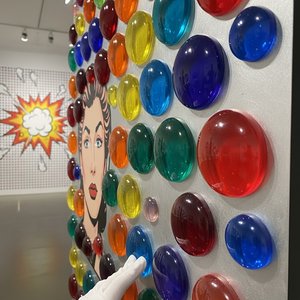
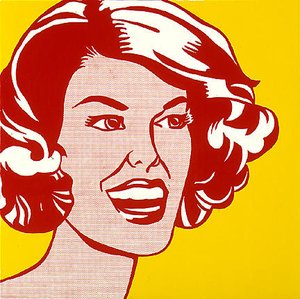
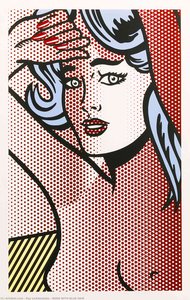
Lichtenstein’s most recognizable contribution to the visual language of the twentieth century was his mastery of the Ben-Day dot. This technique, borrowed directly from the commercial printing processes used in newspapers and comic books, became much more than a mere stylistic choice; it became a tool for re-engineering perception. By utilizing these tiny, meticulously rendered dots to create texture and tonal variation, Lichtenstein achieved a sense of depth and flatness simultaneously, mimicking the mechanical look of mass-produced media while elevating it to the status of fine art.
When you gaze closely at a masterpiece like Woman in a Wheelchair, you see how these dots function as a mosaic effect. This deliberate mimicry of halftone patterns allows the artist to build up color without the use of smooth gradients, creating a distinctive graphic punch that feels both modern and industrial. It is a brilliant paradox: using a technique designed for cheap, mass-market reproduction to demand the viewer's attention in a gallery setting. Through this mechanical aesthetic, Lichtenstein forced us to confront the pervasive influence of mass media on our visual consciousness, turning the "cheap" into something monumental.
Primary Power: Decoding the Psychology of Lichtenstein’s Palette
 The Psychology of the Palette: Decoding Roy Lichtenstein's Bold Color Theory
The Post-War Shift: From Abstract Expressionism to Pop Iconography Beyond the Ben-Day Dots: Roy Lichtenstein's Pop Art Revolution & Enduring Legacy The Precursors to Pop: Challenging Artistic Conventions Pop art Pop art is an art movement that emerge...
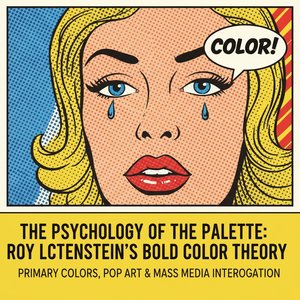
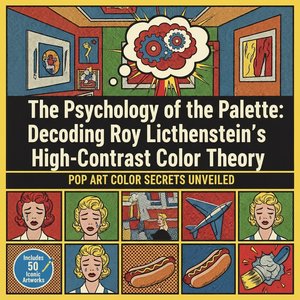
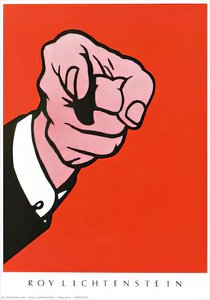
The true heartbeat of Lichtenstein’s work lies in his unapologetic use of primary colors. His palette is not one of subtlety or nuance, but of impact. By leaning heavily on bold blues, vibrant yellows, and stark reds, he created a visual language that was impossible to ignore. This color theory was deeply psychological; the cool, sharp blue often used in his figures provides a striking contrast against warmer background tones, intensifying feelings of isolation or detachment. In works exploring more somber themes, such as Woman in a Wheelchair, the interplay between these primary hues can underscore a sense of vulnerability and quiet contemplation.
This use of color was a direct rebellion against the emotive, muddy, and often dark tones of the Abstract Expressionists. Lichtenstein sought clarity, punch, and immediate recognition. His colors do not whisper; they shout. This high-contrast approach allows for a clean, graphic composition where every element—from a thick black outline to a splash of yellow—serves a specific structural purpose. It is this very "pop" that makes his work so enduringly relevant to contemporary design, offering a sense of energy and optimism that resonates with the fast-paced, visually saturated world we inhabit today.
Comic Book Aesthetics: Elevating Mass Media to Fine Art
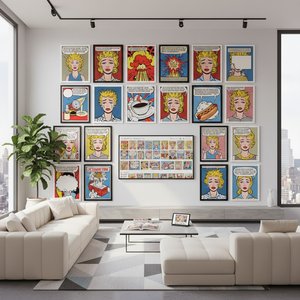 Roy Lichtenstein's Masterpieces: 25 Iconic Pop Artworks for Your Home | ArtsDot
Introduction To embark on a journey through the top 25 artworks of Roy Lichtenstein is to enter a world where the boundaries between high art and popular culture dissolve, replaced by bold lines, vibrant colors, and an audacious commentary on America...
Lichtenstein’s genius was his ability to take the "low" culture of comic book panels and advertising and recontextualize them as profound artistic statements. He did not simply copy these images; he interrogated them. By enlarging and refining the aesthetics of the comic strip—the thick outlines, the dramatic speech bubbles, and the hyper-stylized characters—he stripped away the disposable nature of the medium to reveal its underlying power. He recognized that these images were the new icons of a consumerist society, speaking a universal visual language that everyone understood.
Beyond the Frame: The Enduring Influence on Modern Design and Street Art
 Design for Dreamworks logo
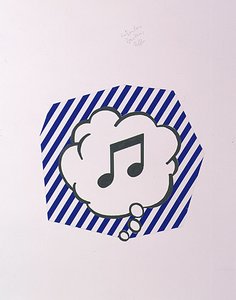
The Genesis of a Pop Visionary: Roy Lichtenstein and the Dreamworks Logo Roy Fox Lichtenstein’s 1996 design for the Dreamworks logo isn't merely a corporate emblem; it’s a potent distillation of his signature Pop Art style, a vibrant collision of com...
The legacy of Roy Lichtenstein extends far beyond the boundaries of the canvas. His influence is woven into the very fabric of contemporary visual culture, from the bold graphics of modern branding to the high-impact aesthetics of street art and digital design. The way we consume imagery today—through saturated screens and rapid-fire social media feeds—is a direct descendant of the visual revolution he ignited. His ability to blend commercial motifs with fine art paved the way for everything from Andy Warhol’s pop icons to the graphic, stencil-heavy works of modern street artists.
Today, we see his DNA in the clean lines of UI/UX design, the vibrant palettes of character animation, and the bold, typographic energy of streetwear branding. Lichtenstein taught us that there is no boundary between "art" and "culture." He proved that the most powerful messages often come from the most unexpected places. As we continue to navigate an era of unprecedented visual stimulation, his work remains a masterclass in how to capture attention, command respect, and find profound meaning within the bright, loud, and beautiful chaos of popular culture.
Discover the power of bold contemporary art at ArtsDot.com. From high-impact reproductions to custom commissions that transform your personal photos into pop-art masterpieces, we bring the energy of the streets into your home. Explore our curated collection of vibrant, graphic works designed for the modern collector.