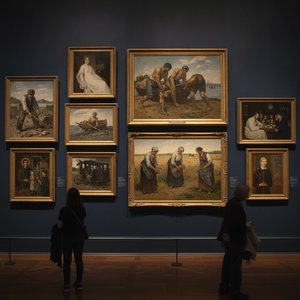
The Earth as Canvas: Millet’s Deep-Rooted Connection to the Normandy Landscape
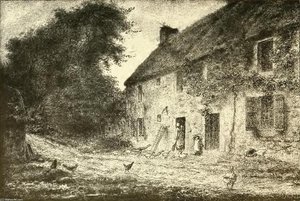 House birthplace Millet
The Canvas of a Village: An Exploration of Millet's "House Birthplace" Jean-François Millet’s “House Birthplace” (La Maison de naissance de Millet), painted around 1857, isn’t merely a depiction of a humble dwelling; it’s a profound meditation on the...
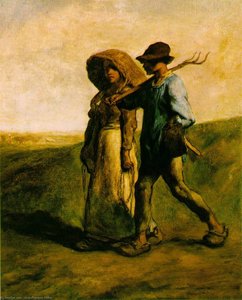
To step into the world of Jean-François Millet is to descend into the very soul of the earth itself. There is a profound, quiet gravity in his work—a sense that every brushstroke carries the weight of the soil, the rhythm of the seasons, and the dignified struggle of those who labor beneath the vast French sky. Unlike many artists of his era who sought fame through grand historical or mythological subjects, Millet’s artistic vision was inextricably linked to the rhythms of farm life. Born in the humble village of Gruchy, Normandy, he did not merely observe rural life; he lived it. His childhood was defined by the visceral realities of agricultural labor: mowing, making hay, binding sheaves, and ploughing. This intimate connection profoundly shaped his artistic vision, imbuing his canvases with an authenticity that resonated deeply with a society undergoing rapid change.
His early years in Normandy provided more than just a backdrop; they offered a vocabulary of texture and toil. The landscape was not a distant, idealized scenery but a living, breathing participant in his life. This deep-seated connection to the land meant that when Millet approached a canvas, he was engaging in a sacred dialogue between humanity and the landscape. His work emerged from a deep understanding of the cyclical nature of sowing and reaping, far removed from the polished, idealized pastoral scenes favored by the Parisian salons of his era. Every element of the French countryside—the weathered barns, the heavy clouds, and the damp, fertile earth—was rendered with a reverence born of experience.
Beyond the Pastoral: Breaking from Romanticism through Radical Realism
 Realism (art movement)
Realism was an artistic movement that emerged in France in the 1840s. Realists rejected Romanticism, which had dominated French literature and art since the early 19th century. The artist Gustave Courbet, the original proponent of Realism, sought to ...
As the mid-19th century approached, the art world was dominated by the Romantic Movement, characterized by its dramatic landscapes, exotic subject matter, and exaggerated emotionalism. Millet, however, chose a different path, becoming a cornerstone of the Barbizon School. This movement sought to reject academic artifice in favor of
plein air truth. While his contemporaries often leaned into theatrical lighting and grand narratives, Millet moved toward a more subdued, realistic depiction of motifs that stood in stark contrast to traditional romanticism. He was not interested in the spectacular; he was interested in the real.
This shift toward Realism was nothing short man radical for its time. By focusing on unidealized subjects, Millet challenged the existing art establishment. His work was often perceived as controversial because it brought the grit and sweat of the working class into the realm of high art. He rejected the polished perfection of the Academy, opting instead to capture the essence of rural France through direct observation. This commitment to truth allowed him to transform the mundane tasks of agricultural life into scenes of epic, almost biblical importance, proving that there is a profound majesty to be found in the unadorned reality of existence.
The Weight of Labor: Capturing Dignity and Resilience in the Peasantry
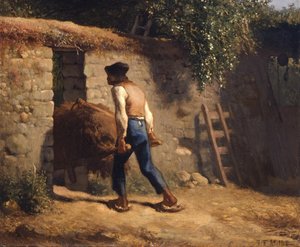 Peasant with a Wheelbarrow
The Dignified Laborer: Jean-François Millet’s ‘Peasant with a Wheelbarrow’ Jean-François Millet's “Peasant with a Wheelbarrow,” painted in 1848, is more than just a depiction of rural toil; it’s a poignant meditation on the dignity of manual labor an...
At the heart of Millet’s oeuvre lies a powerful meditation on the dignity of manual labor. In iconic works such as
Peasant with a Wheelbarrow, we see more than just a depiction of rural toil; we witness a poignant statement about the changing face of French society. The solitary figure navigating an earthy expanse, burdened by the weight of his livelihood, serves as a symbol of perseverance. Millet’s genius lay in his ability to render the worn fabric of clothes and the glistening sweat on a brow with remarkable detail, yet he never allowed the hardship to descend into mere misery. Instead, he imbued his subjects with an undeniable sense of self-respect and strength.
This portrayal of the peasantry was a revolutionary act of social realism. In works like
The Sower, Millet depicts the physical strain of agricultural life—the long strides, the heavy bag of seeds, the rhythmic motion of sowing—with a seriousness that commanded respect. He did not shy away from the "ugly" or the difficult; rather, he found the monumental resilience within the struggle. His figures are not idealized heroes of legend, but real people whose lives were defined by the relentless rhythms of the land. Through his eyes, the act of labor becomes a sacred ritual, and the peasant becomes a figure of quiet, unyielding dignity.
Light, Shadow, and Soul: The Emotional Power of Millet’s Atmospheric Mastery
 The Sower (Millet)
The Sower is an oil painting by the French artist Jean-François Millet from 1850. It is one of several versions of the theme that he painted. The work has been in the collection of the Museum of Fine Arts in Boston since 1917. == History == Millet mo...
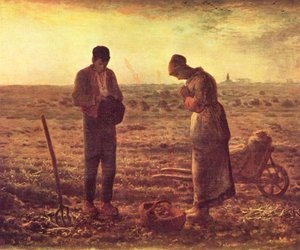
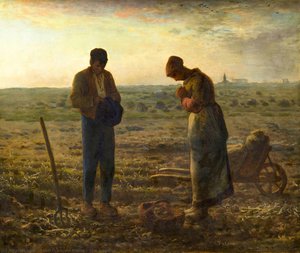
Millet’s technical mastery is perhaps most evident in his use of light and atmosphere to evoke deep emotional responses. He possessed an unparalleled ability to orchestrate illumination, using a warm, golden glow to bathe scenes in a way that elevates the ordinary into something sublime. In many of his paintings, the light does not merely illuminate; it sanctifies. Whether it is the soft, diffused light of dawn in
The S_ower or the quietude of dusk in
The Angelus, the atmosphere carries a heavy emotional weight, suggesting themes of faith, mortality, and the passage of time.
This mastery of light and shadow—the interplay of
chiaroscuro within a realist framework—creates a sense of depth that transcends the two-dimensional surface of the canvas. The shadows are not merely dark spaces; they are reservoirs of mystery and quietude. By carefully modeling textures through light, Millet allows the viewer to feel the weight of the soil and the coolness of the morning mist. This atmospheric precision is what allows his work to move beyond mere documentation into the realm of poetry, capturing the very breath of the French countryside and the spiritual pulse of those who inhabit it.
From History to Home: Bringing the Timeless Gravity of Millet into Modern Interiors
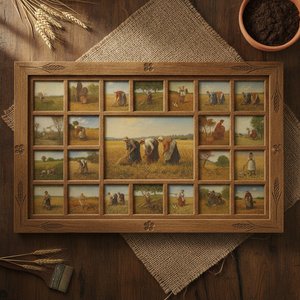 Masterpieces of the Soil: The Top 25 Jean-François Millet Artworks
Introduction To step into the world of Jean-François Millet is to descend into the very soul of the earth itself. There is a profound, quiet gravity in his work—a sense that every brushstroke carries the weight of the soil, the rhythm of the seasons,...
In an age increasingly defined by digital fleetingness and urban detachment, the works of Jean-François Millet remain strikingly vital. His ability to find the sublime in the ordinary serves as a powerful reminder of our fundamental connection to nature and the enduring strength of the human spirit. For the modern art enthusiast, integrating the gravity of Millet’s masterpieces into a contemporary space offers a way to anchor a room with historical depth and emotional resonance. His paintings provide a window into a vanished way of life, offering a sense of permanence and peace that is rare in the modern aesthetic.
Whether through the acquisition of a museum-quality reproduction or the commissioning of a custom piece that echoes his impasto textures, Millet’s influence can transform an interior. His work invites contemplation, encouraging us to slow down and appreciate the quiet strength found in the simplest moments. By bringing these "masterpieces of the soil" into our homes, we do more than decorate a wall; we invite a sacred dialogue between our modern lives and the timeless, dignified rhythms of the earth itself.
This article was featured on ArtsDot.com