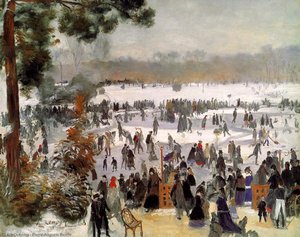
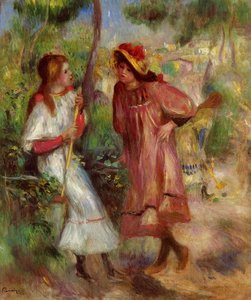
The Dawn of Modernity: Paris in 1878
The Belle Époque (French pronunciation: [bɛlepɔk]) or La Belle Époque (French for 'The Beautiful Era') was a period of French and European history that began after the end of the Franco-Prussian War in 1871 and continued until the outbreak of World W...
The year 1878 occupies a fascinating, often overlooked space in the narrative of modern art. It wasn’t marked by a single revolutionary event, but rather by a confluence of social, political, and technological shifts that fundamentally altered the artistic landscape – particularly within the vibrant heart of Paris. Following the tumultuous years after the Franco-Prussian War, a fragile peace settled over France, allowing for a period of relative prosperity and cultural blossoming known as the Belle Époque. This wasn’t an era of universal joy; beneath the glittering surface lay deep social inequalities and anxieties, but it was undeniably a time of optimism, innovation, and a burgeoning middle class eager to embrace new experiences. Paris, rebuilt and reimagined under Haussmann's grand boulevards, became a magnet for artists seeking to capture the essence of this rapidly changing world. The rigid academic traditions that had long dominated the art scene were beginning to fray, giving rise to movements like Realism and Impressionism – both deeply intertwined with the spirit of 1878.
Realism's Grip: Depicting Everyday Life with Unflinching Honesty
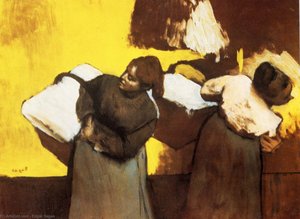 Laundresses Carrying Linen in Town
Experience Edgar Degas’s ‘Laundresses Carrying Linen’! This Impressionist masterpiece captures daily life with vibrant colors and realistic detail, showcasing teamwork & the beauty of ordinary moments.
The seeds of Realism had been sown decades earlier by artists like Gustave Courbet, who challenged the idealized depictions favored by the Salon. However, in 1878, this commitment to portraying “life as it is” reached a new intensity. Artists weren’t merely documenting reality; they were actively engaging with its complexities and contradictions. This meant turning their attention away from historical or mythological subjects and towards the everyday lives of ordinary people – laborers, shopkeepers, laundresses, and boulevardiers. Edgar Degas’s “Laundresses Carrying Linen in Town” exemplifies this shift beautifully. The painting isn't a romanticized vision of domestic labor; it presents a candid glimpse into the physical demands and communal spirit of working-class women. Notice the deliberate lack of sentimentality, the focus on the figures’ posture and movement, and the gritty realism of the urban setting. This wasn’t about creating beautiful images; it was about bearing witness to the realities of modern life. The rejection of polished technique in favor of a more direct, observational approach reflected a broader societal desire for authenticity and truth.
Impressionism’s Fluorescence: Capturing Fleeting Moments and Shifting Light
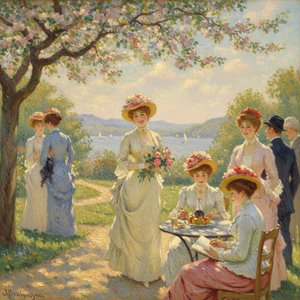
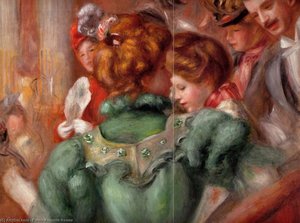
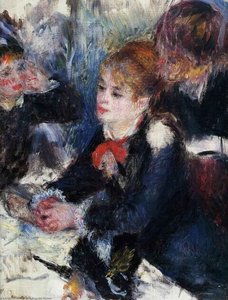 At the Milliner`s
Renoir's "At the Milliner’s" captures Parisian life with vibrant colors and figures amidst a bustling hat shop. Experience Impressionism’s beauty in this charming portrait.
While Realism sought to capture the *what* of contemporary life, Impressionism focused on the *how*. Artists like Pierre-Auguste Renoir, in works such as “At the Milliner’s,” were less concerned with social commentary and more interested in exploring the effects of light and color. The Salon exhibitions of the 1870s had been largely hostile to Impressionist techniques, but by 1878, a growing audience was beginning to appreciate their radical approach. The broken brushstrokes, vibrant palettes, and emphasis on capturing fleeting moments weren’t simply stylistic choices; they were attempts to represent the subjective experience of seeing. The bustling hat shop in Renoir's painting isn’t just a depiction of commerce; it’s an evocation of atmosphere, movement, and the ephemeral beauty of everyday life. The Impressionists sought to break free from the constraints of academic realism, embracing spontaneity and capturing the sensory richness of the modern world.
Beyond the Canvas: Social Commentary & Parisian Society
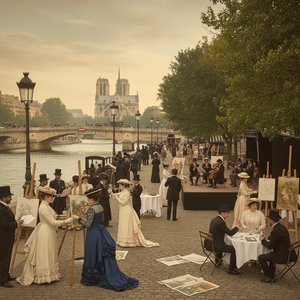
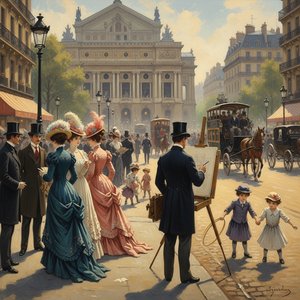 Jean-Georges Béraud: Capturing Parisian Life in the Belle Époque
Explore the captivating world of Jean-Georges Béraud, master painter of Belle Époque Paris. Discover his iconic scenes, artistic evolution, and social commentary. A deep dive into 19th-century French art.
It's crucial to understand that even within the seemingly apolitical realm of Impressionism, social commentary was often present. The very act of depicting modern life – the cafes, boulevards, and theaters of Paris – was a statement in itself. Artists were documenting a society undergoing rapid transformation, and their paintings offer valuable insights into the values, anxieties, and aspirations of the era. Jean-Georges Béraud and Jean-Louis Forain, though often categorized as Impressionists, possessed a particularly keen eye for social satire. Their works frequently depicted the ironies and hypocrisies of Parisian society – the pretensions of the bourgeoisie, the complexities of romantic relationships, and the darker undercurrents of urban life. Forain’s paintings, in particular, are characterized by their wit and realism, offering a nuanced portrayal of Parisian manners and morals.
Key Artists of the Era: Degas, Renoir, Béraud, and Forain
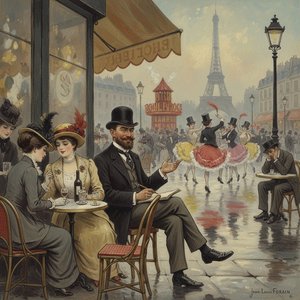 Jean-Louis Forain: Capturing Parisian Life with Wit & Realism
Explore the captivating world of Jean-Louis Forain, a master Impressionist chronicler of Belle Époque Paris. Discover his satirical paintings, realistic scenes & lasting legacy. Learn about collecting Forain's art today!
These four artists – Degas, Renoir, Béraud, and Forain – represent distinct yet interconnected strands within the artistic fabric of 1878. Degas, a master of observation and composition, focused on capturing movement and the human form, often depicting ballet dancers and scenes from everyday life with an almost scientific precision. Renoir, celebrated for his luminous palettes and depictions of leisure and beauty, captured the joy and vitality of Parisian society. Béraud, a keen observer of social customs, offered a nuanced portrayal of Parisian manners and morals, often with a touch of irony. And Forain, known for his satirical wit and realistic scenes, provided a critical commentary on the complexities of modern life. While their styles differed, all four artists shared a commitment to capturing the essence of 1878 – a year marked by both optimism and anxiety, innovation and tradition.
Collecting Art from 1878: A Legacy of Observation and Innovation
Today, artworks created in 1878 offer a unique window into a pivotal moment in art history. They represent not only the aesthetic sensibilities of the era but also its social and political currents. Collecting these paintings isn’t simply about acquiring beautiful objects; it's about investing in a legacy of observation, innovation, and artistic courage. The works of Degas, Renoir, Béraud, and Forain continue to resonate with audiences today because they speak to universal themes – the human condition, the beauty of everyday life, and the complexities of modern society. At ArtsDot.com, we are dedicated to making these masterpieces accessible to all, offering high-quality reproductions that capture the essence and spirit of these iconic works. Explore our collection today and discover the enduring power of art from 1878.