The Dissatisfaction with Spontaneity: Moving Beyond Impressionism
 Chromatic Islands: Exploring the Theory & Legacy of Pointillism in 19th-Century Art
The Dawn of Division: Impressionism’s Dissatisfaction & Seurat’s Vision The late 19th century Parisian art world was a crucible of innovation, yet beneath the shimmering surfaces of Impressionism lay a growing discontent. While artists like Monet and...
To understand the seismic shift brought about by Neo-Impressionism, one must first look back at the shimmering, ephemeral world of its predecessor. In the late 19th century, the Impressionists had already begun to dismantle the rigid hierarchies of academic painting, replacing somber studio tones with a vibrant, subjective celebration of light and movement. Artists like Claude Monet and Pierre-Auguste Renoir sought to capture the fleeting moment—the way a sunbeam dances upon water or how a passing cloud alters the hue of a cathedral. Theirs was an art of the immediate, a beautiful, breathless attempt to freeze the transient essence of nature.
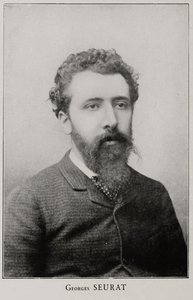
Yet, beneath these luminous surfaces, a growing discontent began to stir within a younger generation of thinkers. For artists like Georges Seurat, the spontaneous, almost arbitrary application of pigment used by the Impressionists felt dangerously close to chaos. While they shared a profound fascination with light and modern life, this new circle of artists questioned the very foundations of the Impressionist approach. They perceived a lack of underlying structure, an absence of a cohesive, intellectual foundation that could ground the fleeting sensation in something more permanent. This was not a rejection of the Impressionist spirit, but rather a desire for an evolution—a transition from the subjective, momentary impression toward a structured, almost mathematical exploration of visual reality.
The Physics of Vision: Understanding Chromoluminarism and Divisionism
 Divisionism
Divisionism, also called chromoluminarism, is the characteristic style in Neo-Impressionist painting defined by the separation of colors into individual dots or patches that interact optically. By requiring the viewer to combine the colors optically ...
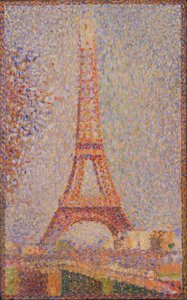
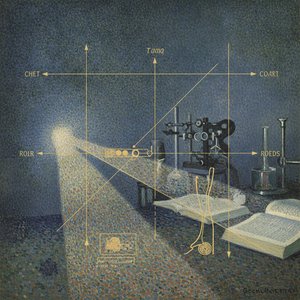
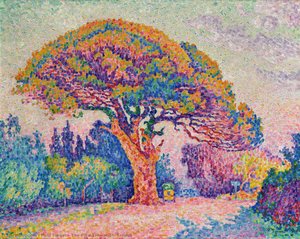
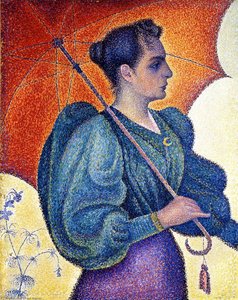
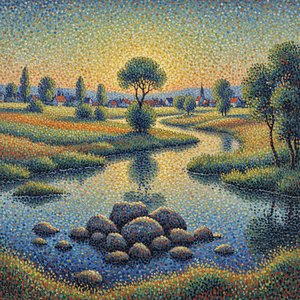
As the 19th century progressed, the boundaries between the art studio and the scientific laboratory began to blur. The Neo-Impressionists did not wish to simply witness the transient effects of nature; they desired to decode them. This period saw the emergence of a more disciplined ambition, where painting became a systematic inquiry into the physics of light. This movement, often referred to as Divisionism or chromoluminarism, was defined by the separation of colors into individual dots or patches that interact optically rather than being physically blended on a palette.
The technical distinction is vital for any student of art history. While Pointillism refers specifically to the application of tiny, precise dots of paint, Divisionism describes the broader theoretical approach of separating colors to achieve maximum luminosity. By requiring the viewer's eye to combine these individual points from a distance, the artists believed they were achieving a level of brilliance that traditional pigment mixing could never reach. This method sought to replicate the way light itself is composed, moving away from the subtractive mixing of physical paints—which often results in duller, muddier tones—toward an approach that mimicked the additive properties of light, much like the technology found in modern computer monitors.
The Architects of Color: The Intellectual Partnership of Seurat and Signac
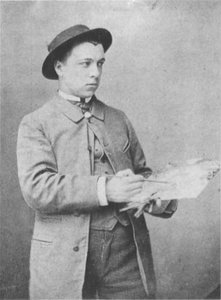 Paul Signac
The Harmonious Vision of Paul Signac Paul Victor Jules Signac, born in Paris in 1863, emerged as a pivotal figure in the evolution of modern art, inextricably linked to the birth and development of Neo-Impressionism. Initially drawn to architecture, ...
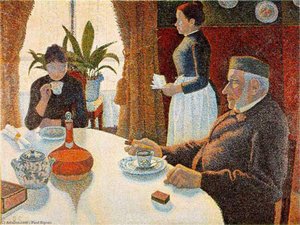
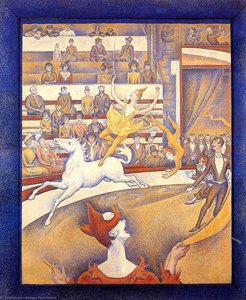
At the heart of this revolution stood two pivotal figures whose meeting in 1884 proved transformative for the trajectory of modern art: Georges Seurat and Paul Signac. Seurat, a visionary with an unwavering pursuit of optical truth, provided the intellectual rigor and the foundational technique. His work was characterized by a profound sensitivity to the nuances of light, grounded in a meticulous observation of the world around him. He approached the canvas not as a place for emotional outbursts, but as a site for scientific application.
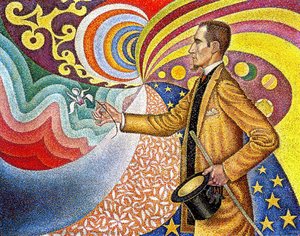
Paul Signac, often regarded as the movement's greatest propagandist, brought a harmonious vision and a dedicated exploration of color theory to their partnership. Initially drawn to architecture, Signac’s encounter with Monet’s work ignited his passion, but it was his collaboration with Seurat that allowed him to redefine artistic expression. Together, they drew inspiration from the writings of scientists and theorists such as Michel Eugène Chevreul, Ogden Rood, and Charles Blanc. They shared a fascination with Eugène Delacroix’s explorations of complementary contrasts, translating these complex theories into a revolutionary painting technique. Their partnership was not merely technical but deeply intellectual, fueled by a shared mission to elevate painting to the level of a rigorous, systematic science.
Mélange Optique: The Mechanics of Optical Mixing and the Human Eye
--- title: Neo-Impressionist Color Theory (article) | Khan Academy url: https://www.khanacademy.org/humanities/becoming-modern/avant-garde-france/post-impressionism/a/neo-impressionist-color-theory hostname: khanacademy.org sitename: Khan Academy dat...
The true magic of Neo-impresionism lies in the concept of mélange optique, or optical mixture. This process relies entirely on the mechanics of human perception. Instead of the artist performing the labor of blending colors on a wooden palette, the labor is transferred to the viewer. When small, adjacent dabs of primary and secondary colors are placed in close proximity, the eye and brain perform a feat of biological synthesis. From a distance, these distinct points of color coalesce into a single, vibrant hue that appears to pulsate with an internal light.
This technique utilizes the principle of simultaneous contrast, where the placement of highly contrasting colors next to one another increases their apparent visual intensity. While some modern scholars note that Seurat did not achieve true additive mixing in the way a digital screen does—as the reflected light from pigments is still technically subtractive—the effect remains undeniably luminous. The result is a shimmering, atmospheric quality that seems to emanate from within the canvas itself. In masterpieces like The Poppy Field (1884), one can witness this breathtaking vibrancy, where the landscape is not merely depicted but is reconstructed through the very act of looking.
A Legacy of Precision: The Lasting Impact of Neo-Impressionism on Modern Art
--- title: Neo-impressionism | Tate url: https://www.tate.org.uk/art/art-terms/n/neo-impressionism hostname: tate.org.uk description: Tate glossary definition for neo-impressionism: The name given to the post-impressionist work of Georges Seurat, Pau...
The legacy of Seurat and Signac extends far beyond the late 19th century. By introducing a disciplined, measured approach to painting, they paved the way for the abstraction and structural experimentation that would define much of 20th-century modern art. Their influence can be seen in the works of Henri Edmond Cross and other members of the Neo-Impressionist circle, who continued to explore the intersection of light, color, and scientific precision. The movement's emphasis on the autonomy of the brushstroke and the importance of color theory fundamentally altered our understanding of visual reality.
Today, we see the echoes of their revolution in everything from digital imaging to contemporary graphic design. The precision they sought amidst a rapidly industrializing world remains a testament to the power of human intellect applied to the medium of art. For those who wish to bring this sense of luminous history into their own spaces, the preservation of these techniques is paramount. At ArtsDot.com, we celebrate this enduring legacy by offering museum-quality, hand-painted oil reproductions that capture the true texture and depth of these masterpieces. Our artists, trained in the highest academic traditions, use the same meticulous layering and vibrant color application to ensure that the soul of the original—the very light Seurat and Signac worked so hard to decode—is preserved for generations to come.