The Golden Age Context: Prosperity, Independence, and the Rise of Dutch Realism
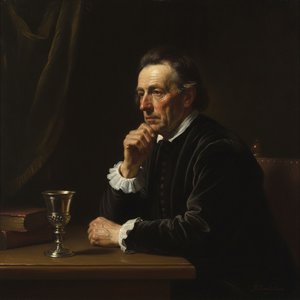 Chiaroscuro & Character: Mastering the Dramatic Light of Dutch Golden Age Art
The Golden Glow: How 17th-Century Prosperity Fueled an Artistic Revolution Illuminating Realism: Exploring the Dutch Golden Age of Painting (1600-1700) The Rise of a Republic: Historical Context & Artistic Flourishing The 17th century Netherlands, a ...
To step into the seventeenth-century Netherlands is to enter a realm where the very air seems heavy with the scent of salt spray, damp earth, and the quiet hum of a nation finding its soul. This was the era of the Dutch Golden Age, a period of unprecedented artistic flourishing born from the crucible of independence and the burgeoning prosperity of the Dutch Republic. Following decades of struggle for liberation from Spanish rule, the Netherlands emerged not merely as a sovereign state, but as the most prosperous nation in Europe, leading the world in trade, science, and, most vibrantly, art. Unlike the grand, often intimidating displays of power found in the royal palaces of France or the religious monuments of Italy, the art of this era was profoundly intimate. As the new Republic moved away from monarchist and Catholic traditions, the demand for religious iconography waned, replaced by a hunger for something more personal—a mirror held up to the lives of the people themselves. This shift birthed a unique aesthetic where the mundane was elevated to the extraordinary, and where the quiet beauty of a domestic interior or a sweeping horizon could command as much reverence as any saint or king.
The Science of Chiaroscuro: Mastering Dramatic Contrast and Depth
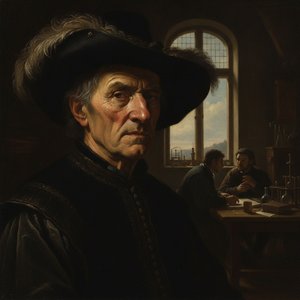 Chiaroscuro and Character: A Masterclass in Light and Shadow within Dutch Golden Age Painting
The Luminous Dawn: Historical Context of the Dutch Golden Age Dutch Golden Age The Dutch Golden Age (Dutch: Gouden Eeuw [ˈɣʌudən ˈeːu, ˈɣʌudə ˈʔeːu]) was a period in the history of the Netherlands which roughly lasted from 1588, when the Dutch Republ...
At the heart of this artistic revolution lay a technical obsession with the behavior of light. The mastery of
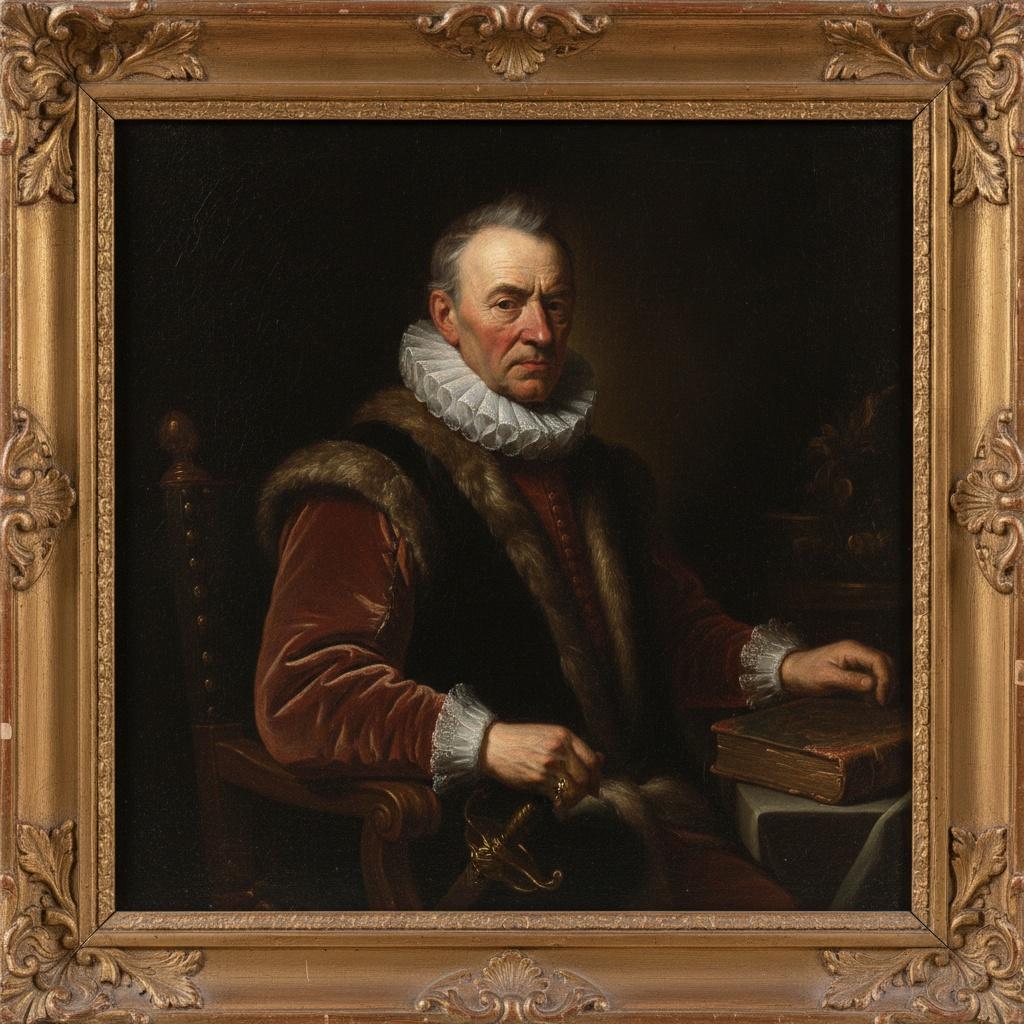
chiaroscuro—the dramatic interplay between light and shadow—became the defining language of the Dutch Baroque. This was not merely a stylistic choice but a profound tool for psychological exploration. By plunging large portions of the canvas into deep, velvety darkness, artists could direct the viewer's gaze with surgical precision, illuminating only what was essential to the narrative. This technique creates a sense of three-dimensional volume and atmospheric depth that pulls the spectator into the scene. When we observe the works of this era, we see how light does not simply sit upon a surface; it carves out forms, defines the texture of silk, and reveals the weary lines on a human face. The tension between the luminous highlights and the encroating shadows creates a palpable energy, a sense of a moment caught in the fleeting transition between day and night, or between presence and absence.
Utrecht Caravaggism: The Italian Influence on Northern Shadows
 Utrecht Caravaggism
Utrecht Caravaggism (Dutch: Utrechtse caravaggisten) refers to the work of a group of artists who were from, or had studied in, the Dutch city of Utrecht, and during their stay in Rome during the early seventeenth century had become distinctly influe...
While the Dutch spirit was uniquely local, its artistic vocabulary was enriched by a profound connection to the Mediterranean. A significant movement known as
Utrecht Caravaggism emerged from the artists who traveled to Rome in the early seventeenth century and returned to the Dutch Republic transformed. Figures such as Hendrick ter Bruggen, Gerrit van Honthorst, and Dirck van Baburen had been deeply influenced by the radical, tenebristic style of Caravaggio. Upon their return, they brought with them a penchant for dramatic, high-contrast scenes that utilized single, often hidden light sources—such as a flickering candle or a lantern—to create intense, theatrical atmospheres. This movement introduced a gritty realism and a sense of immediate, almost startling, presence to Dutch painting. Their works often depicted genre scenes, such as card-players or musicians, executed with a robust physicality that bridged the gap between Italian drama and Northern meticulousness, forever altering the trajectory of Dutch light and shadow.
Genre Painting and Intimacy: Capturing Everyday Life through Light
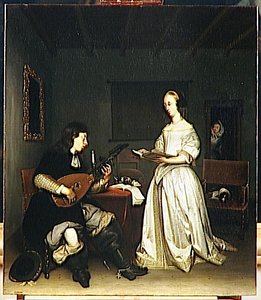 LE DUO CHANTEUSE ET JOUEUR DE LUTH THEORBE
LE DUO CHANTEUSE ET JOUEUR DE LUTH THEORBE – A Window into Dutch Golden Age Intimacy Gerard ter Borch’s “Le Duo: chanteuse et joueur de luth théorbé,” painted around 1669-1670, stands as a quintessential example of Dutch genre painting—a movement tha...
Beyond the grand historical narratives, the true soul of the Dutch Golden Age resided in
genre painting—the depiction of everyday life with remarkable realism and psychological depth. This movement sought to find the extraordinary within the ordinary. Consider the works of Gerard ter Borch, such as
Le Duo: chanteuse et joueur de luth théorbé, where a modestly furnished interior becomes a stage for quiet contemplation. In these scenes, light is used to foster intimacy; it softly touches the curve of a lute or the sheen of a satin sleeve, creating a sense of domestic tranquility. Similarly, the works of Pieter Janssens Elinga, such as
Room in a Dutch House, invite us into a world defined by order, cleanliness, and quiet labor. In these paintings, light is not always dramatic; often, it is the soft, diffused northern light that illuminates a household, elevating a simple moment of domesticity to a subject worthy of eternal preservation. This focus on the "everyday" allowed for an unprecedented exploration of human emotion, captured through the subtle nuances of a glance or the way light falls upon a resting hand.
The Master’s Touch: Analyzing Rembrandt, Hals, and Ter Borch
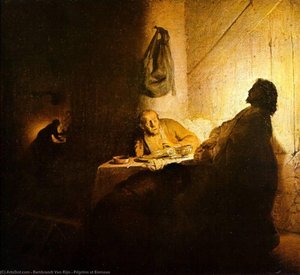 Pilgrims at Emmaus
Introduction to the Dutch Golden Age Art Movement The Dutch Golden Age was a period of unprecedented economic, scientific, and cultural growth in the history of the Netherlands, spanning roughly from 1588 to 1672. During this time, Dutch art flourish...
To study the Dutch Baroque is to engage in a dialogue with its greatest masters.
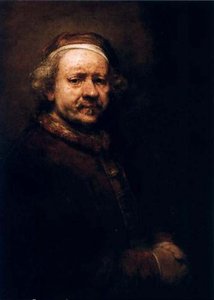
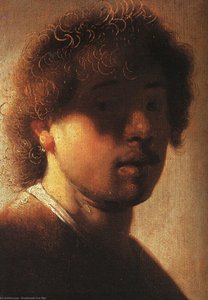
Rembrandt van Rijn stands as perhaps the most towering figure, a painter who used chiaroscuro not just for drama, but to explore the very depths of the human soul. In works like
Pilgrims at Emmaus, his use of light creates a sense of profound spiritual intensity and emotional resonance, drawing the viewer into the sacred moment through thick, expressive brushwork. In contrast,
Frans Hals offered a different kind of brilliance. Known for his revolutionary, loose brushstrokes, Hals captured the vitality of life in Haarlem. His portraits are not static; they are alive with fleeting expressions and dynamic gestures, as if the subjects might shift their seats at any moment. Then there is the enigmatic
Nicolaes Keyser, whose portraits shimmer with a distinctive golden hue, reflecting his background as a goldsmith and his ability to imbue his subjects with an almost theatrical sense of status and wealth. Each of these masters utilized light differently—some for spiritual revelation, some for social prestige, and others for the raw pulse of life—yet all shared a common devotion to the truth of the visible world.
Preserving the Glow: Collecting and Curating Dutch Masterpieces
 Dutch Masters: 10 Golden Age Paintings That Still Inspire |
Introduction Imagine stepping into a world bathed in soft northern light, where everyday life is elevated to extraordinary beauty and quiet contemplation reigns supreme. This is the realm of the Dutch Golden Age – a period of unprecedented artistic f...
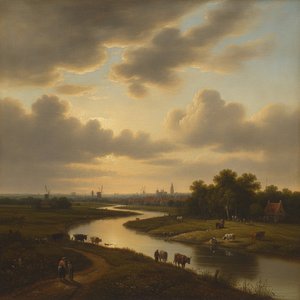
For the modern enthusiast and collector, the allure of the Dutch Golden Age remains as potent today as it was in the seventeenth century. The enduring power of these works lies in their ability to transcend time, offering a window into a period of profound human achievement. Whether one is drawn to the sweeping landscapes of
François van Knibbergen or the intricate textures of a portrait by Keyser, collecting these masterpieces is an act of preserving cultural memory. For those seeking to bring this historical grandeur into a contemporary space, the pursuit of high-quality reproductions offers a meaningful way to honor this legacy. At
ArtsDot.com, we specialize in providing museum-grade, hand-painted oil reproductions that capture the true essence of these works—from the palpable texture of the impasto brushstrokes to the complex tonal ranges of the original chiaroscuro. By choosing a reproduction that honors the academic excellence of the Old Masters, collectors can ensure that the luminous dawn of the Dutch Golden Age continues to illuminate our modern world for generations to come.