



Introduction
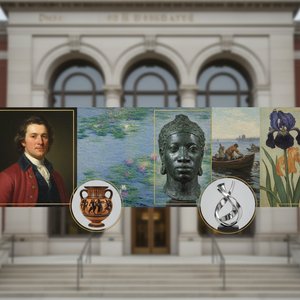
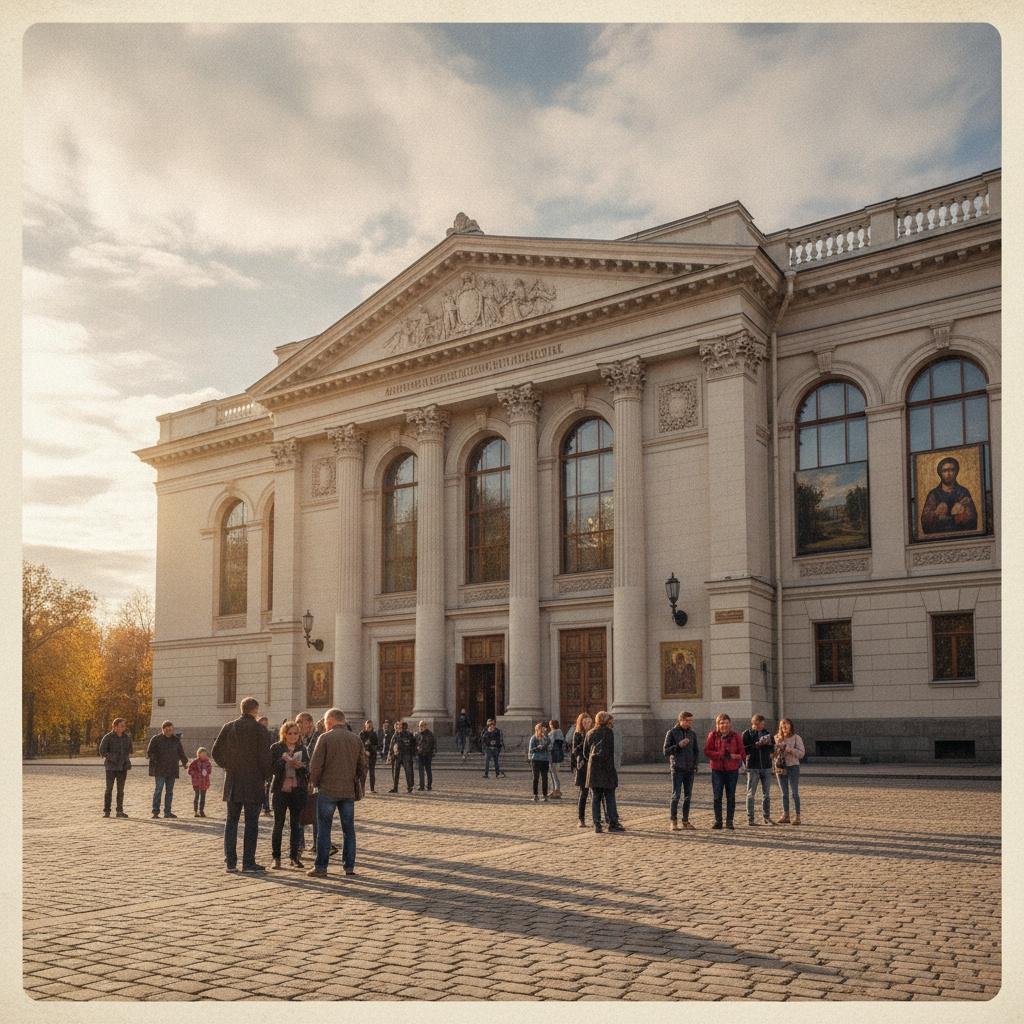
To step into the Museum of Fine Arts, Boston, is to embark on a journey through the very fabric of human creativity, spanning millennia and continents. It is not merely a building housing objects; it is a grand, silent dialogue between the past and the present. As you wander through its vast, light-filled galleries, you are invited to witness the evolution of the human spirit—from the primal echoes of ancient civilizations to the sophisticated brushstrokes of the Renaissance and the bold provocations of modernism. The museum serves as a profound cultural anchor, where the weight of history meets the lightness of aesthetic wonder.
The collection is a breathtaking tapestry of global heritage, meticulously curated to reflect the interconnectedness of our world. Within these walls, the rugged textures of ancient stone carvings stand in silent conversation with the delicate, luminous surfaces of Impressionist canvases. This institution has long served as a sanctuary for those seeking to understand the cultural currents that have shaped our shared identity, offering a window into the religious devotion, scientific curiosity, and artistic rebellion that define different eras. Each masterpiece here is a testament to the resilience of culture, surviving the passage of time to tell its story to a new generation.
What makes these works remain so deeply meaningful today is their ability to transcend their original contexts. A portrait from centuries ago still captures a flicker of recognizable emotion; a sculpture from a lost empire still commands a sense of awe; a contemporary experiment still challenges our perception of reality. These artworks act as mirrors, reflecting our own enduring struggles, joys, and questions back at us. They remind us that while technology and societies change, the fundamental impulse to create, to capture beauty, and to seek meaning remains constant.
In the following pages, we will guide you through a curated selection of twenty-five extraordinary works that embody this spirit. From the iconic and the monumental to the intimate and the exquisitely detailed, these pieces represent the pinnacle of the MFA Boston’s collection. As we explore each work, we invite you to look beyond the frame and immerse yourself in the stories, the techniques, and the profound legacies that continue to resonate within the heart of this magnificent institution.
The Fog Warning - Winslow Homer
 The Fog Warning - Winslow Homer
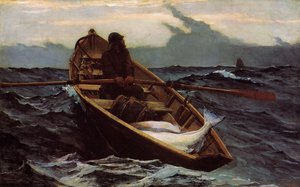
In the haunting stillness of The Fog Warning by Winslow Homer, time seems to suspend itself between the spray of a turbulent sea and the encroaching shroud of the Atlantic mist. As one of the most profound entries among the top 25 artworks in the Museum of Fine Arts, Boston, this 1885 masterpiece captures the visceral tension of human resilience against the infinite power of nature. Homer utilizes a somber, masterful palette of deep ochre, slate gray, and bruised blues to render the weight of the waves and the heavy, salt-laden air.
The texture of the oil paint breathes life into the scene; thick, expressive brushstrokes create an impasto effect that mirrors the chaotic energy of the churning water. This work transcends mere maritime realism, offering a meditative study on solitude and the precariousness of existence. For the modern collector, such a piece brings a sense of dramatic sophistication and historical gravity to a room, serving as a powerful focal point that invites quiet contemplation of our own enduring strength amidst life's inevitable storms.
Grainstack in the Morning, Snow Effect - Claude Monet
 Grainstack in the Morning, Snow Effect - Claude Monet
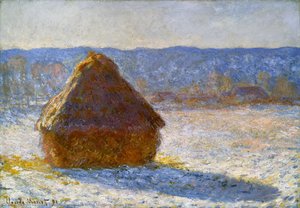
To stand before Grainstack in the Morning, Snow Effect by Claude Monet is to witness the very pulse of Impressionism. The surface of this 1890 masterpiece vibrates with short, broken brushstrokes that eschew rigid outlines for a sensory experience of light. One can almost feel the crispness of the winter air through the thick, textured application of paint, where warm ochres and deep browns of the haystack collide with the ethereal, cool violets and blues of the snow-covered landscape. This technique—capturing the ephemeral en plein air —is precisely why this work remains a cornerstone of the top 25 artworks in the Museum of Fine Arts, Boston.
At ArtsDot.com, we strive to preserve this tactile, three-dimensional quality for your own collection. Our handmade oil reproductions are meticulously crafted on cotton canvas, ensuring that the visible impasto and the luminous, atmospheric depth of Monet’s original vision are translated into a physical presence that brings the quiet prestige of the gallery into the home.
Fisherman's Cottage at Varengeville - Claude Monet
 Fisherman's Cottage at Varengeville - Claude Monet
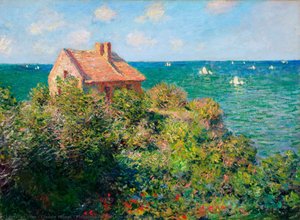
There is a gaze in Fisherman's Cottage at Varengeville by Claude Monet that follows you—not with judgment, but with understanding . This isn’t a portrait; it’s a mirror . As one of the most luminous treasures within the collection of the Museum of Fine Arts, Boston, this 1882 masterpiece reflects our own longing for tranquility. The painting captures a weathered red cottage nestled in lush, verdant foliage, overlooking a shimmering blue sea where sailboats drift like whispers on the horizon.
Monet’s Impressionist genius is felt through every textured, impasto brushstroke, capturing the fleeting, hazy light of the Normandy coast. The vibrant blues and soft greens evoke a sense of profound stillness, making the artwork a testament to its power to make the invisible visible. Now, imagine that gaze in your space. Not watching you, but reminding you : you are seen. You are part of this timeless story of nature and peace. For those seeking to bring this atmospheric depth into their own homes, our museum-quality handmade oil reproductions allow you to inhabit the light of Monet every single day.
Capri (also known as A Girl of Capri) - John Singer Sargent
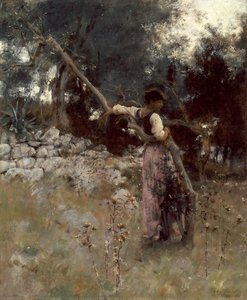 Capri (also known as A Girl of Capri) - John Singer Sargent
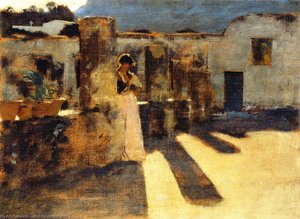
In Capri (also known as A Girl of Capri ), John Singer Sargent achieves a breathtaking structural harmony that secures its place among the top 25 artworks in the Museum of Fine Arts, Boston. The composition is anchored by the organic geometry of a weathered stone wall, which creates a soft diagonal line guiding the eye toward the solitary figure of Rosina Ferrara. This balance between the rugged, textured landscape and the delicate, vertical presence of the young woman establishes a sense of timeless perfection.
Sargent’s mastery of light and atmospheric perspective—using muted earth tones and dappled sunlight—creates an internal equilibrium that feels remarkably modern. Much like the principles of contemporary minimalist design, the painting relies on a clean, intentional arrangement of shapes and a restrained palette to ground the viewer in a moment of profound stillness. For those looking to bring this serene aesthetic into a modern interior, our hand-painted oil reproductions capture every visible brushstroke and luminous nuance of this Impressionist masterpiece, offering a sophisticated focal point that embodies both historical depth and a tranquil, contemporary elegance.
Madame Monet in Japanese Costume (La Japonaise) - Claude Monet
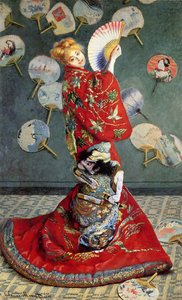 Madame Monet in Japanese Costume (La Japonaise) - Claude Monet
To gaze upon Madame Monet in Japanese Costume (La Japonaise) is to witness a breathtaking moment of cultural intersection, where the boundaries between East and West dissolve into a vibrant spectacle of color. In this 1876 masterpiece, Claude Monet captures his wife, Camille, not merely as a subject, but as a vessel for the era's profound fascination with Japonisme . The painting radiates an opulent energy; the deep, saturated reds of her elaborate uchikake kimono clash magnificently against a backdrop of delicate uchiwa fans, creating a sensory experience that feels both theatrical and intimate.
This work earns its place among the top 25 artworks in the Museum of Fine Arts, Boston due to its unparalleled ability to tell a story of global artistic exchange. Monet’s brushwork breathes life into the heavy silks and intricate embroidery, offering a tactile richness that transcends time. At ArtsDot.com, we strive to preserve this very soul. Our hand-painted oil reproductions utilize thick, visible brushstrokes and authentic pigments to ensure that the luminous reds and dramatic textures of Monet’s vision are brought into your own home, allowing you to live alongside a piece of Impressionist history.
Long Branch, New Jersey - Winslow Homer
 Long Branch, New Jersey - Winslow Homer
To stand before Winslow Homer’s Long Branch, New Jersey is to feel the warm, salt-kissed breeze of a summer afternoon in 1869. There is a profound, nostalgic tenderness in how Homer captures this Gilded Age vignette; he does not merely paint a beach, but rather the very essence of shared human tranquility. As figures in elegant Victorian attire gather along the shoreline, the viewer is drawn into a rhythmic dance of soft blues, sun-drenched sands, and the gentle movement of the Atlantic tide.
This masterpiece earns its place among the top 25 artworks in the Museum of Fine Arts, Boston through its masterful ability to blend American Realism with an early, impressionistic light. The composition guides the eye across a lively social landscape, evoking a sense of freedom and timeless connection to nature. At ArtsDot.com, we believe such evocative beauty should not be confined to museum walls. Our artisans meticulously recreate this work using 100% hand-painted oil techniques on cotton canvas, ensuring that the visible brushstrokes and luminous textures of Homer’s original vision bring that same historical elegance and serene atmosphere directly into your private collection.
Harvesters Resting - Jean-François Millet
 Harvesters Resting - Jean-François Millet
To stand before Jean-François Millet’s Harvesters Resting is to feel the heavy, sun-drenched stillness of a summer afternoon in the French countryside. There is a profound, rhythmic quietude in this 1853 masterpiece, where the exhaustion of manual labor meets the restorative grace of a shared moment. As part of the prestigious collection of the Museum of Fine Arts, Boston , this work serves as a cornerstone of the Barbizon School, moving beyond mere documentation to capture the very soul of the peasantry.
Millet employs an earthy, tonal palette—rich ochres, muted greens, and deep umbers—to ground the figures within the landscape. The composition, thick with the textures of grain and coarse fabric, celebrates the dignity of toil and the resilience of community. It earns its place among the top 25 artworks in Museum of Fine Arts, Boston through its ability to evoke a sense of timelessness and groundedness. Bringing such a piece into a modern home offers more than decoration; it introduces an atmosphere of contemplative serenity and a deep connection to the enduring cycles of nature and human perseverance.
Dance at Bougival - Pierre-Auguste Renoir
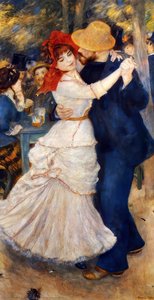 Dance at Bougival - Pierre-Auguste Renoir
In the hallowed halls of the Museum of Fine Arts, Boston, few works radiate as much warmth as Dance at Bougival by Pierre-Auguste Renoir. Created in 1883, this masterpiece serves as a luminous window into the heart of French leisure. Renoir captures a fleeting, tender moment of intimacy within the bustling social fabric of a village dance, where the central couple’s embrace anchors the composition amidst a swirling sea of café-goers.
The painting is a triumph of late Impressionist technique; Renoir utilizes fluid, broken brushstrokes and a soft, pastel palette to simulate the dappled sunlight of an afternoon outing. The textures are tactile and vibrant, evoking the movement of fabric and the gentle atmosphere of the Seine valley. For the discerning collector, this work is more than a depiction of joy—it is an invitation to transform a private space into a gallery of the soul. Whether through a museum-grade oil reproduction or a curated print, bringing Renoir’s light into your home allows you to surround yourself with the eternal celebration of human connection.
The Execution of the Emperor Maximilian of Mexico - Édouard Manet
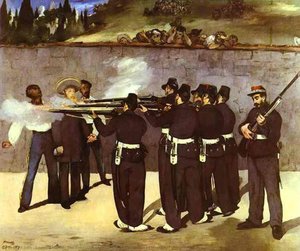 The Execution of the Emperor Maximilian of Mexico - Édouard Manet
In the somber stillness of The Execution of the Emperor Maximilian of Mexico by Édouard Manet, history is frozen in a moment of profound tragedy and political tension. This masterpiece stands among the top 25 artworks in the Museum of Fine Arts, Boston, because it transcends mere reportage, capturing the heavy, breathless atmosphere of an empire's collapse. Manet utilizes a stark, Realist technique, where muted earth tones and deep shadows collide with the disciplined, geometric lines of military uniforms to evoke a sense of inevitable doom.
The painting breathes with a textured, visceral energy; one can almost feel the cold weight of the soldiers' rifles and the grim solemnity of the firing squad. The dramatic lighting casts sharp shadows that shape the figures, pulling the viewer into this confrontation between imperial ambition and republican sacrifice. For the discerning collector, bringing a high-quality oil reproduction of this work into a modern interior introduces a powerful layer of intellectual depth and historical gravity. It is more than a painting; it is a window into the human cost of power, offering a sophisticated focal point that inspires deep reflection and conversation.
Portrait of Victorine Meurent - Édouard Manet
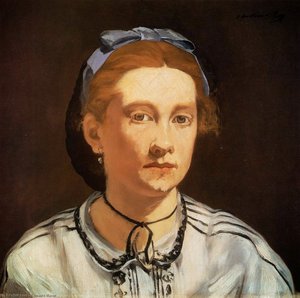 Portrait of Victorine Meurent - Édouard Manet
In the Portrait of Victorine Meurent , Édouard Manet captures more than a mere likeness; he captures the very pulse of emerging modernity. As one of the top 25 artworks in the Museum of Fine Arts, Boston, this 1862 masterpiece serves as a profound psychological bridge between the structured world of Realism and the fleeting light of Impressionism. The subject, Victorine—a formidable painter herself and Manet’s frequent muse—confronts the viewer with an gaze that is both strikingly direct and quietly introspective.
Manet’s technique eschews academic polish for a more visceral, textured reality. Through loose brushwork and a masterful interplay of light and shadow, he defines form through contrasting planes rather than meticulous blending. The warm, earthy palette and the vibrant flash of her red hair create an intimacy that feels remarkably contemporary. In today's era of digital perfection, Manet’s emphasis on the visible, human touch resonates deeply with those seeking authenticity in art. For collectors looking to bring this sense of historical gravity into a modern home, our hand-painted oil reproductions offer a way to preserve the tactile depth and soulful energy of this iconic moment in art history.
Mars and Venus - Nicolas Poussin
 Mars and Venus - Nicolas Poussin
In the halls of the Museum of Fine Arts, Boston, Mars and Venus by Nicolas Poussin stands not merely as a painting, but as a dance frozen in time. Completed in 1628, this masterpiece orchestrates a profound dialogue between the ferocity of war and the serenity of love. The lines within this canvas are not simply drawn; they are choreographed to guide the eye through a landscape of classical perfection. Pouslin utilizes a masterful chiaroscuro , where soft, diffused light sculpts the muscular form of Mars against the luminous, porcelain skin of Venus, creating a rhythmic tension between strength and grace.
As you observe the playful Cupids manipulating the god of war's armor, you witness the triumph of affection over conflict. The composition achieves a sublime equilibrium, making chaos feel like absolute harmony. For those seeking to bring this same sense of intellectual order and atmospheric depth into their own environments, our museum-quality oil reproductions allow your walls to breathe with the rhythm of antiquity. It is an invitation to transform a modern space into a sanctuary of classical balance.
Houses in Auvers 2 - vincent willem van gogh
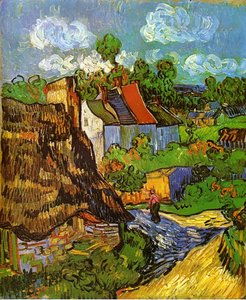 Houses in Auvers 2 - vincent willem van gogh
In Vincent van Gogh’s Houses in Auvers 2 , a deep, earthy ochre dominates the canvas, anchoring the composition with a sense of grounded, rustic warmth. This palette, characteristic of his final period in Auvers-sur-Oise, avoids the turbulent shadows of his earlier works, instead offering a rhythmic harmony between the architecture and the landscape. The masterful interplay of sun-drenched yellows and verdant greens creates an atmosphere of profound rural serenity, earning its prestigious place among the top 25 artworks in the Museum of Fine Arts, Boston.
For the discerning collector or interior designer, this painting offers a blueprint for creating a tranquil sanctuary. The soothing, light-filled color scheme can be used to curate the emotional lighting of a modern dining room, bringing an organic, pastoral energy to a sophisticated space. Whether you are drawn to the physical texture of his impasto brushstrokes or wish to commission a custom oil reproduction that captures this very essence of peace, Van Gogh’s vision remains a timeless cornerstone for any curated collection.
Twilight at Leeds, New York - Winslow Homer
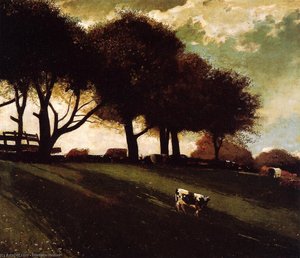 Twilight at Leeds, New York - Winslow Homer
In Winslow Homer’s 1876 masterpiece, Twilight at Leeds, New York , light is not merely an environmental condition; it is a profound emotional language. As one of the most captivating works within the Museum of Fine Arts, Boston collection, this painting captures that fleeting, sacred moment when the sun retreats, leaving behind a luminous, atmospheric glow. Homer does not simply depict a farm; he composes a sonata of shadows and soft radiance.
The scene unfolds with a quiet, rhythmic grace: two cows anchor the foreground, their forms softened by the encroaching dusk, while a horse and a solitary figure emerge from the deepening silhouettes of the trees. Through masterful use of atmospheric perspective , Homer invites us into a world where the boundary between the earth and the sky dissolves into a palette of muted, twilight hues. This work stands as a pinnacle of American Realism, offering a sense of profound stillness that transcends time. For the discerning collector, owning a hand-painted oil reproduction of such a piece means bringing this very portal of tranquility into your own home, allowing the evocative light of the 19th century to illuminate your modern space.
La Perspective (View through the Trees in the Park of Pierre Crozat) - Jean-Antoine Watteau
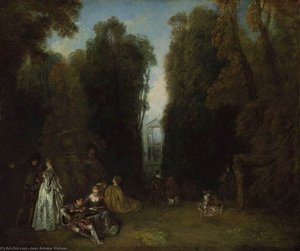 La Perspective (View through the Trees in the Park of Pierre Crozat) - Jean-Antoine Watteau
Acquiring La Perspective (View through the Trees in the Park of Pierre Crozat) by Jean-Antoine Watteau is an investment in a legacy of unparalleled French elegance and refined taste. As one of the top 25 artworks in the Museum of Fine Arts, Boston, this 1715 masterpiece stands as a cornerstone of the Rococo movement, representing the pinnacle of the fête galante genre. Its presence in such a prestigious collection confirms its immense historical influence and enduring market prestige, serving as a benchmark for collectors of 18th-century French art.
Watteau masterfully employs a soft, atmospheric perspective, guiding the eye through dappled sunlight and verdant groves toward a hazy, dreamlike horizon. The scene is alive with the subtle theater of social grace; figures emerge from the foliage like characters from an Italian comedy, their gestures suggesting whispered romances and quiet aristocratic leisure. This delicate interplay of light and shadow creates a sense of ephemeral beauty that remains breathtaking centuries later. For the modern connoisseur, a high-quality oil reproduction of this work brings a profound aesthetic authority to luxury interiors, offering a window into a world of timeless sophistication and grace.
A Turn in the Road - Paul Cézanne
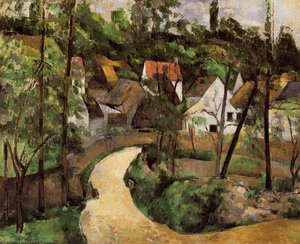 A Turn in the Road - Paul Cézanne
Acquiring A Turn in the Road by Paul Cézanne is more than a mere purchase; it is an investment in a profound artistic legacy and a testament to refined taste for the discerning collector. As one of the top 25 artworks in the Museum of Fine Arts, Boston, this 1882 masterpiece stands as a pivotal bridge between Impressionism and the birth of Cubism. Cézanne’s revolutionary ability to distill the landscape into geometric planes and structural essences has secured its place in the global canon, driving immense historical and market significance.
The canvas invites us onto a sun-drenched hillside, where winding paths and rustic cottages are rendered through deliberate, rhythmic brushstrokes. The palette—a sophisticated harmony of earthy ochres, deep forest greens, and soft cerulean—captures the quiet dignity of rural life with an almost architectural solidity. For those curating modern luxury interiors, this work offers unparalleled aesthetic authority. A meticulously hand-painted oil reproduction brings this same sense of permanence and prestige to a contemporary space, allowing the serene, structural beauty of Cézanne’s vision to anchor a room with timeless elegance.
Postman Joseph Roulin - vincent willem van gogh
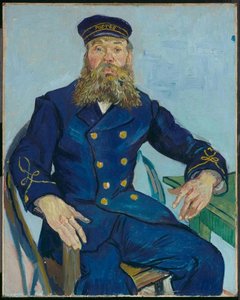 Postman Joseph Roulin - vincent willem van gogh
Imagine standing before a canvas where the very air seems to vibrate with the pulse of human connection. In Vincent van Gogh’s 1888 masterpiece, Postman Joseph Roulin , we do not merely see a portrait; we encounter the soul of Arles. The painting radiates a profound sense of steadfastness, captured through Van Gogh's legendary impasto technique , where thick, rhythmic strokes of blue and ochre create a tactile landscape of emotion.
As one of the most significant works within the Museum of Fine Arts, Boston’s collection, this portrait transcends its subject. Roulin, the local postman, becomes a universal symbol of duty and quiet dignity. Van Gogh uses bold, directional brushwork to elevate an ordinary man into a monumental figure of stability. This ability to find the extraordinary within the everyday is why this work remains essential among the top 25 artworks in the museum. Bringing such a piece into your own home—perhaps as a bespoke oil reproduction—allows that same sense of textured vitality and historical depth to anchor your space, transforming a modern room into a sanctuary of timeless, expressive beauty.
La Berceuse (Augustine Roulin) - vincent willem van gogh
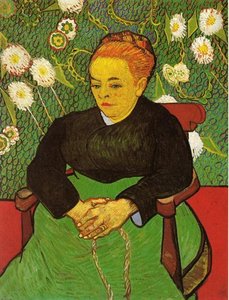 La Berceuse (Augustine Roulin) - vincent willem van gogh
Imagine a moment of profound stillness, where the frantic pulse of the world fades into the rhythmic, soothing motion of a cradle. In La Berceuse (Augustine Roulin) , Vincent van Gogh captures this very essence of maternal peace. As one of the top 25 artworks in the Museum of Fine Arts, Boston , this 1889 masterpiece transcends mere portraiture to become a universal hymn to comfort.
Van Gogh utilizes his signature Post-Impressionist technique—bold, swirling patterns and a vibrant palette of greens and yellows—to surround Augustine Roulin with the vitality of nature. The floral wallpaper and the symbolic clock evoke a sense of timelessness, suggesting that the care of a lullaby exists outside the reach of passing hours. This painting earns its place among the museum's greatest treasures through its ability to provoke deep emotional resonance; it is a visual sanctuary. Bringing such a piece into a modern home via a handmade oil reproduction allows one to invite this same sense of serenity and historical depth into their daily environment, transforming a living space into a gallery of quiet contemplation.
Trout Breaking - Winslow Homer
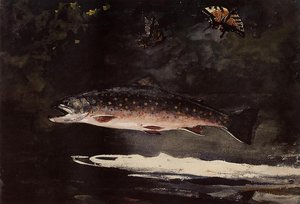 Trout Breaking - Winslow Homer
What story does the churning, sun-dappled water in Trout Breaking by Winslow Homer tell us about the raw vitality of the American wilderness? As one of the most captivating entries in the top 25 artworks in the Museum of Fine Arts, Boston, this 1889 watercolor captures a singular, breathless moment of survival and movement. Eschewing the rigid academic traditions of Europe, Homer utilized his background as an illustrator to master the spontaneity of light and fluid motion. The painting presents a rhythmic dance of muted greens and cool blues, where the shimmering surface tension of the stream is broken by the sudden, silver arc of a leaping trout.
For the modern collector, this piece offers more than historical significance; it provides a curated escape into the tranquil, rugged beauty of rural New England. The atmospheric stillness and the visceral energy of the splash create a sense of quiet prestige, making it an ideal inspiration for those seeking to bring a touch of nature's enduring resilience into their own homes through a high-quality oil reproduction.
Street Corner, Santiago de Cuba - Winslow Homer
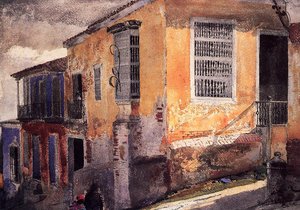 Street Corner, Santiago de Cuba - Winslow Homer
In Street Corner, Santiago de Cuba , the viewer is immediately struck by the luminous fluidity of Winslow Homer’s watercolor technique. The pigment dances across the paper with a remarkable transparency, where the sun-drenched yellow of the architecture seems to radiate heat, and the loose, spontaneous brushstrokes capture the fleeting vibrations of a Caribbean afternoon. This piece stands as a vital entry in the top 25 artworks in the Museum of Fine Arts, Boston, because it marks a transformative era in Homer’s career—moving from maritime realism toward a vibrant, light-drenched impressionism inspired by his 1885 Cuban sojourn.
The magic lies in the interplay of light and shadow, where the delicate washes of color create a sense of atmospheric depth that a mere print cannot replicate. At ArtsDot.com, we strive to preserve this tactile, three-dimensional quality for collectors. Our master artists recreate Homer’s energetic strokes on 100% cotton canvas, ensuring the visible texture and tonal range of the original watercolor are honored in a hand-painted oil reproduction that brings the soul of Santiago de Cuba into your own space.
Fruit and Jug on a Table - Paul Cézanne
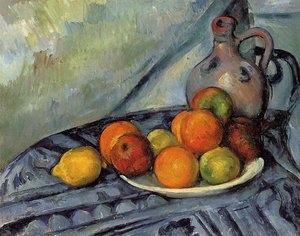 Fruit and Jug on a Table - Paul Cézanne
To encounter Fruit and Jug on a Table by Paul Cézanne is to witness the very moment modern art found its structural soul. Within the prestigious collection of the Museum of Fine Arts, Boston, this 1894 masterpiece stands as a profound rebellion against the fleeting nature of Impressionism. Rather than merely capturing light, Cézanne used deliberate, rhythmic brushstrokes to build a world of geometric permanence, transforming simple oranges, apples, and a wine jug into an architectural study of color and form.
This work is essential to our Top 25 selection because it serves as the bridge between the nineteenth century and the dawn of Cubism. The way the blue cloth interacts with the warm tones of the fruit creates a visual harmony that remains strikingly contemporary. At ArtsDot.com, we believe such transformative energy should not be confined to museum walls. Our hand-painted oil reproductions allow you to bring this Post-Impressionist legacy into your own sanctuary, turning a private study or a refined living space into a curated gallery of historical significance.
Meton Seen from Cap Martin - Claude Monet
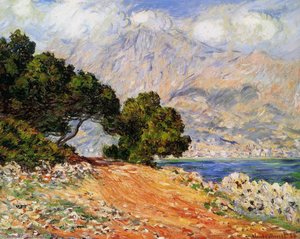 Meton Seen from Cap Martin - Claude Monet
In Meton Seen from Cap Martin , Claude Monet achieves a breathtaking mastery of luminosity, where the primary subject is not merely the Mediterranean landscape, but the very air that breathes life into it. The painting is defined by a radiant, diffused light that dissolves the hard edges of the distant mountains, replacing them with a soft, atmospheric haze characteristic of the French Riviera. This delicate play of light—capturing the sun’s warmth as it filters through foreground foliage—is precisely what secured this work's prestigious place among the top 25 artworks in the Museum of Fine Arts, Boston .
Monet’s ability to render the shimmering interplay between sea, sky, and earth creates a sensory experience that transcends the canvas. For the discerning collector, owning a high-quality oil reproduction of this masterpiece offers more than mere decoration; it introduces a sophisticated layer of depth and luminous tranquility to a contemporary interior. The visible, textured brushstrokes of a hand-painted version allow the light to dance across the surface, bringing the eternal spring of Provence into the modern home with unparalleled elegance.
Ravine - vincent willem van gogh
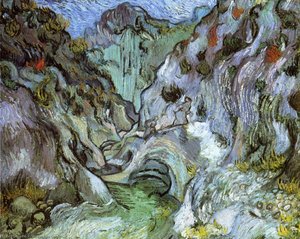 Ravine - vincent willem van gogh
While many associate Vincent van Gogh's most profound works with the turbulent skies of Saint-Rémy, Ravine (1889) captures a rare, breath-taking moment of stillness amidst his internal struggle. As one of the standout pieces in the collection of the Museum of Fine Arts, Boston , this landscape serves as a masterclass in Post-Impressionist emotional depth. Van Gogh moves beyond mere observation, using thick, rhythmic impasto strokes to sculpt the very earth and water of the valley.
The technical brilliance lies in his use of color; deep verdant greens and earthy ochres dance alongside the cool blues of the flowing river, creating a tactile sense of presence. The subtle inclusion of a single bird perched upon a textured rock provides a poignant heartbeat to the composition. This deliberate layering of light and texture does more than depict nature—it captures a soul seeking sanctuary. For the discerning collector, bringing such a masterpiece into a modern study or home office creates an atmosphere of profound focus and intellectual tranquility, turning a workspace into a personal gallery of inspiration.
View of the Sea at Sunset - Claude Monet
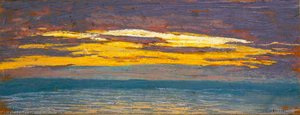 View of the Sea at Sunset - Claude Monet
In View of the Sea at Sunset , the early brushwork of Claude Monet reveals a fascinating tension between academic precision and the burgeoning Impressionist spirit. Upon close inspection, one can sense the artist's struggle to capture the ephemeral; the paint is applied with a deliberate, rhythmic touch that begins to break away from rigid outlines, favoring instead the way light dances across the Normandy coast. This 1862 masterpiece stands as a vital entry among the top 25 artworks in the Museum of Fine Arts, Boston, because it documents the precise moment Monet began prioritizing atmospheric truth over mere topographical accuracy.
The palette—a luminous infusion of warm oranges, soft peaches, and deep yellows—creates a shimmering, glass-like sea that feels almost tactile. At ArtsDot.com, our mission is to preserve this very materiality for the discerning collector. Our handmade oil reproductions utilize thick, visible brushstrokes and 100% cotton canvas to recreate the three-dimensional depth and impasto texture of Monet’s original vision, ensuring that the soul of this sunset resides vibrantly within your own home.
The Cliffs of Les Petites-Dalles - Claude Monet
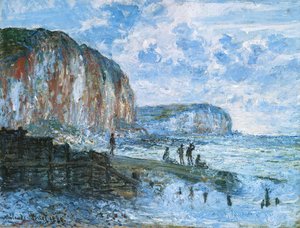 The Cliffs of Les Petites-Dalles - Claude Monet
In The Cliffs of Les Petites-Dalles , Claude Monet achieves a breathtaking mastery of luminosity, capturing the precise moment when the Atlantic light dissolves the boundaries between sea and sky. As one of the most significant works within the top 25 artworks in the Museum of Fine Arts, Boston, this 1880 masterpiece serves as a profound study of atmospheric vibration. Monet eschews rigid outlines, using short, broken brushstrokes to replicate the flickering interplay of sunlight against the Normandy coastline. The way the light dances across the rugged cliffs and reflects off the tranquil waves creates a sensory experience that transcends mere landscape painting.
This sophisticated command of illumination—where shadows are not merely dark, but composed of deep blues and violets—is what secured this work's place in the canon of Impressionism. For the discerning collector, owning a high-quality oil reproduction of such a piece brings this same luminous energy into a private residence. The visible texture of hand-painted impasto allows the light to catch the canvas, adding an unmistakable layer of depth and historical luxury to any contemporary wall, much like a window opening onto the French coast.
The Path at La Cavee, Pourville - Claude Monet
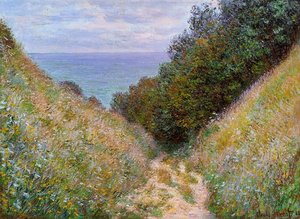 The Path at La Cavee, Pourville - Claude Monet
In The Path at La Cavee, Pourville by Claude Monet, the viewer is greeted by a masterful orchestration of geometric harmony and organic grace. The composition is anchored by the winding path, a rhythmic line that draws the eye through verdant, undulating hills toward the vast, shimmering horizon of the sea. This structural balance—the way the terrestrial weight of the grassy slopes meets the ethereal lightness of the sky—creates a sense of timeless perfection that secures its place among the top 25 artworks in the Museum of Fine Arts, Boston .
Monet’s ability to organize nature into such a balanced, tranquil vista offers a profound connection to modern minimalist design. The painting’s clean visual flow and restrained, atmospheric palette provide a grounding element for contemporary interiors, where simplicity and light are paramount. As you stand before this Impressionist treasure, the interplay of sunlight filtering through foliage evokes a sensory experience of coastal breezes and warmth. For those seeking to bring this serene aesthetic into their own homes, our hand-made oil reproductions capture every delicate brushstroke and luminous hue of Monet’s original vision.
Conclusion
To wander through the halls of the Museum of Fine Arts, Boston, is to engage in a silent dialogue with the centuries. The masterpieces we have explored are far more than mere relics of a bygone era; they are living presences that continue to pulse with the same emotional intensity that moved their creators. Whether it is the profound stillness found in a classical portrait or the vibrant, sweeping energy of an impressionist landscape, these works possess a unique ability to transcend time, shaping our modern perceptions of beauty and resilience. They serve as anchors for the human spirit, reminding us that while technology and borders may shift, the fundamental language of light, shadow, and emotion remains eternal.
As the sun sets on this virtual gallery tour, we invite you to bring that sense of wonder into your own sanctuary. At ArtsDot.com , we believe that the soul of a masterpiece should not be confined to museum walls. Every iconic work in our full collection can be reborn as a bespoke, hand-painted reproduction. Our dedicated artists, trained in the rigorous traditions of fine art academies, meticulously honor the original's brushstrokes, texture, and tonal depth, ensuring that the historical essence of these treasures is preserved on canvas for your home. Through the careful application of oil on cotton and the intentional layering of pigment, we strive to bridge the gap between the museum archive and your personal space, allowing you to live alongside the greatness of art history every single day.