

Introduction
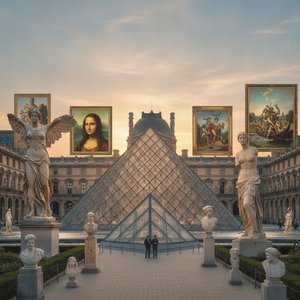
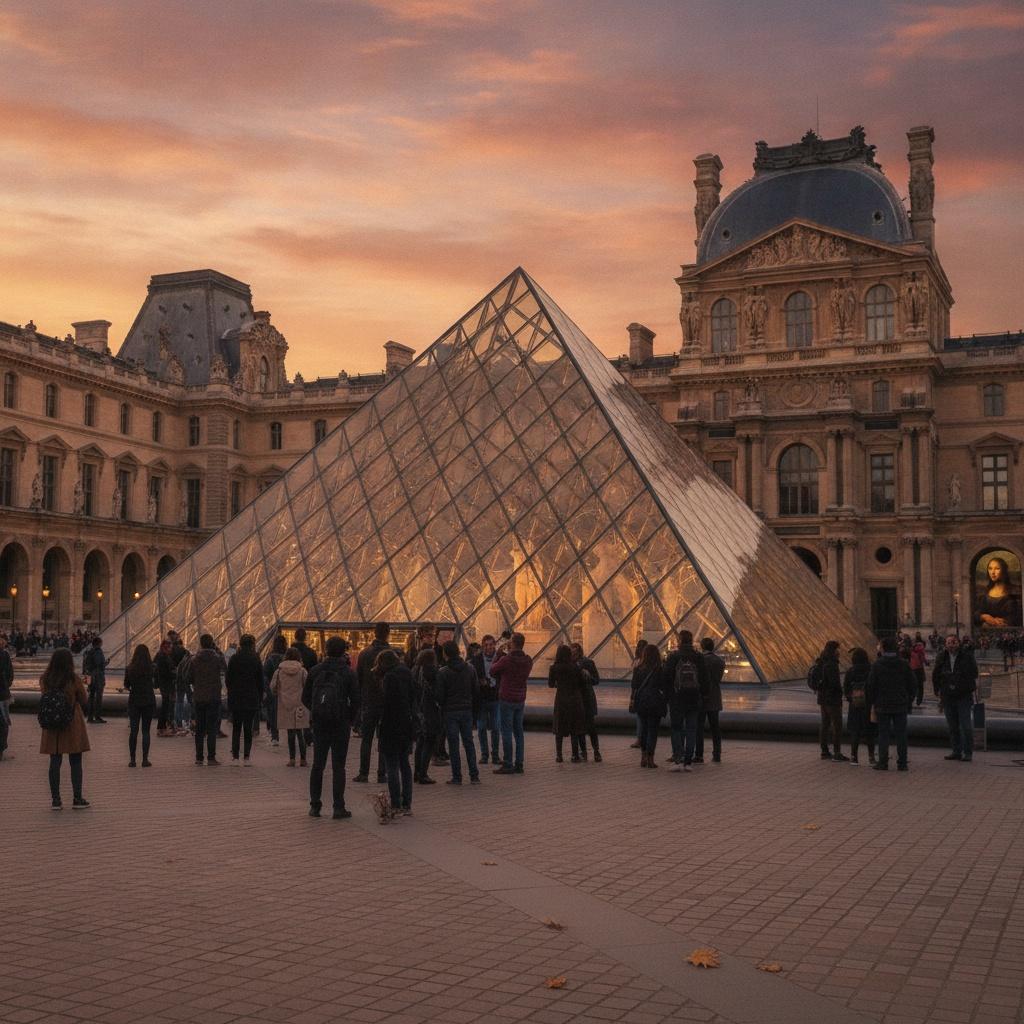
To step across the threshold of the Musée du Louvre is to leave the frantic pace of the modern world behind and enter a sanctuary where time itself seems to pause. This is not merely a building housing masterpieces; it is a palimpsest etched in stone and canvas, a living chronicle that began as a formidable 12th-century fortress under Philip II and evolved into the opulent palace of kings. As you wander through its labyrinthine halls, you are walking through the very heartbeat of French history—from the Renaissance elegance of Pierre Lescal’s arcades to the regal grandeur of Louis XIV’s architectural ambitions.
The collection within these walls offers an unparalleled journey through human creativity across millennia. From the silent, colossal sentinels of Egyptian antiquity to the luminous brushstrokes of the Renaissance masters, each work serves as a window into a different era of our shared existence. These artworks remain profoundly meaningful today because they transcend their original contexts; they speak to universal truths about power, divinity, mortality, and the eternal pursuit of beauty that continues to resonate in our contemporary soul.
In the following exploration, we invite you to journey through twenty-five of the most iconic works housed within this legendary institution. Each selection represents a pinnacle of artistic achievement, offering a glimpse into the profound cultural shifts that have shaped our world. Prepare to encounter the legends that continue to command the gaze of millions and define the very essence of art history.
Mona Lisa (La Gioconda) - Leonardo da Vinci
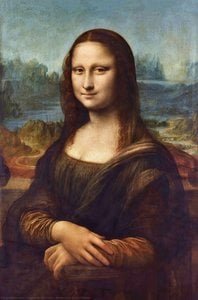 Mona Lisa (La Gioconda) - Leonardo da Vinci
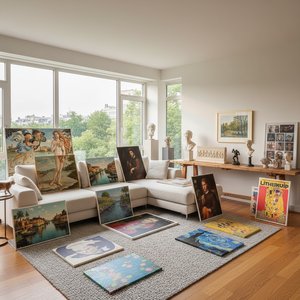
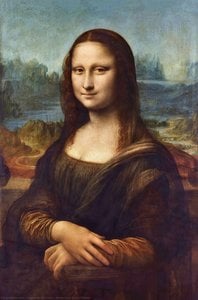
To encounter the Mona Lisa is to meet a gaze that seems to follow you through time, an enigmatic presence that remains the very heartbeat of the museum. Within the prestigious collection of the top 25 artworks in 'The Louvre, Paris' , Leonardo da Vinci’s 1519 masterpiece stands unparalleled for its psychological depth. Through his revolutionary sfumato technique, Da Vinci blurred the edges of reality, using delicate layers of translucent oil glazes to create a smoky, lifelike softness that breathes life into Lisa Gherardini’s subtle, mysterious smile. This painting is more than a mere portrait; it is a universal mirror of human emotion, capturing a fleeting moment of secret knowledge and quiet contemplation. Integrating this profound emotional resonance into your own home—perhaps through a meticulous hand-painted oil reproduction—can transform a personal sanctuary into a space for deep reflection, inviting the same sense of timeless wonder that has captivated the world for centuries.
Liberty Leading the People - Eugène Delacroix
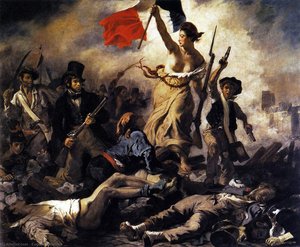 Liberty Leading the People - Eugène Delacroix
In the hallowed galleries of The Louvre, few works command the room quite like Liberty Leading the People by Eugène Delacroix. Within this monumental achievement of Romanticism, the lines are not merely drawn; they are choreographed . This is far more than a historical record of the July Revolution; it is a dance frozen in time , where the visceral chaos of the barricades is distilled into a singular, harmonious moment of triumph.
As your eyes follow the tricolor flag through the haze of smoke and grit, you encounter a pyramidal composition that directs the soul upward. Delacroix masterfully balances the stark, patriotic reds against somber, earthy tones, creating a visual tension that is both haunting and heroic. For collectors exploring the top 25 artworks in The Louvre, Paris, this piece offers an unparalleled emotional depth. It invites you to consider what happens when your own space holds such balance—where your walls can breathe rhythm and reflect the enduring struggle for freedom through a masterpiece of light and movement.
Gilles - Jean-Antoine Watteau
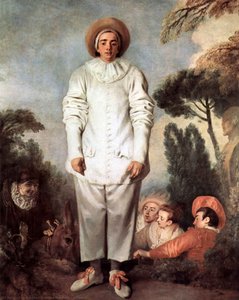 Gilles - Jean-Antoine Watteau
Imagine standing before a figure draped in luminous white, frozen in a moment of profound, quiet vulnerability amidst the hazy greenery of an 18th-century stage. Jean-Antoine Watteau’s Gilles (1719) is a hauntingly beautiful cornerstone of the Rococo movement and a standout among the top 25 artworks in The Louvre, Paris .
The painting captures the enigmatic Pierrot—a character from the commedia dell'arte —with a technical mastery that blurs the line between theater and reality. Watteau employs a delicate, almost weightless brushwork to render the costume, while the soft, atmospheric landscape recedes into a dreamlike mist, evoking a sense of gentle melancholy. The interplay of light and shadow creates a texture so supple it feels as though the fabric might flutter at any moment.
Bringing such a piece into a contemporary space offers more than mere decoration; it introduces a sense of quiet prestige and historical depth. The painting’s ethereal palette and emotive stillness serve as an anchor for reflection, elevating a room with timeless, sophisticated grace.
The Raft of the Medusa - Théodore Géricault
 The Raft of the Medusa - Théodore Géricault
Standing before The Raft of the Medusa , one does not merely observe a maritime disaster; one feels the visceral weight of human desperation. As a cornerstone of the top 25 artworks in The Louvre, Paris, Géricault's masterpiece transcends historical tragedy to become an emblem of Romantic intensity. The canvas is a turbulent sea of dark ochres and bruised blues, where bodies contort within a pyramidal struggle for salvation amidst stark chiaroscuro.
There is a gaze in The Raft of the Medusa by Théodore Géricault that follows you—not with judgment, but with understanding . This isn’t a portrait; it’s a mirror . Its spot in the top 25 is a testament to its power to make the invisible visible. As you navigate the shadows of this monumental work, imagine that gaze in your own space—not watching you, but reminding you: you are seen. You are part of the story.
Self-portrait at 22 - Albrecht Dürer
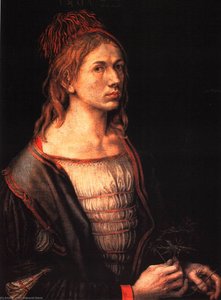 Self-portrait at 22 - Albrecht Dürer
Before he became the titan of the German Renaissance, a twenty-two-year-old Albrecht Dürer sat before his canvas, perhaps gripped by the weight of his own burgeoning identity. In this 1493 masterpiece, we witness the precise dawn of Northern Renaissance realism . Observe how the light catches the thistle—a poignant symbol of resilience and suffering—and how Dürer's meticulous oil glazes create a lifelike texture in the subject's skin and heavy, armor-like garments. This work represents a significant conceptual leap, using shadow and light to transform a simple likeness into a profound psychological study. As one of the most captivating entries among the top 25 artworks in The Louvre, Paris , this portrait captures an intensity that transcends time. Bringing a masterfully crafted reproduction of this piece into a modern home office or study invites that same spirit of disciplined focus and quiet introspection, fostering a sophisticated atmosphere perfect for deep, productive thought.
The Embarkation for Cythera - Jean-Antoine Watteau
 The Embarkation for Cythera - Jean-Antoine Watteau
In the grand tapestry of the top 25 artworks in The Louvre, Paris , few pieces capture the ephemeral pulse of life quite like Jean-Antoine Watteau’s The Embarkation for Cythera . To look upon this canvas is to realize that the lines aren’t merely drawn; they are choreographed . This is not a static composition; it is a dance frozen in time.
As you wander through the museum, this 1717 masterpiece invites you into the world of the fête galante , where aristocratic figures move with a rhythmic grace toward the mythical island of love. Watteau employs soft, wispy brushstrokes and a luminous palette of golds and earthy tones to create an atmosphere that feels both dreamlike and deeply tactile. The movement of the lovers, the fluttering cupids, and the hazy, receding landscape work in perfect harmony to transform potential chaos into a serene, rhythmic elegance. Imagine if your own living room could hold this same exquisite balance—where your walls do not just decorate, but truly breathe with the rhythm of history.
Basket with Oranges - Henri Matisse
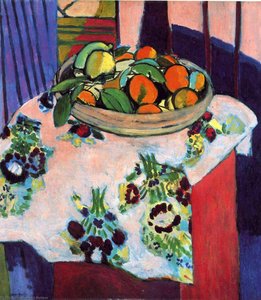 Basket with Oranges - Henri Matisse
A burst of sun-drenched vitality, Basket with Oranges by Henri Matisse captures a moment where light and pigment dance in eternal harmony. As one of the most captivating entries among the top 25 artworks in The Louvre, Paris , this 1913 masterpiece stands as a pillar of the Fauvist movement, breaking from tradition to prioritize emotional truth through color. Matisse employs a palette of searing oranges and luminous yellows, contrasted against deep, rhythmic blues that breathe life into the floral-patterned cloth. The thick, tactile brushstrokes create a surface that feels alive, inviting the eye to wander through its simplified, geometric forms. Beyond its historical significance, the painting’s vibrant energy offers a sophisticated infusion of warmth for the modern home. Whether as a centerpiece in a minimalist gallery or a soulful accent in a contemporary living space, its ability to evoke prosperity and renewal makes it a timeless choice for any discerning collector seeking to bring the spirit of French Modernism into their daily lives.
Arab Horses Fighting in a Stable - Eugène Delacroix
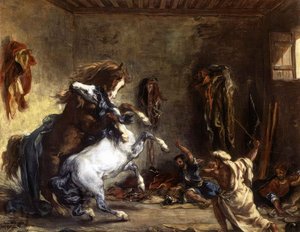 Arab Horses Fighting in a Stable - Eugène Delacroix
To witness Arab Horses Fighting in a Stable is to feel the raw, kinetic energy of Eugène Delacroix’s brush. Up close, the canvas reveals a masterful use of expressive, loose strokes that capture the frantic muscular tension of the rearing stallions and the gritty texture of the stable's wooden beams. This work stands as a pillar among the top 25 artworks in The Louvre, Paris , because it embodies the very heart of Romanticism—prioritizing visceral emotion and dramatic movement over classical restraint. Delacroix’s ability to weave earthy ochres and deep shadows into a narrative of North African chaos is nothing short of revolutionary. At ArtsDot.com , our mission is to preserve this tactile, three-dimensional quality for the discerning collector. Our hand-painted oil reproductions are meticulously crafted to honor these visible brushstrokes and the profound depth of the original, ensuring that the dramatic spirit of Delacroix’s masterpiece is not merely viewed, but felt within your own space.
The Poet's Inspiration - Nicolas Poussin
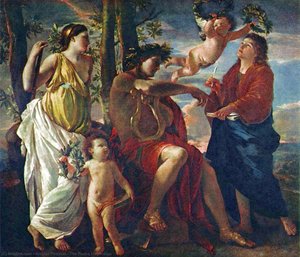 The Poet's Inspiration - Nicolas Poussin
Imagine stepping into a sun-drenched grove where the air hums with the first notes of a lyre. In The Poet's Inspiration , Nicolas Poussin captures that precise, breathless moment when the divine touches human creativity. As one of the most profound works within The Louvre’s collection, this 1630 masterpiece transcends mere mythology through its disciplined, classical grace.
You can almost feel the warmth of the golden ochres and deep reds as Apollo sits centered in a balanced, triangular formation. The play of light—a masterful use of chiaroscuro —illuminates the laurel wreath of victory and the soft, ethereal glow of the hovering cherub, pulling your gaze into a world of intellectual order and poetic passion. Bringing this sense of classical serenity into a modern home allows for a space of deep reflection and creative energy. A hand-painted oil reproduction of this Poussin masterpiece serves as a timeless anchor, inviting the grandeur of Paris into your personal sanctuary.
Young Christian Martyr - hippolyte-paul delaroche
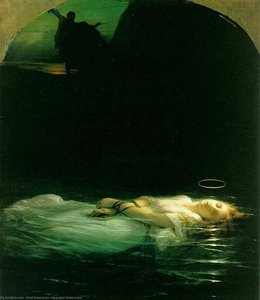 Young Christian Martyr - hippolyte-paul delaroche
A haunting silence hangs over Young Christian Martyr by Hippolyte-Paul Delaroche, where light and shadow dance upon the threshold of life and death. Standing as a profound highlight among the top 25 artworks in 'The Louvre, Paris' , this masterpiece captures the very essence of Romanticism through its themes of sacrifice and transcendence. The painting’s palette is a symphony of melancholy, with deep emerald greens and midnight blues swirling around the pale, ethereal form of the submerged figure. Delaroche’s meticulous technique creates a tactile sense of water and light, drawing the eye toward the shadowy presence watching from the cliffs above. Beyond its historical significance, the work offers an unparalleled emotional depth; its dramatic chiaroscuro and somber elegance serve as a sophisticated anchor for modern interiors, inviting a sense of quiet contemplation and timeless grace into any curated collection.
The Four Evangelists - Jacob Jordaens
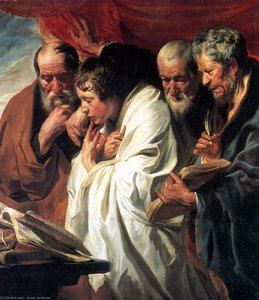 The Four Evangelists - Jacob Jordaens
To acquire a piece such as "The Four Evangelists" by Jacob Jordaens is to invest in a profound legacy of Flemish mastery and discerning taste. Standing as a cornerstone among the top 25 artworks in 'The Louvre, Paris' , this 1620 masterpiece exemplifies the dramatic intensity of the Baroque era. Through a masterful use of chiaroscuro , Jordaens illuminates the weathered faces and scholarly focus of the four figures, pulling the viewer into a sacred moment of intellectual and spiritual pursuit. The rich, earthy palette of deep browns and muted reds creates an intimate atmosphere that has captivated collectors for centuries.
Beyond its historical significance, the painting’s profound emotional depth offers a striking aesthetic authority for modern luxury interiors . A meticulous, hand-painted oil reproduction allows the dramatic light and textured realism of Jordaens' work to anchor a contemporary space, providing a timeless connection to the grandeur of art history.
The Virgin and Child with Saint Anne - Leonardo da Vinci
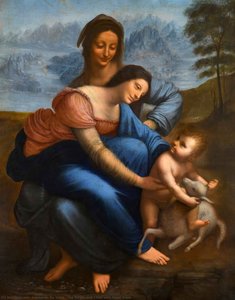 The Virgin and Child with Saint Anne - Leonardo da Vinci
Imagine standing before a canvas where the very air seems to soften, and a profound stillness settles over your soul. In Leonardo da Vinci’s The Virgin and Child with Saint Anne , we encounter a moment of divine intimacy captured through the master's revolutionary sfumato technique. As the misty, ethereal landscape recedes into distant, blue-hued mountains, three generations of sacred lineage—Saint Anne, the Virgin Mary, and the Christ Child—emerge in a perfect, pyramidal harmony.
This masterpiece stands among the top 25 artworks in The Louvre, Paris because it transcends mere religious iconography; it embodies the High Renaissance ideal of emotional depth and technical perfection. The subtle transitions of light and shadow evoke a sense of eternal peace that remains as moving today as it was in 1510. Bringing such a vision into a contemporary space through a meticulously hand-painted oil reproduction allows one to invite this timeless serenity and the profound beauty of the Renaissance into the modern home, creating a personal sanctuary of historical meaning.
The battle of san romano - the counter-attack by mich - Paolo Uccello
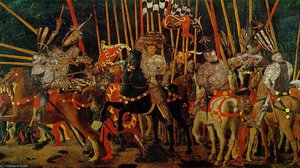 The battle of san romano - the counter-attack by mich - Paolo Uccello
A frozen moment of clashing steel and heraldic splendor, The Battle of San Romano - The Counter-Attack by Mich captures the very heartbeat of Renaissance conflict. As one of the most essential works within the top 25 artworks in The Louvre, Paris , Paolo Uccello’s masterpiece is immortalized for its revolutionary fusion of mathematical perspective and cinematic dynamism.
The sensory experience is profound, defined by a palette of warm golds, fiery oranges, and deep reds that emerge from the somber shadows of the battlefield. The textured oil layers evoke the heavy weight of ceremonial armor and the visceral energy of the charge. In a contemporary setting, this painting offers an unparalleled sense of historical gravity; its disciplined geometry and rich, earthy tones provide a sophisticated focal point, bringing the profound architectural strength of the Quattrocento into the modern interior.
Portrait of Nikolaus Kratzer - Hans Holbein the Younger
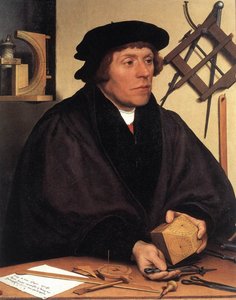 Portrait of Nikolaus Kratzer - Hans Holbein the Younger
In the hallowed halls of The Louvre, Portrait of Nikolaus Kratzer by Hans Holbein the Younger emerges as more than a mere likeness; it is a profound window into the Renaissance intellect. This work earns its place among the top 25 artworks in The Louvre through its breathtaking precision, capturing the very pulse of scientific inquiry through the meticulous rendering of astronomical tools and scholarly textures. Holbein’s mastery of light and shadow invites us into Kratzer's world, where every instrument tells a story of human curiosity.
What if I told you that this portrait was born from a moment of quiet defiance against the ordinary? Its presence in your personal sanctuary—perhaps above a mahogany desk or within a refined study—is not just decor; it is a manifesto . It turns every glance into a reminder: your space is not just a room. It’s a statement. At ArtsDot.com, we bring this historical gravity to your walls through hand-painted oil reproductions, allowing you to inhabit the same atmosphere of intellectual brilliance that defined the Northern Renaissance.
La Belle Jardiniere - Raphael
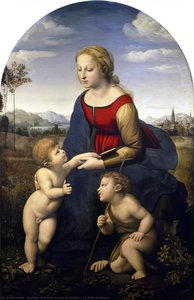 La Belle Jardiniere - Raphael
Can you feel the light in La Belle Jardiniere by Raphael? It is not merely illumination; it is a language. The artist did not simply paint light—he composed it, like a musician crafting a silent sonata of grace. In this 1507 masterpiece, Raphael employs a masterful use of chiaroscuro and sfumato to breathe life into the Madonna and Child, creating a soft, velvety texture that feels almost tactile.
The pyramidal composition anchors the scene, leading your eye from the tender gaze of the Virgin through the lush, atmospheric landscape toward the distant, hazy mountains. Every brushstroke embodies the High Renaissance pursuit of harmony and divine beauty. This is why it remains a crown jewel of The Louvre: it does not just reflect light; it invents it. Now, open your eyes. That sacred glow? It is waiting to spill into your home, turning your walls into portals of inspiration through our meticulous, hand-painted oil reproductions that capture every luminous layer and delicate shadow of this Renaissance treasure.
Virgin of the Rocks - London - Leonardo da Vinci
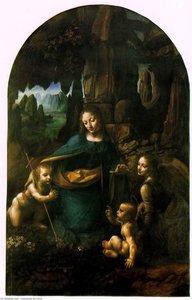 Virgin of the Rocks - London - Leonardo da Vinci
Leonardo da Vinci’s Virgin of the Rocks stands as a profound testament to the High Renaissance, capturing a moment where the divine and the natural world become indistinguishable. As one of the top 25 artworks in The Louvre, Paris , its significance lies in Leonardo's revolutionary use of sfumato . By masterfully blending tones to create a smoky, atmospheric depth, he allows the figures to emerge from the shadows of the rocky grotto with an almost supernatural lifelikeness.
The painting invites us to contemplate the delicate balance between human tenderness and cosmic mystery. Through the pyramidal arrangement of the Holy Family, we see a blueprint for harmony and spiritual unity that continues to resonate today. This masterpiece does more than depict a sacred encounter; it offers a window into the very essence of beauty and grace. For the discerning collector, bringing a hand-painted reproduction of this work into a modern environment provides an opportunity to infuse a sophisticated space with a sense of eternal tranquility and historical depth.
The Lictors Returning to Brutus the Bodies of his Sons - Jacques-Louis David
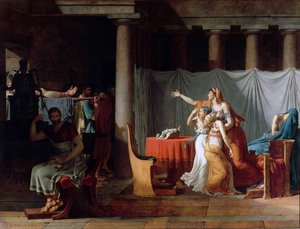 The Lictors Returning to Brutus the Bodies of his Sons - Jacques-Louis David
There’s a gaze in "The Lictors Returning to Brutus the Bodies of his Sons by Jacques-Louis David" that follows you—not with judgment, but with understanding . This isn’t a portrait; it’s a mirror . Its spot in the Top 25 is a testament to its power to make the invisible visible. Now, imagine that gaze in your space. Not watching you, but reminding you : you are seen. You are part of the story.
Painted in 1789, as France stood on the precipice of revolution, this Neoclassical masterpiece captures a harrowing moment of Roman history. David utilizes a dramatic interplay of light and shadow to highlight the tragic tension between Lucius Junius Brutus’s paternal grief and his unwavering civic duty. The composition is a study in contrasts: the cold, unyielding stone of classical architecture set against the heavy, somber reality of sacrifice. Through meticulous brushwork and an earthy, muted palette, the artist renders every fold of fabric and texture of skin with profound gravity. Owning a hand-painted oil reproduction of this work allows you to invite this powerful legacy of moral integrity and historical grandeur into your own environment.
The Parnassus: Mars and Venus - Andrea Mantegna
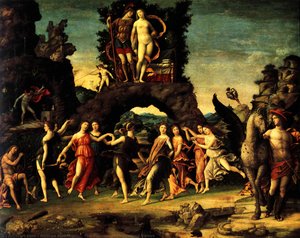 The Parnassus: Mars and Venus - Andrea Mantegna
A serene, sun-bleached ochre and the cool, muted greys of classical marble dominate The Parnassus: Mars and Venus , casting a mood of eternal, tranquil afternoon light across the scene. This masterful use of a restrained, earthy palette is precisely why Mantegna’s work remains a cornerstone among the top 25 artworks in The Louvre, Paris ; his ability to marry these naturalistic tones with revolutionary linear perspective creates a sculptural depth that feels both ancient and alive. For those looking to curate a sophisticated atmosphere in a modern living space or dining room, this painting offers an exquisite blueprint. The harmonious interplay of stone-like neutrals and soft, celestial blues can anchor a room’s aesthetic, providing a calm, intellectual foundation. By pairing such a piece with warm, directional lighting, one can replicate the fresco's soft glow, transforming a contemporary interior into a sanctuary of Renaissance elegance and historical depth.
Leonidas at Thermopylae - Jacques-Louis David
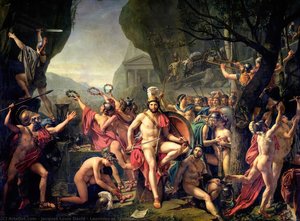 Leonidas at Thermopylae - Jacques-Louis David
In the grand narrative of the top 25 artworks in 'The Louvre, Paris', few pieces command the room with such visceral intensity as Leonidas at Thermopylae . Within this colossal canvas by Jacques-Louis David, the lines are not merely drawn; they are choreographed . It is a dance of bronze and blood frozen in time, where the chaos of the Persian invasion meets the rigid, rhythmic order of Neoclassical idealism.
As you gaze upon the dramatic chiaroscuro, the tension of the narrow pass becomes palpable. David utilizes a masterful pyramidal composition to elevate King Leonidas from a mere soldier to an eternal symbol of Stoic duty and sacrifice. The interplay of light and shadow breathes life into every spear tip and crimson cloak, creating a sense of harmony amidst the battlefield's fury. What if your own walls could hold this same profound balance? Our handmade oil reproductions allow you to invite this historical gravity into your home, meticulously hand-painted on cotton canvas to preserve the authentic texture and heroic spirit of David’s masterpiece.
Saint John the Baptist - Leonardo da Vinci
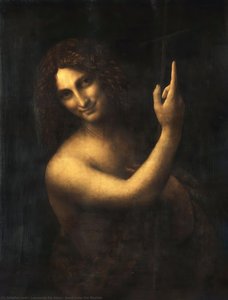 Saint John the Baptist - Leonardo da Vinci
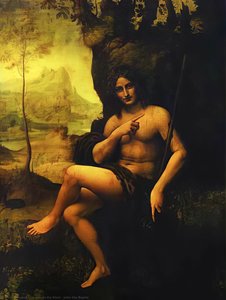
Emerging from the velvety shadows of the High Renaissance, Saint John the Baptist stands as one of the most enigmatic and spiritually profound entries among the top 25 artworks in 'The Louvre, Paris'. As one of Leonardo da Vinci’s final works, it captures the master at the height of his psychological insight. Through his legendary sfumato technique, Da Vinci dissolves rigid lines into soft, smoky transitions, allowing the saint's face to emerge from a deep, mysterious darkness with an unsettlingly familiar, enigmatic smile.
The painting transcends mere religious iconography; it is a profound meditation on the human soul and the divine. The upward gesture of the finger serves as a silent command toward the heavens, inviting viewers to reflect on faith, mystery, and the unseen. For the modern collector, this piece offers an unparalleled sense of drama and intellectual depth. Its masterful use of light and shadow makes it a timeless cornerstone for any curated space, bridging the gap between 16th-century devotion and contemporary aesthetic elegance.
Philosopher in Meditation - Rembrandt van Rijn
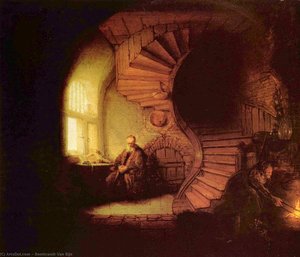 Philosopher in Meditation - Rembrandt van Rijn
To stand before Rembrandt’s 1632 masterpiece is to enter a sanctuary of silence, where flickering light dances against the profound shadows of the human soul. In this intimate study, the dramatic chiaroscuro does more than illuminate a room; it illuminates the very essence of introspection. As one of the most evocative pieces among the top 25 artworks in 'The Louvre, Paris' , this painting redefined the boundaries of emotional depth through its masterful interplay of light and darkness.
What if I told you that "Philosopher in Meditation" by Rembrandt van Rijn was born from a moment of rebellion—a stroke of defiance against the ordinary? This is not merely art; it is a manifesto . Its place in history is not just earned; it is demanded by the weight of its own genius. Now, imagine this rebellion hanging above your desk or within your personal sanctuary, turning every glance into a reminder: your space is not just a room. It’s a statement.
St Louis, King of France, with a Page - El Greco
 St Louis, King of France, with a Page - El Greco
As you navigate the top 25 artworks in The Louvre, Paris, El Greco’s 1592 masterpiece, St Louis, King of France, with a Page , stands as a profound testament to the transition from Mannerism to Baroque. This is not merely a portrait; it is an exploration of divine authority and human vulnerability. El Greco employs his iconic, elongated figures and masterful chiaroscuro to sculpt the King’s face from the surrounding shadows, creating a sense of spiritual intensity. The interplay of light on the King's regal attire and the polished armor of his young attendant evokes a world of chivalry and solemn duty. To possess a hand-painted reproduction of this work is to experience true transformation. It is not mere decoration; it is an act of liberating history, turning your space into a gallery of the soul where the dramatic light and historical gravity of the 16th century can reside.
LE CALVAIRE - Andrea Mantegna
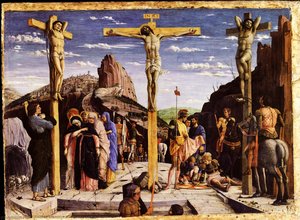 LE CALVAIRE - Andrea Mantegna
In the hallowed corridors of the Louvre, Andrea Mantegna’s Le Calvaire stands as a profound testament to the Renaissance's obsession with classical antiquity. This is not merely a religious scene; it is an architectural reconstruction of faith. Through his revolutionary use of linear perspective, Mantegna manipulates space to create an illusion of immense sculptural depth, forcing the viewer’s eye upward toward the central figure of Christ. The figures—including Saint John the Baptist and Mary Magdalene—are rendered with such anatomical precision they appear carved from marble rather than painted on wood. This somber, monumental atmosphere, enriched by the dramatic presence of a horse on the periphery, invites a deep, meditative stillness. For the collector seeking to transcend mere decoration, our hand-painted oil reproductions allow you to bring this historical gravity into your home, transforming your personal space into a true gallery of the soul.
Christ on the Cross Adored by Two Donors - El Greco
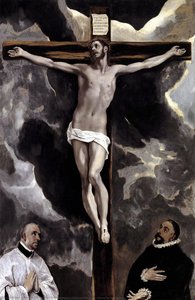 Christ on the Cross Adored by Two Donors - El Greco
Before he became a pillar of the Spanish Renaissance, El Greco was often viewed as a stylistic rebel, pushing the boundaries of form far beyond the classical ideals of his era. In Christ on the Cross Adored by Two Donors , one witnesses the breathtaking power of Tenebrism , where stark, celestial light pierces through deep, somber shadows to illuminate Christ’s contorted, suffering form. The painting is a masterclass in emotional depth; the elongated figures and swirling, turbulent clouds create a sense of spiritual movement that transcends the canvas. As one of the most profound pieces among the top 25 artworks in 'The Louvre, Paris', it captures a haunting dialogue between the human and the divine through its dramatic palette of greys, blacks, and piercing whites. Such intense, focused energy is more than just historical—it serves as a powerful inspiration for a modern study or home office, where the gravity of El Greco’s vision can foster an atmosphere of profound contemplation and intellectual rigor.
Orpheus and Eurydice (Landscape with Orpheus and Eurydice) - Nicolas Poussin
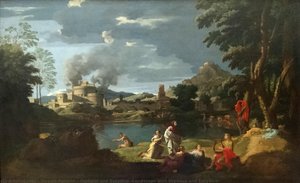 Orpheus and Eurydice (Landscape with Orpheus and Eurydice) - Nicolas Poussin
To stand before Nicolas Poussin’s Orpheus and Eurydice within the hallowed halls of the Louvre is to witness a profound dialogue between light and shadow. Painted around 1650, this work transcends mere mythology; it captures the agonizing suspense of Orpheus’s ascent from the Underworld, where one backward glance could seal a tragic fate. Poussin employs a deliberate, intellectual composition, using chiaroscuro to pull the figures from the gloom of the landscape—a setting inspired by the Roman Campagna that whispers of antiquity and decay. The river flows as a symbol of life’s transition, mirroring the fragile hope of the lovers. This painting is not merely an artifact; it is a window into the human condition. For collectors who wish to surround themselves with such enduring genius, our handmade oil reproductions offer a way to bring this museum-grade mastery into your private space, meticulously recreating Poussin's classical textures and emotional depth.
Conclusion
As the evening shadows lengthen across the galleries of the Louvre, we are left with a profound realization: these masterpieces are far more than silent witnesses to history. They are living, breathing presences that continue to pulse with the energy of the hands that created them. Each stroke of oil and layer of glaze serves as a bridge between centuries, connecting the grandeur of the French monarchy to the intimate sanctuaries we call home. These works do not merely exist within museum walls; they reside within our collective memory, shaping how we perceive light, shadow, and the very essence of human emotion. To surround oneself with such artistry is to invite a timeless dialogue into the everyday, transforming a mere room into a space of reflection and wonder. As you continue your journey through art history, we invite you to discover more within our full collection , where the legacy of the masters remains eternally accessible.