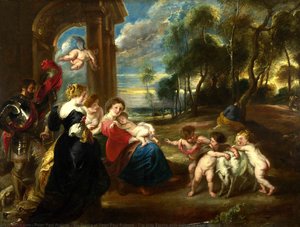

The Seismic Shift: From Renaissance Harmony to Baroque Emotion
 The Visceral Stage: Exploring Dramatic Narratives & Emotional Intensity in Baroque Art
The Baroque Embrace of Emotion: A Shift from Renaissance Rationality Wikipedia: Baroque painting Baroque painting is the painting associated with the Baroque cultural movement. The movement is often identified with Absolutism, the Counter Reformation...
To understand the breathtaking intensity of the Baroque landscape, one must first remember the quietude that preceded it. For generations, the Renaissance reigned supreme, offering a world defined by rationality, balance, and mathematical harmony. It was an era of clarity, where every horizon line felt measured and every figure placed with surgical precision, inviting a sense of intellectual contemplation rather than visceral reaction. However, as Europe grappled with the profound religious and political upheavals of the seventeenth century—most notably the Counter-Reformation—the art world underwent an artistic earthquake.
The calm, symmetrical compositions of the past were no longer sufficient to express the intense spiritual fervor and the burgeoning power of absolute monarchies. The Baroque movement emerged not as a rejection of Renaissance principles, but as an exuberant, visceral expansion upon them. It was a period where art ceased to be merely an object of study and became a theatrical stage designed to move the soul. In the realm of landscape painting, this meant moving away from static, idealized vistas toward scenes that felt alive, unpredictable, and deeply immersive, capturing the very breath of a changing world.
Chiaroscuro and Chaos: The Visual Language of Dramatic Skies
 Chiaroscuro
In art, chiaroscuro (English: kee-AR-ə-SKOOR-oh, -SKURE-, Italian: [ˌkjaroˈskuːro]; lit. 'light-dark') is the use of strong contrasts between light and dark, usually bold contrasts affecting a whole composition. It is also a technical term used by a...
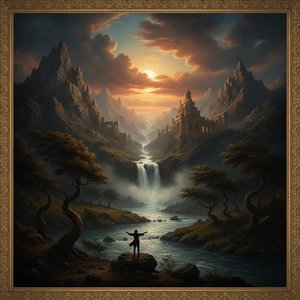
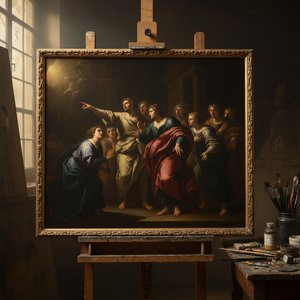
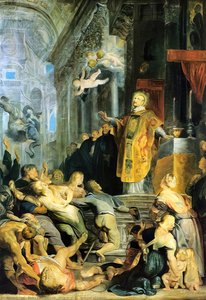
If the Renaissance was a sunlit afternoon of clarity, the Baroque is the gathering storm. The visual language of this era is defined by chiaroscuro—the masterful use of strong contrasts between light and dark to achieve volume and emotional weight. In the hands of a Baroque master, light does not simply illuminate; it pierces through the gloom, creating a sense of divine intervention or sudden, fleeting revelation. This technique allows the artist to sculpt three-dimensional forms out of the shadows, pulling figures and landscapes into sharp, dramatic relief.
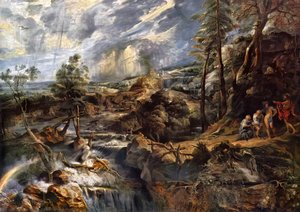
Nowhere is this more evident than in the treatment of the sky. The heavens in Baroque landscapes are rarely passive; they are active participants in the drama. We see clouds pressing down upon the earth, heavy with the weight of impending rain or the glow of a setting sun. This use of atmospheric perspective—layering rich blues, grays, and brilliant whites—creates a dynamic sense of movement. The sky becomes a swirling canvas of energy, mirroring the internal emotional turbulence of the era, where the boundary between the earthly realm and the divine seems perpetually thin and permeable.
Architectural Drama: Towers, Castles, and the Human Presence in Nature
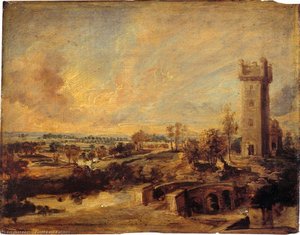 Landscape with Tower
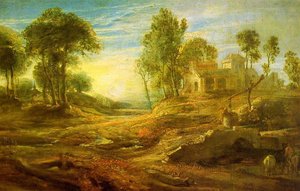
A Vision of Baroque Grandeur: Landscape with Tower by Peter Paul Rubens Peter Paul Rubens’s “Landscape with Tower,” painted in 1638, is more than just a depiction of a serene countryside; it's an immersive experience of the Baroque era. This oil-on-p...
In these sweeping vistas, nature is rarely presented as a lonely, empty void. Instead, it is punctuated by architectural elements that suggest power, history, and even a hint of melancholy. Consider the works of Peter Paul Rubens, such as his Landscape with Tower. Here, a substantial tower anchors the composition, acting not merely as a decorative feature but as a symbol of authority and permanence amidst the shifting natural world. Such structures provide a sense of scale, allowing the viewer to grasp the vastness of the surrounding countryside.
The human presence within these landscapes is equally nuanced. Figures and animals are often placed strategically to create subtle tension or to ground the more fantastical elements of the scene with a touch of rustic realism. Whether it is a lone traveler navigating a rocky path or a horse positioned near a castle wall, these small details remind us of our own place within the grand, often overwhelming, spectacle of nature. The architecture and the inhabitants serve as the emotional anchors, translating the infinite scale of the landscape into something deeply relatable to the human experience.
The Master's Touch: Exploring Rubens, Peruzzini, and the Flemish Tradition
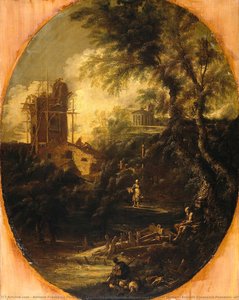 antonio francesco peruzzini
Antonio Francesco Peruzzini: Master of Italian Capriccio Antonio Francesco Peruzzini (c. 1643 – August 20, 1724) stands as a pivotal figure in the late Baroque landscape tradition of Italy, particularly renowned for his captivating capricci—scenes of...
The heart of this movement beat most vibrantly in the Low Countries, particularly within the Flemish Baroque tradition. Artists like Rubens brought an unparalleled opulence to the genre, utilizing a signature technique of layering rich, vibrant colors through multiple glazes of oil paint. This method allowed for a luminous depth that made the textures of trees, stone, and sky feel almost tactile. His ability to blend natural beauty with architectural drama remains a pinnacle of artistic innovation.
Following this tradition, we find artists like Antonio Francesco Peruzzini, who specialized in the capriccio—scenes of imagined or fleeting moments imbued with psychological depth. Peruzzini’s work demonstrates how the late Baroque could move toward a more atmospheric, almost dreamlike state, absorbing influences from both the realism of Dutch painting and the dramatic lighting of the Italian masters. These artists did not just paint scenery; they painted atmosphere, capturing the very essence of movement and emotion that defines the era.
A Legacy of Grandeur: How Baroque Landscapes Paved the Way for Romanticism
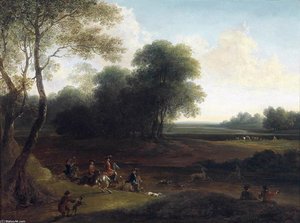 Christian Hilfgott Brand
Christian Hilfgott Brand (1694–1756): Bridging Baroque and Romantic Landscape Christian Hilfgott Brand stands as a pivotal figure in the transition from the opulent Baroque to the burgeoning Romantic landscape movement of the 18th century. Born in Fr...
As we look back from our modern perspective, we can see the seeds of the Romantic movement germinating within the dramatic flourishes of the Baroque. The transition was not abrupt but rather a gradual evolution, seen in figures like Christian Hilfgott Brand, who bridged the gap between Baroque opulence and Romantic sensibility. By prioritizing atmospheric landscapes and the emotional resonance of nature, these artists laid the groundwork for a century of art that would celebrate the sublime and the untamed.
The legacy of the Baroque landscape lies in its refusal to be still. It taught us that nature is not merely a backdrop for human history, but a powerful, living force capable of inspiring awe, piety, and even terror. From the heavy, textured impasto of a Rubens sky to the haunting shadows of a Peruzzini vista, the Baroque era remains an eternal testament to the power of art to capture the magnificent, dramatic, and deeply moving grandeur of the natural world.