The Fractured Lens: Understanding the Intellectual Revolution of Cubism
To gaze upon a Cubist canvas is to witness the dissolution of the singular perspective that had governed Western art since the Renaissance. For centuries, the window of the canvas was intended to be transparent, offering a fixed, illusionistic view of a stable world. However, at the dawn of the twentieth century, a profound intellectual shift occurred, one that mirrored the era's burgeoning scientific discoveries and the fragmented nature of modern urban life. Cubism did not merely seek to depict objects; it sought to represent the very essence of perception itself—a multidimensional experience where time and space converge.
This movement was less an aesthetic choice and more a philosophical inquiry into the nature of reality. By rejecting the traditional single viewpoint, artists began to present subjects from multiple angles simultaneously, capturing the way the human mind actually processes information: through a series of overlapping memories, movements, and shifting glances. This revolutionary approach challenged the viewer to move beyond passive observation and engage in an active, intellectual reconstruction of the image. It was a brave departure from the literal, inviting a deeper, more cerebral connection with the subject matter.
Analytical vs. Synthetic Cubism: A Study in Form, Texture, and Depth
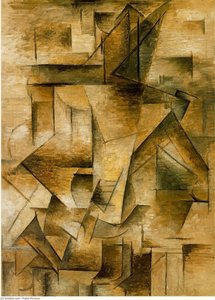
The evolution of Cubism is traditionally understood through two distinct yet interconnected phases: Analytical and Synthetic. In its initial, Analytical stage, the focus was one of intense deconstruction. Artists like Picasso and Braque meticulously dissected their subjects into a complex web of overlapping planes and monochromatic tones. The palette was often restrained, utilizing ochres, greys, and muted browns to ensure that the viewer's attention remained fixed on the structural integrity of the composition rather than the distraction of color. This phase was an exercise in pure geometry, where the boundaries between object and atmosphere became beautifully blurred, creating a dense, rhythmic architecture of light and shadow.
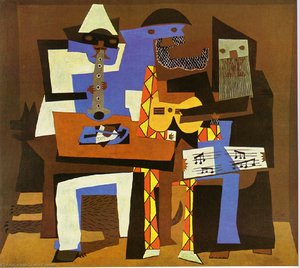
As the movement matured, it transitioned into the Synthetic phase, which brought a newfound sense of playfulness and material richness to the canvas. Rather than breaking objects down, artists began to build them up, integrating diverse elements such as newspaper clippings, sand, and patterned papers into the work itself. This introduction of collage—the very essence of "synthesis"—reintroduced color and texture in a way that bridged the gap between high art and the tangible world. The compositions became flatter and more decorative, yet arguably more complex, as they played with the tension between real-world fragments and painted illusions, forever altering the definition of what constitutes a masterpiece.
The Picasso Legacy: Deconstructing the Masterpieces that Redefined Modernity
No discussion of Cubism is complete without acknowledging the seismic impact of Pablo Picasso. His work served as the primary engine for this aesthetic revolution, pushing the boundaries of form with an almost relentless curiosity. In seminal works such as Les Demoiselles d'Avignon, we see the initial tremors of a new era, where the influence of African sculpture and Iberian art provided the raw, primal energy needed to shatter classical proportions. Picasso’s ability to navigate between the rigorous structure of his early Cubist experiments and the more fluid, expressive compositions of his later years remains unparalleled in art history.
Consider the profound simplicity found in works like Guitar (1920), a quintessential example of Synthetic Cubism. Here, the instrument is not merely depicted; it is reconstructed through geometric forms and earthy tones that evoke its very soul. Through his mastery, Picasso demonstrated that an object could be stripped of its literal likeness yet retain a powerful, rhythmic presence. His legacy is not found solely in the paintings themselves, but in the permission he granted future generations to view the world as a collection of beautiful, interconnected fragments, forever liberating the artist from the constraints of mimesis.
Geometric Elegance: Integrating Cubist Aesthetics into Contemporary Interiors
For the discerning collector, bringing Cubist aesthetics into a contemporary living space offers an opportunity to introduce intellectual depth and architectural rigor to an interior design. The power of Cubism lies in its ability to command attention through structure rather than ornament. A well-placed Cubist reproduction can act as a focal point that anchors a room, providing a sophisticated counterpoint to the softer textures of modern furniture or the clean lines of minimalist architecture. The interplay of geometric shapes and rhythmic compositions creates a sense of dynamic energy that prevents a space from feeling static.
Integrating such profound works requires a delicate balance of color and scale. In a room characterized by neutral tones, a piece featuring the muted, earthy palette of Analytical Cubism can provide a subtle, sophisticated layer of complexity. Conversely, for more daring interiors, the vibrant textures and layered compositions of Synthetic-inspired works can serve as a bold statement of cultural literacy. When curated with care, these artworks do not merely decorate a wall; they transform an environment into a curated gallery of thought, where every angle invites a new perspective on the beauty of form.
The Collector's Eye: Evaluating Authenticity, Style, and Provenance in Modern Art
Acquiring works within the Cubist tradition requires a refined eye capable of distinguishing between mere abstraction and true structural innovation. For the serious collector, the value of a piece lies in its ability to communicate the specific nuances of the movement’s historical progression. One must look beyond the surface to evaluate how effectively an artist utilizes the tension between plane and void, or how successfully they employ texture to create depth. Understanding the distinction between the monochromatic rigor of the Analytical period and the tactile richness of the Synthetic era is essential for building a cohesive and historically significant collection.
Beyond the aesthetic, the integrity of a collection is bolstered by a commitment to quality and provenance. In an age where accessibility is at an all-time high, discerning collectors seek out reproductions and works that honor the original's "living" quality—the visible, tactile brushstrokes and the three-dimensional texture that a flat print simply cannot replicate. True connoisseurship involves recognizing the soul of the movement: the way light interacts with impasto and how the weight of the pigment reflects the artist's intent. It is this pursuit of excellence and historical resonance that elevates a collection from a mere assembly of images to a profound testament to human creativity.
At ArtsDot.com, we are dedicated to preserving this legacy of human creativity for a modern audience. Whether you are seeking a meticulously handcrafted oil reproduction that captures the tactile depth of a Picasso masterpiece or looking to transform your personal memories through our bespoke commission services, our mission is to provide unparalleled access to the world's most significant artistic movements. From professional digital mockups to our global logistics network, we ensure that every piece added to your collection meets the highest standards of academic excellence and museum-grade quality.