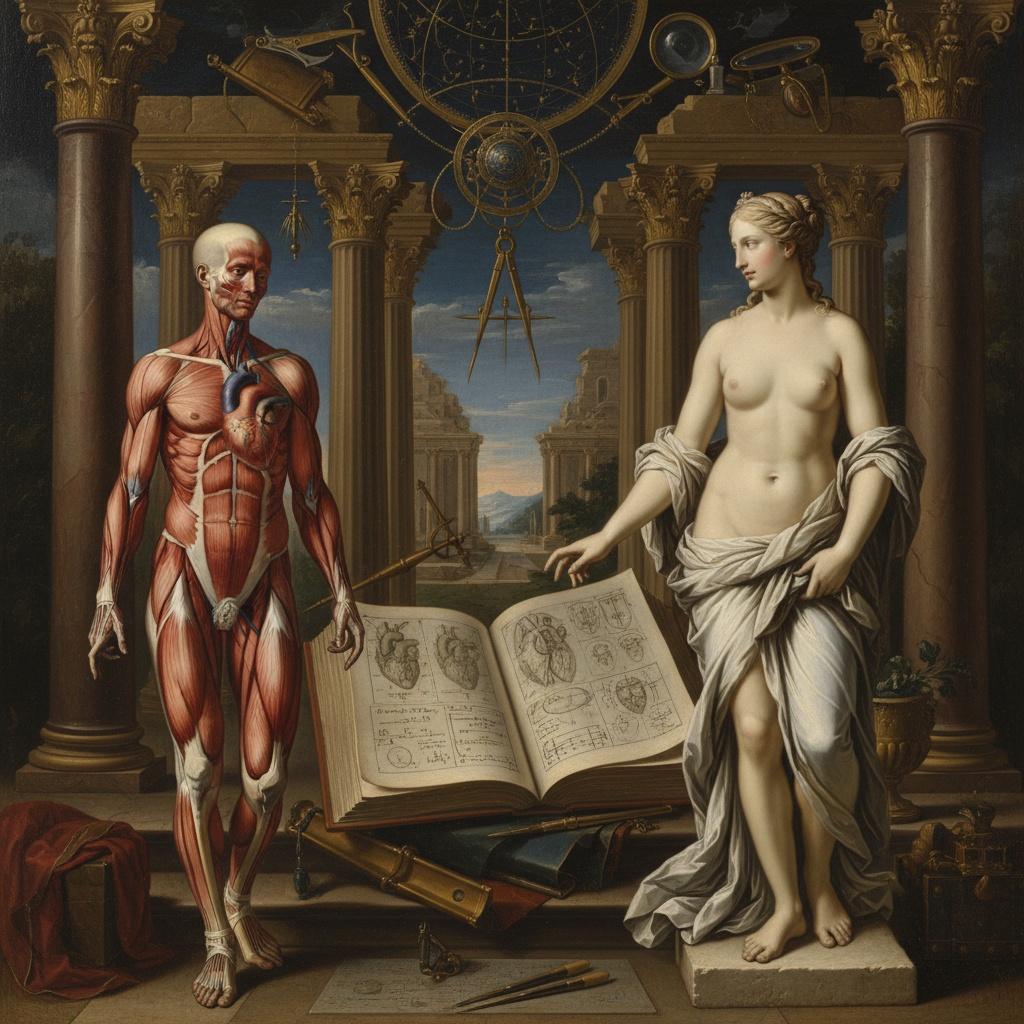
The Renaissance Blueprint: Scientific Precision and the Birth of Anatomical Realism
To gaze upon the great works of the Renaissance is to witness a profound moment in human history where the boundaries between the artist's studio and the scientist's laboratory dissolved into a single, unified pursuit of truth. This era marked a departure from the stylized, symbolic figures of the Middle Ages, moving instead toward an uncompromising investigation of the physical world. The masters of this period did not merely seek to represent the human figure; they sought to understand the very mechanics of life itself. This movement was fueled by a burgeoning curiosity about the underlying structures that dictate form—the bones, the tendons, and the intricate web of musculature that resides beneath the skin.
The pursuit of anatomical realism required a rigorous, almost clinical approach to observation. Artists began to engage in dissections and detailed studies, treating the human body as a complex architectural marvel. This scientific rigor allowed for a new level of depth and presence in painting, where figures no longer appeared as flat icons but as heavy, breathing entities occupying three-scale space. By mastering the hidden geometry of the skeleton and the tension of the muscle, these creators laid the foundation for a visual language that could communicate both physical weight and spiritual vitality, forever altering the trajectory of Western art.
The Sculptural Line: Michelangelo and the Study of Muscular Tension
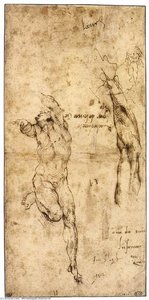
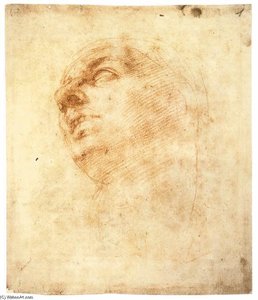
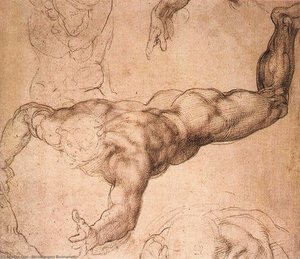
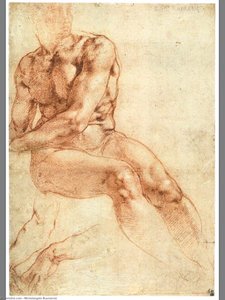
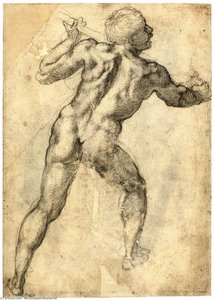
No name resonates more powerfully within this dialogue of flesh and form than Michelangelo Buonarroti. For Michelangelo, the human body was the ultimate vessel for divine expression, and his approach to anatomy was nothing short of heroic. His work transcends mere representation; it is an exploration of muscular tension and the psychological weight of existence. When we examine his preparatory studies, such as his profound Study of David from 1505, we see more than just a drawing; we witness a masterclass in anatomical precision. Every line serves to map the way a muscle reacts to strain, how a tendon pulls against bone, and how the skin stretches over a flexed limb.
Michelangelo’s genius lay in his ability to imbue stone and pigment with the sensation of movement. His figures often possess a sculptural quality, even when rendered in charcoal or oil, characterized by an exaggerated musculature that emphasizes the struggle between the physical and the eternal. This "terribilità"—a sense of awe-inspiring power—is achieved through a meticulous understanding of how anatomical structures interact under pressure. In his hands, the human form becomes a landscape of peaks and valleys, where every shadow cast by a bicep or a ribcage tells a story of strength, vulnerability, and the monumental scale of the human spirit.
The Art of the Detail: Exploring Hands, Feet, and the Nuances of Form
While the grand gestures of the torso and limbs capture our immediate attention, the true mastery of anatomy is often found in the quiet, delicate extremities. The hands and feet are perhaps the most communicative elements of the human figure, capable of conveying tenderness, agony, or profound stillness with a mere shift in finger position. Artists throughout history have recognized that to master the whole, one must first master the parts. Detailed studies, such as those by Michel François Dandré-Bardon, demonstrate how even a black and white drawing can capture the complex architecture of the hands and feet with Renaissance-level precision.
Consider the profound intimacy found in Benjamin West’s Study for the left hand of 'The Woman clothed with the Sun.' Here, the focus shifts from the monumental to the minute. The artist meticulously renders the way light catches the knuckles and how the subtle protrusion of a vein suggests a living, pulsing reality. These smaller studies serve as the essential building blocks of anatomical art; they are the exercises in nuance that allow a painter to imbriate a larger composition with authenticity. By focusing on these extremities, artists bridge the gap between the mechanical structure of the body and the emotional resonance of the human touch.
Light, Shadow, and Sinew: How Chiaroscuro Defines Human Volume
Anatomy alone, no matter how scientifically accurate, remains a skeletal concept without the transformative power of light. The technique of chiaroscuro—the dramatic contrast between light and dark—is the essential tool used by masters to breathe volume into the human form. It is through the careful manipulation of shadow that a flat surface acquires the illusion of depth, allowing the viewer to perceive the rounded swell of a thigh or the hollow of an eye socket. Without this interplay, the intricate musculature studied by the Renaissance masters would remain mere outlines, lacking the tactile presence required to move the soul.
In the hands of a master, light does not simply illuminate; it sculpts. Shadows are used to define the boundaries of sinew and the contours of bone, creating a sense of weight and density. This technique allows for the creation of anatomical volume, where the viewer can almost feel the texture of the skin and the hardness of the underlying structure. The interplay of light and shadow creates a rhythmic movement across the body, guiding the eye through the complex topography of the human form and ensuring that every anatomical detail contributes to a cohesive, living whole.
Beyond the Surface: The Evolution from Anatomical Study to Emotional Expression
As art history progressed, the purely scientific pursuit of anatomy began to evolve into something more profound: the use of physical form as a vehicle for emotional and psychological depth. While the early masters focused on the accuracy of the muscle, later generations learned to manipulate those very muscles to reflect the internal state of the subject. The tension in a clenched fist or the slackness of a drooping eyelid became symbols of grief, triumph, or exhaustion. Anatomy ceased to be just a study of biology and became a language of the psyche.
This evolution represents the ultimate achievement of anatomical art. When an artist can use the structural reality of the body to evoke empathy in the viewer, they have moved beyond mere imitation of nature. The human form becomes a mirror for the human condition. We see this in the way later movements utilized the foundations of classical anatomy to explore themes of mortality, desire, and transcendence. The physical structure remains the foundation, but the purpose has shifted from documenting the body to expressing the boundless complexity of the human experience.
Preserving the Masterpiece: Bringing Classical Anatomy into the Modern Interior
In our contemporary era, the grandeur of these anatomical studies continues to find a place in the modern home, offering a sense of timelessness and intellectual depth. Whether through large-scale museum-quality reproductions or custom commissions that reimagine historical styles, the presence of the human form brings an unparalleled energy to interior design. These works serve as morements of contemplation, inviting viewers to reconnect with the classical traditions of beauty and scientific inquiry.
At ArtsDot.com, we celebrate this enduring legacy by making the profound beauty of the Old Masters accessible to collectors worldwide. Our mission is to preserve human creativity through hand-painted oil reproductions that capture the very essence of these anatomical triumphs—from the visible brushstrokes of a Renaissance study to the deep tonal ranges of a Baroque masterpiece. Whether you are seeking a custom portrait that utilizes historical techniques or an expansive mural to transform a space, we provide the bridge between the storied past and the modern aesthetic, ensuring that the mastery of the human form continues to inspire generations to come.