The Geometry of Illusion: Defining the Op Art Movement
To encounter Op Art is to enter into a silent dialogue with one's own perception. Emerging as a profound phenomenon in the mid-20th century, Optical Art—or Op Art—transcends the traditional boundaries of static imagery, inviting the viewer to participate in the creation of the work itself. Unlike the emotive, gestural outbursts of Abstract Expressionism, Op Art finds its strength in the rigorous application of geometry, precision, and mathematical rhythm. It is a movement rooted in the tension between what is seen and what is known, utilizing high-contrast palettes and repetitive patterns to trigger physiological responses within the retina.
The essence of this movement lies in its ability to manipulate light and space through calculated arrangement. By employing stark monochromatic contrasts or vibrant, clashing hues, artists create a sense of depth where none exists, or motion where there is only stillness. For the discerning collector, Op Art represents more than mere decoration; it is an exploration of the mechanics of sight, a sophisticated interrogation of how our brains interpret structure and boundary. It is an art form that refuses to remain passive, demanding an active, engaged gaze that shifts as one moves through the space surrounding the canvas.
Masters of Motion: The Visionary Legacies of Vasarely and Riley
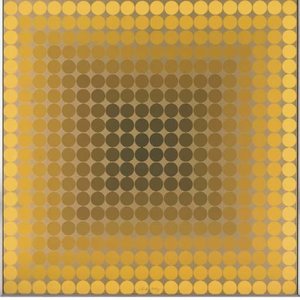
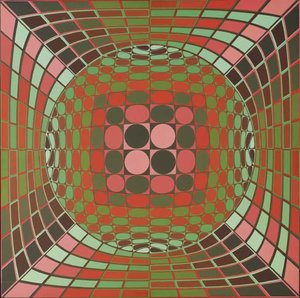
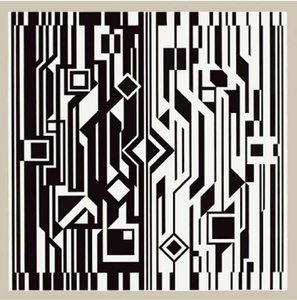
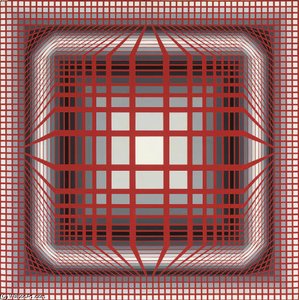
The history of Op Art is inextricably linked to the pioneering brilliance of figures such as Victor Vasarely, often revered as the progenitor of this optical revolution. His work, characterized by complex geometric abstractions, serves as a blueprint for the movement's potential. In masterpieces like Abstract Composition 11, Vasarely utilizes monochrome patterns to create a sense of swelling volume and rhythmic vibration. His ability to transform flat surfaces into multidimensional landscapes through the strategic use of circles and squares remains a cornerstone of modern abstraction, offering a legacy of structured dynamism that continues to influence contemporary design.
Parallel to this geometric rigor is the more fluid, perceptual complexity introduced by Bridget Louise Riley. While Vasarely often focused on the structural architecture of the image, Riley’s work delves into the undulating, almost hypnotic movement of lines and waves. Her paintings redefine modern art by creating illusions that seem to shimmer or flicker under the viewer's gaze, challenging the stability of the visual field. Together, these masters have provided a rich vocabulary for collectors, ranging from the structured, architectural precision of Vasarely’s screen prints to the ethereal, rhythmic pulses found in Riley’s more fluid compositions.
The Science of Sight: How Optical Patterns Engage the Human Eye
At its core, Op Art is an intersection of fine art and physiological science. The movement exploits specific neurological phenomena, such as afterimages and motion aftereffects, to create a "living" canvas. When the eye encounters high-frequency patterns—alternating black and white stripes or tightly packed concentric circles—the photoreceptors in the retina become momentarily fatigued. This fatigue leads to the perception of shimmering, flickering, or even rotating shapes, effectively turning the artwork into a kinetic experience without the need for mechanical parts.
This engagement is achieved through the meticulous control of edge, contrast, and frequency. The placement of a single line or a subtle shift in color saturation can disrupt the brain's ability to find a resting point, forcing the eye to constantly readjust. For the connoisseur, understanding this science adds a layer of appreciation for the technical mastery required to execute such works. It is not merely about creating a trick; it is about the disciplined orchestration of visual stimuli to evoke a profound sense of wonder and cognitive dissonance.
Curating Kinetic Energy: Integrating Op Art into Modern Interiors
Integrating Op Art into a sophisticated interior requires a delicate balance of presence and restraint. Because these works possess an inherent energy, they function as powerful focal points that can anchor a room. In a minimalist or contemporary setting, a large-scale geometric abstraction can act as a structural element, providing much-needed visual complexity to otherwise austere spaces. The key is to treat the artwork as a source of light and movement, allowing its rhythmic patterns to interact with the architectural lines of the room.
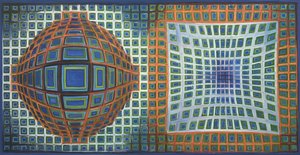
For those looking to create a cohesive aesthetic, consider the interplay between the artwork's palette and the surrounding textures. A monochrome Vasarely-inspired piece pairs exquisitely with natural materials like marble, polished concrete, or dark woods, creating a dialogue between organic stability and mathematical motion. Conversely, more vibrant, multi-colored Op Art can be used to inject vitality into a curated collection of modern furniture. When placed correctly—perhaps as part of a multi-panel installation across a wide wall—Op Art transforms a static room into a dynamic environment that evolves with every step the viewer takes.
Preserving the Pulse: Collecting and Maintaining High-Impact Abstractions
Collecting Op Art is an investment in both aesthetic beauty and technical precision. Because the impact of these works relies so heavily on the clarity of edges and the purity of color, preservation is paramount. For collectors of high-quality reproductions or original prints, protecting the work from direct sunlight is essential to prevent the fading of pigments that could disrupt the intended optical illusion. Similarly, maintaining a stable environment free from excessive moisture ensures that the integrity of the canvas and the vibrancy of the inks remain uncompromified.
When acquiring pieces through professional channels like ArtsDot.com, collectors can find unparalleled excellence in both Giclée prints and handmade oil reproductions. A Giclée print offers incredible accuracy and longevity, utilizing 12-color pigment-based inks that are rated to last for generations. For those seeking a more tactile experience, a handmade oil painting provides the physical depth of impasto brushstrokes, adding a three-dimensional texture that enhances the light-catching properties of the work. Whether through a meticulously crafted reproduction or a rare auction find, the goal remains the same: to preserve the pulse of the movement and ensure that the illusion continues to captivate for decades to come.