A Visionary of Floral Still Life
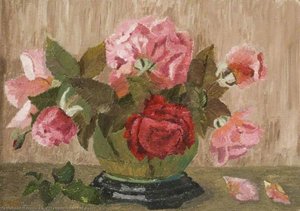
Alice Stainton (1910–1999) stands as a singular figure in the realm of botanical painting, recognized for her exquisitely detailed depictions of flowers that transcend mere representation to embody a profound connection to nature’s beauty and emotional resonance. Born in Worcestershire, England, Stainton possessed an innate fascination with botany from a young age, a passion nurtured by her father's deep commitment to horticulture. This early exposure would profoundly shape her artistic trajectory, establishing an unwavering dedication to capturing the subtle nuances of floral form, texture, and color that would define her life's work.
Her formal journey into the world of fine art began at the Worcestershire School of Art and Design. It was here that she honed her mastery of watercolor painting under the watchful eye of the renowned instructor William Orchard Roberts. A master of his craft, Roberts championed a style characterized by luminous color palettes and meticulous observation—principles that would become the very hallmarks of Stainton’s oeuvre. Through his guidance, she learned to treat the watercolor medium not just as a tool for documentation, but as a way to breathe light and life into the subjects she loved.
The Intersection of Realism and Impressionism
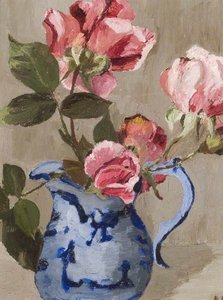
While Stainton’s work is deeply rooted in traditional botanical accuracy, it possesses an ethereal quality that suggests a dialogue with the great Impressionist masters. One can detect the subtle influence of Claude Monet and Pierre-Auguste Renoir in her treatment of light and atmosphere. Although she maintained a more restrained approach than their bolder, more experimental brushwork, Stainton utilized broken brushstrokes and dappled light to capture the fleeting effects of sunlight as it danced across petals and foliage. This delicate balance allowed her to achieve a sense of movement and vitality within the stillness of her compositions.
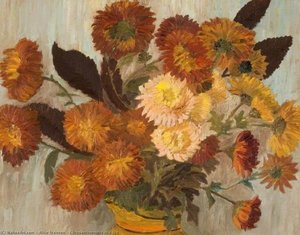
Her artistic output primarily focused on the breathtaking beauty of chrysanthemums, often arranged in simple, rustic jugs or vases. These compositions are remarkable for their astonishing level of detail; each petal is rendered with painstaking accuracy, capturing its unique texture and delicate coloration with breathtaking precision. Yet, her technique was never merely about replicating visual appearances. For Stainton, the meticulous application of pigment served as a conduit for conveying deeper emotion. The flowers themselves became vehicles for expressing feelings of serenity, nostalgia, and a quiet reverence for the natural world.
A Lasting Botanical Legacy
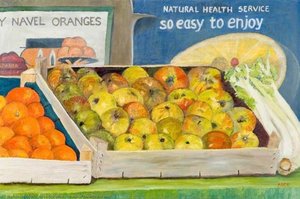
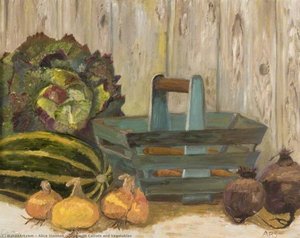
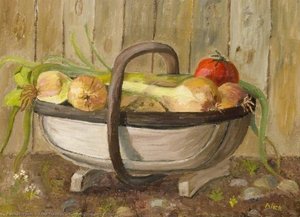
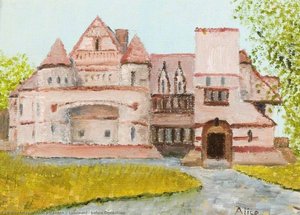
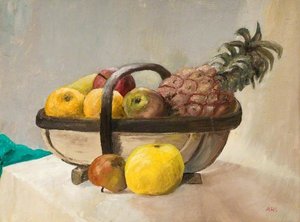
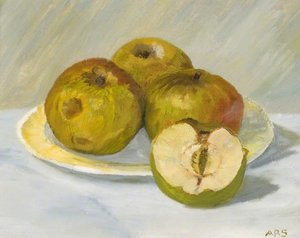
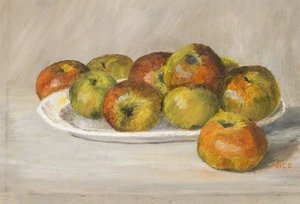
Beyond her celebrated floral still lifes, Stainton’s versatility extended to landscapes and charming depictions of rural life, such as her vibrant fruit stand paintings and scenes capturing fresh produce. Her ability to imbue even the most humble subjects—like a trug filled with carrots and vegetables—with a dreamy, realist charm speaks to her profound empathy for the natural environment. This talent ensured that her work resonated not just with botanical enthusiasts, but with anyone moved by the quiet dignity of the earth's bounty.
The historical significance of Alice Stainton lies in her ability to bridge the gap between scientific observation and poetic expression. She remains a celebrated figure for her contribution to the tradition of British watercolor, leaving behind a body of work that serves as a timeless testament to the beauty of the ephemeral. Her paintings continue to invite viewers into a world of peace and meticulous wonder, reminding us of the profound emotional resonance found in the smallest details of nature.