The Soul of the Canvas: The Life and Legacy of Sébastien-Melchior Cornu
In the heart of nineteenth-century France, a period defined by the tension between classical tradition and the burgeoning romantic spirit, Sébastien-Melchior Cornu emerged as a master of light, faith, and human emotion. Born in the vibrant artistic hub of Lyon on January 6, 1804, Cornu was destined for a life steeped in aesthetic rigor. The son of Martin Lacroix, a respected architect, he inherited an early appreciation for structural harmony and the delicate balance of form. His journey into the heights of the French art world began remarkably early; at just twelve years old, he entered the École nationale supérieure des beaux-arts de Lyon. It was within these hallowed halls that his talent was nurtured under the guidance of Fleury François Richard, a lineage tracing back to the legendary Jacques-Louis David. This foundational training instilled in him a profound respect for anatomical precision and compositional clarity, elements that would become the bedrock of his enduring style.
As Cornu’s ambitions expanded beyond the borders of Lyon, his pursuit of artistic excellence led him to the epicenter of European culture: Paris. In 1826, he sought the mentorship of the great Jean-Auguste-Dominique Ingres, whose influence is palpable in Cornu’s meticulous approach to line and the pursuit of an idealized beauty. This period of intense study was further enriched by a transformative journey to Italy. From 1828 to 1835, residing in Rome alongside contemporaries like Charles Gleyre, Cornu immersed himself in the grandeur of classical antiquity and the Renaissance masters. This era of wandering and discovery allowed him to absorb the timeless elegance of Mediterranean light, a quality that would later infuse his religious compositions with a sense of divine radiance and ethereal grace.
A Tapestry of Devotion and Portraiture
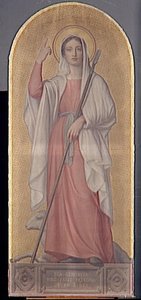
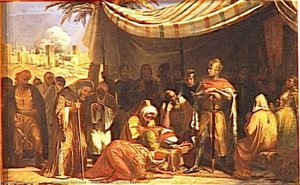
While many artists of his era struggled to find a singular voice, Cornu achieved a rare duality, moving seamlessly between the sacred and the secular. He became widely celebrated for his prolific output of religious paintings, works that served as windows into the spiritual fervor of mid-nineteenth century France. His canvases did not merely illustrate biblical narratives; they breathed life into them through nuanced observation and an expressive brushwork that captured the very essence of human suffering and divine hope. The churches of Paris still bear the marks of his devotion, with his decorative masterpieces adorning the walls of Saint-Merri, Saint-Séverin, Saint-Roch, and the magnificent Saint-Germain-des-Prés. In these sacred spaces, Cornu’s work acts as a bridge between the earthly and the divine, utilizing classical aesthetics to evoke profound theological truths.
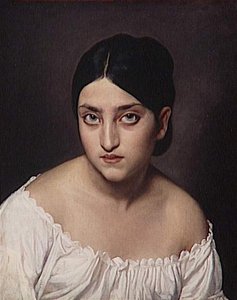
Parallel to his religious triumphs, Cornu was a sought-after portraitist of the French intelligentsia and aristocracy. His ability to capture the psychological depth of his subjects made him a favorite among the era's most notable figures. To look upon a Cornu portrait is to encounter the living presence of history; he possessed the rare gift of rendering not just the physical likeness, but the intellectual and social weight of individuals such as:
- Alexandre Dumas, the legendary novelist whose energy was captured through Cornu's lens.
- Gustave Flaubert, reflecting the introspective nature of the great realist.
- George Sand, embodying the spirited independence of the literary icon.
This mastery of portraiture was bolstered by his personal life and social connections. His marriage in 1833 to Hortense Lacroix, a writer with ties to the court of Napoleon III, provided him with access to the highest echelons of French society, leading to prestigious commissions from both the Royal Court and the Church. This intersection of personal connection and professional skill allowed his influence to permeate the very fabric of French cultural life.
The Twilight of a Master
The later years of Cornu’s life were marked by the same dedication to craft that had defined his youth. Having been named an officer in the Legion of Honor in 1859, he stood as a pillar of the French artistic establishment. His work continued to be a staple of the prestigious Paris Salons, where he remained a regular participant between 1837 and 1848, influencing a new generation of painters who looked to his balance of form and feeling as a standard of excellence. Even as the art world began to shift toward more radical movements, Cornu’s commitment to the classical ideals of his training provided a sense of continuity and stability in a changing landscape.
Sébastien-Melchiel Cornu passed away on October 23, 1870, in Longpont. He left behind a legacy that transcends simple categorization. He was not merely a painter of saints or a recorder of faces; he was an artist who understood that the true purpose of art is to capture the eternal within the ephemeral. Through his sophisticated use of light, his rigorous adherence to classical structure, and his profound empathy for the human condition, Cornu ensured that his vision would remain etched in the annals of art history, a testament to the enduring power of beauty and faith.